C1675

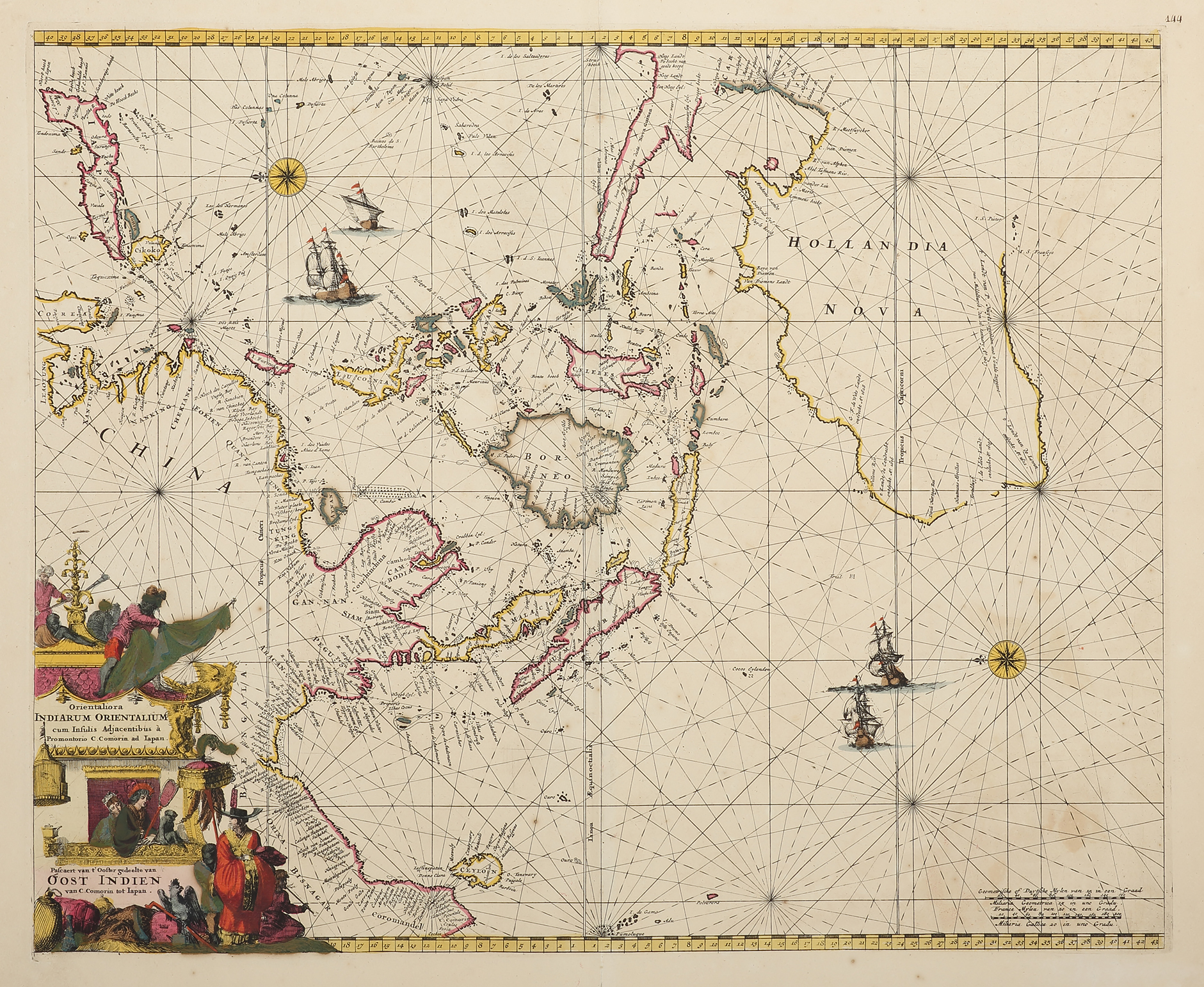
Orientaliora Indiarum Orientalium cum insulis adja…

Magnificent example of this c.17th Dutch sea chart of Australia with north orientated to the left, in full unfaded original period hand colouring, published in de Wit’s, ‘Orbis Maritimus ofte Zee Atlas‘, . Australia is shown with the Dutch discoveries … Read Full Description

$A 9,750

In stock

Free Shipping
Whale Beach – Sydney N.S.W Australian photographs

Within Australia

All orders ship freewithin Australia

Whale Beach – Sydney N.S.W Australian photographs

Rest of the World

Orders over A$300
ship free worldwide

See Shipping page for Terms & Conditions

Details

Full Title:

Orientaliora Indiarum Orientalium cum insulis adjacentibus a promontorio C.Comorin ad Japan. Pascaert van t’ooster gedeelte van Oost Indien van C.Comorin tot Japan.

Date:

C1675

Condition:

As usual small areas of oxidation that have been stabilised with tissue, due to the use of verdigris green color. which is always found in original hand coloured examples. Wide margins, in good condition, with centre fold as issued.

Technique:

Copper engraving with original hand colouring.

Image Size: 

540mm 
x 440mm

Frame Size: 

845mm 
x 750mm

Paper Size: 

625mm 
x 526mm
AUTHENTICITY
Orientaliora Indiarum Orientalium cum insulis adjacentibus a promontorio C.Comorin ad Japan. Pascaert van t’ooster gedeelte van Oost Indien van C.Comorin tot Japan. - Antique Map from 1675

Genuine antique
dated:

1675

Description:

Magnificent example of this c.17th Dutch sea chart of Australia with north orientated to the left, in full unfaded original period hand colouring, published in de Wit’s, ‘Orbis Maritimus ofte Zee Atlas‘, .

Australia is shown with the Dutch discoveries up to Tasman’ second voyage in 1644 but excluding his first voyage discoveries due to the geographical limits of the map. A number of other mapmakers made near identical charts using the same orientation, including van Loon 1661, Goos 1666, Doncker 1669 and Seller 1670. This map was based on the prototype by van Loon, issued in his ‘Klaer Lichtende Noort-Ster Ofte Zee Atlas‘. At lower left de Wit places a decorative title cartouche comprising numerous robed figures, birds and trade goods. It’ use as a sea chart is borne by the numerous rhumb lines and compass points. The other Dutch discoveries noted include: Hartog 1616, Houtman 1619, van Leeuwin 1622, Cartensz 1623, Nuyts 1627 and de Wit 1628. The characteristic feature of Dutch charts produced in the second half of the seventeenth century is that they were based solely on the results of actual observation and where that was lacking, no coastlines were shown.

This chart was reissued a number of times by the following publishers:
1675 De Wit 1st edition as in this example
1715 Louis Renard
1739 Reinier and Josua Ottens
1745 Reinier and Josua Ottens
1802 G Hulst van Keulen (widow)

References:
Clancy, R. The Mapping of Terra Australia. Sydney 1995 :: p.83, ill.6.13.
Parry, D. The Cartography of the East Indian Islands Insulae Indiae Orientalis. London 2005 :: p.119, ill pl 4.31.
Perry, T. The Discovery of Australia. Sydney 1982 :: p.51, ill.23.
Quirino, C. Philippine Cartography (1320-1899) Amsterdam 2010 Manila :: p.112.
Suarez, T. Early Mapping of Southeast Asia. Singapore 1999 :: p.209.
Walter, L. Japan a Cartographic Vision. New York 1994 :: ill. pl.40.
Tooley, R.V. The Mapping of Australia. London 1979 :: 1369, ill. pl.100.
Shirley, R. Maps in the Atlases of The British Library. London 2004 :: V2, p.1320 M.WIT-la.
Koeman, C. Atlantes Neerlandici. Amsterdam 1967. Volumes I-V :: IV M.Wit 2, (19).


Collections:
University Library Melbourne: 11343/113762
National Library Australia: Bib ID: 3621330
State Library of Western Australia: Reid Library

Frederick de Wit (1630 - 1706)

De Wit was born Frederik Hendriksz was born to a Protestant family in Gouda, Netherlands. Frederik was married on 29 August 1661, to Maria van der Way (1632–1711), the daughter of a wealthy Catholic merchant in Amsterdam and from about 1648 until his death in 1706 lived and worked in Amsterdam. By 1654 he had opened a printing office and shop under the name "De Drie Crabben" (the Three Crabs), in 1655, he changed the name to, "Witte Pascaert" (the White Chart). By 1654 he began to publish his first charts and by 1662 he issued his first complete atlas. By 1671, he was publishing a large folio atlas with as many as 100 maps. In 1689, De Wit received a 15 year privilege from the states of Holland and West Friesland that protected his right to publish and sell his maps. After De Wit's death in 1706, his wife Maria continued the business for four years printing and editing De Wit's maps until 1710 when she sold the firms stock at auction. Most of the atlas plates and some of the wall map were sold to Pieter Mortier (1661–1711).

View other items by Frederick de Wit

Related Products

Choose currency

Exchange rates are only indicative. All orders will be processed in Australian dollars. The actual amount charged may vary depending on the exchange rate and conversion fees applied by your credit card issuer.

Account Login

The List

Join our exclusive mailing list for first access to new acquisitions and special offers.