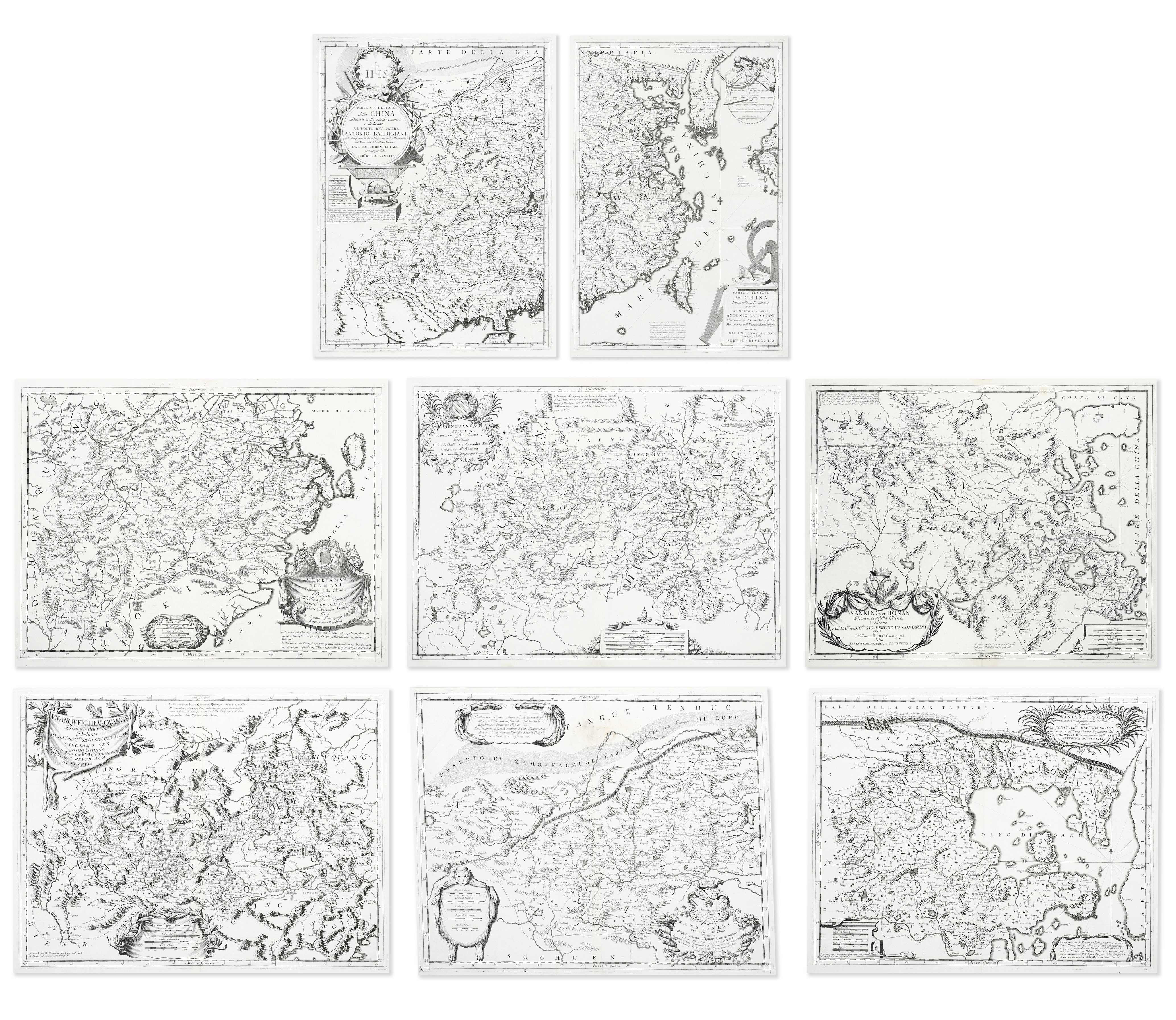
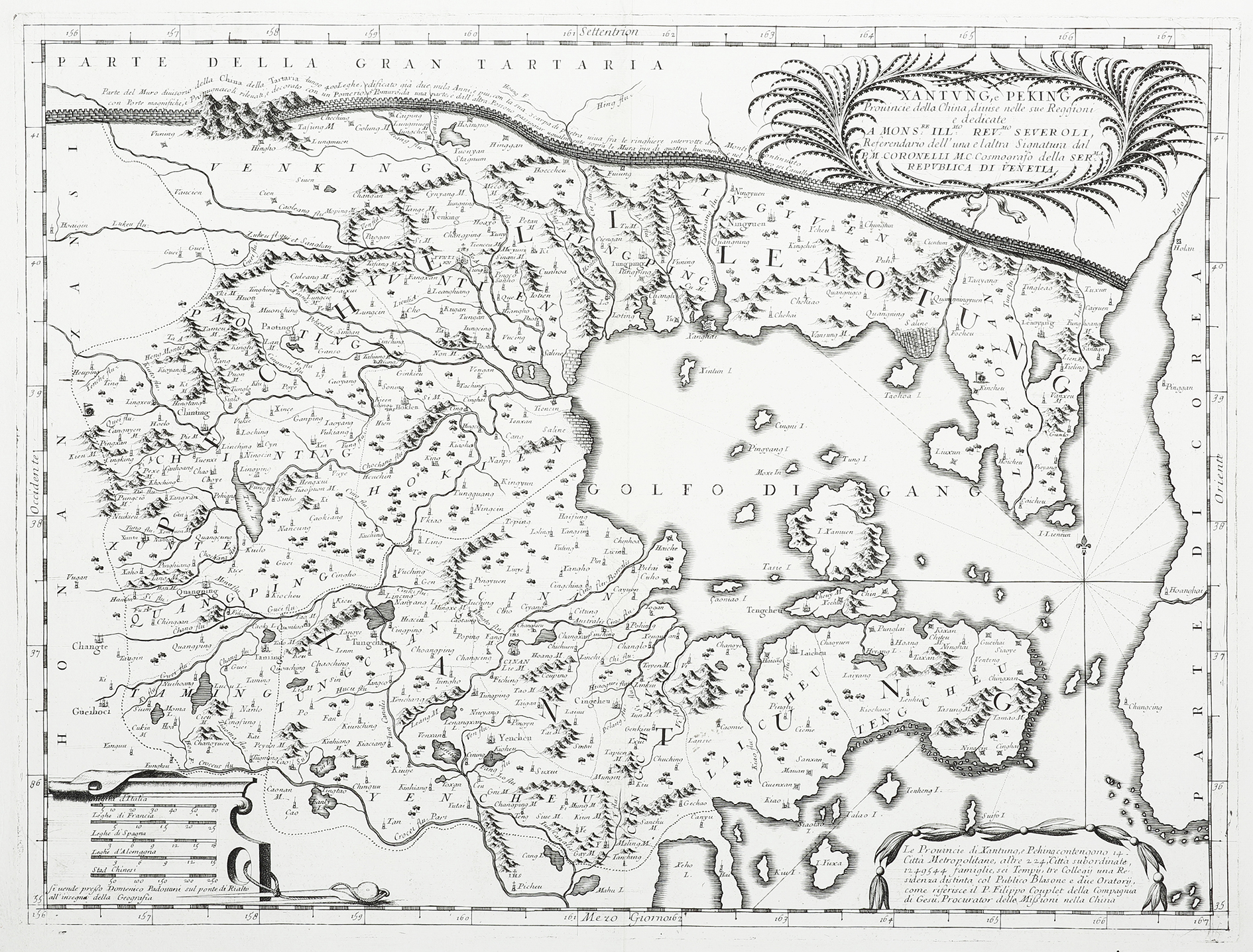
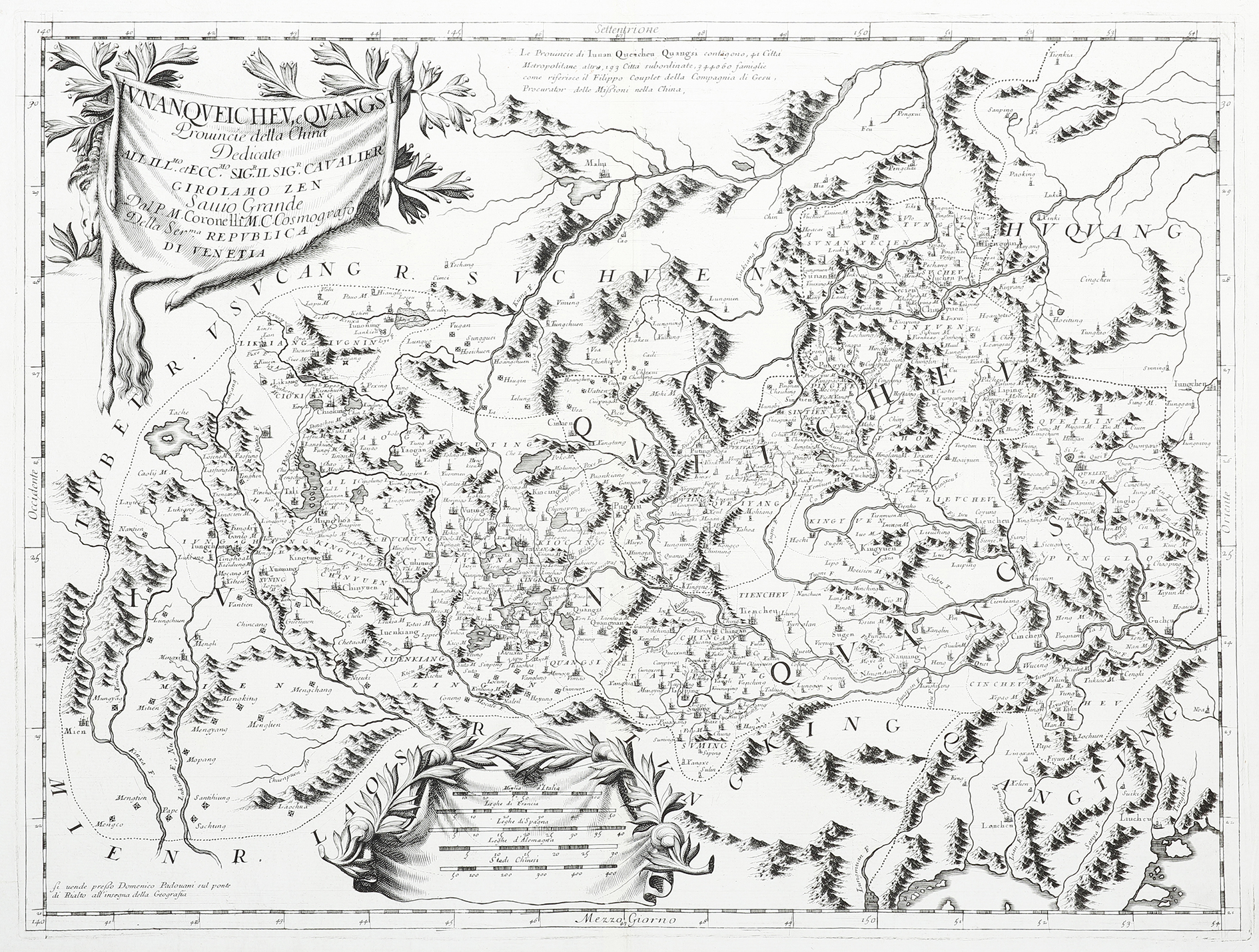
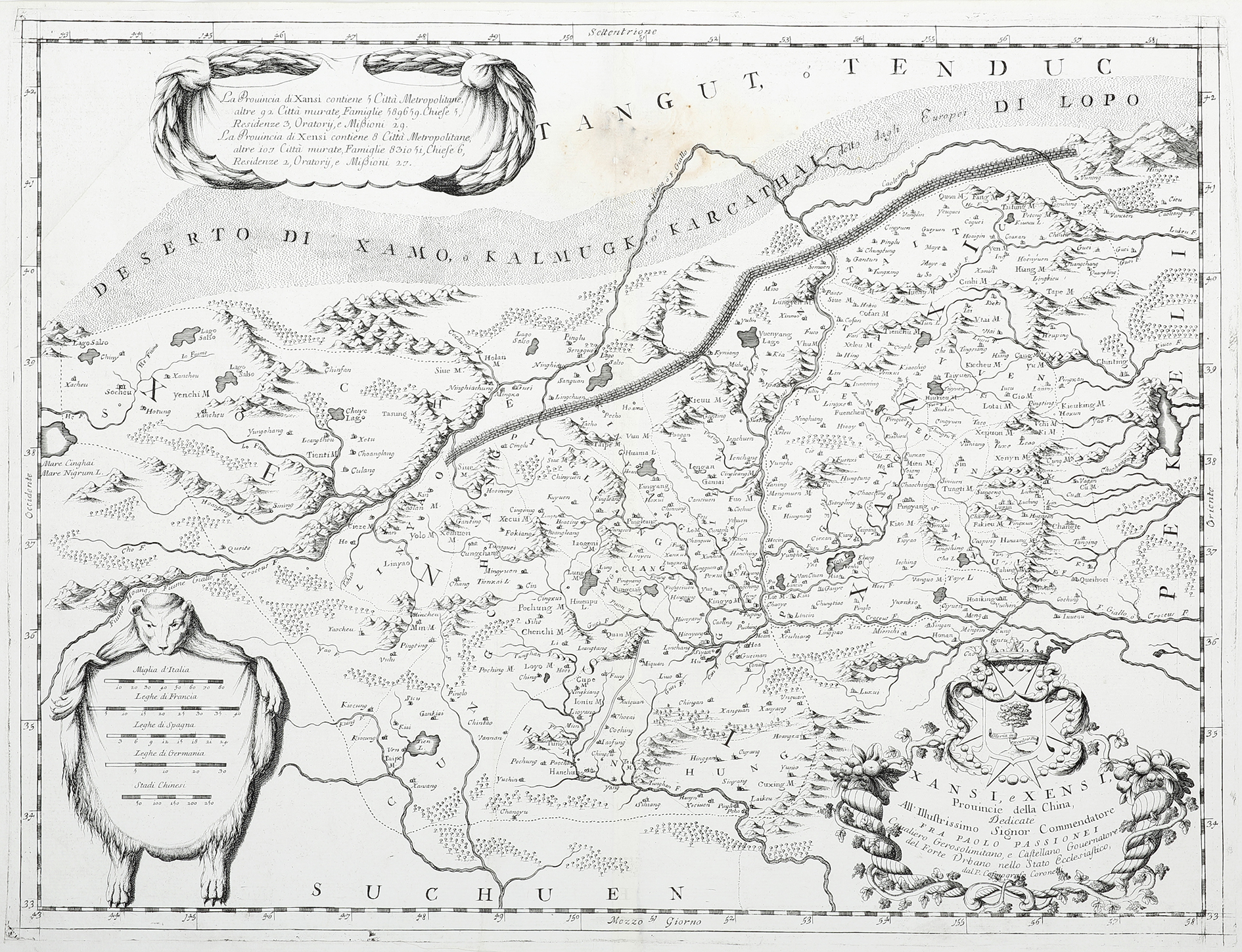
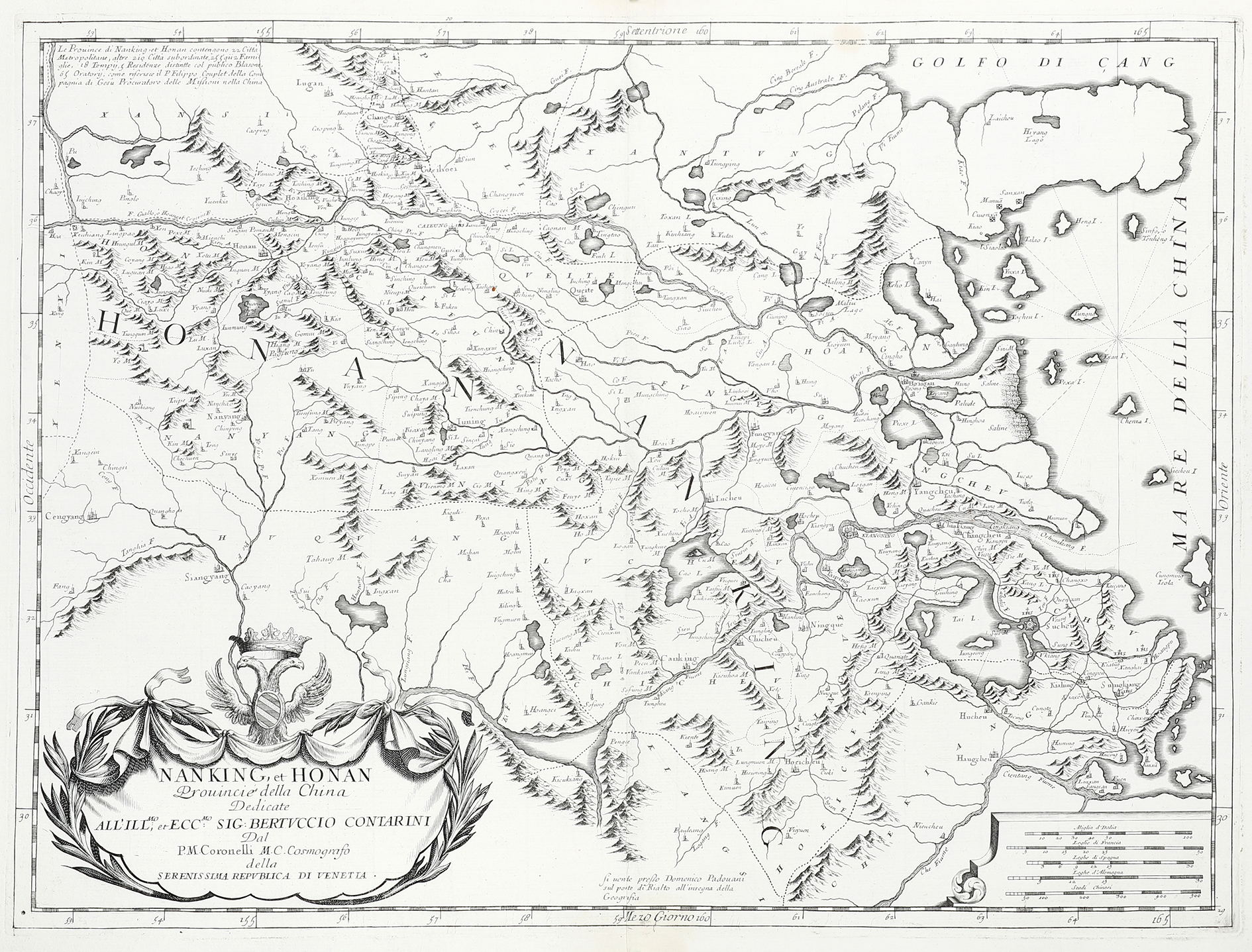
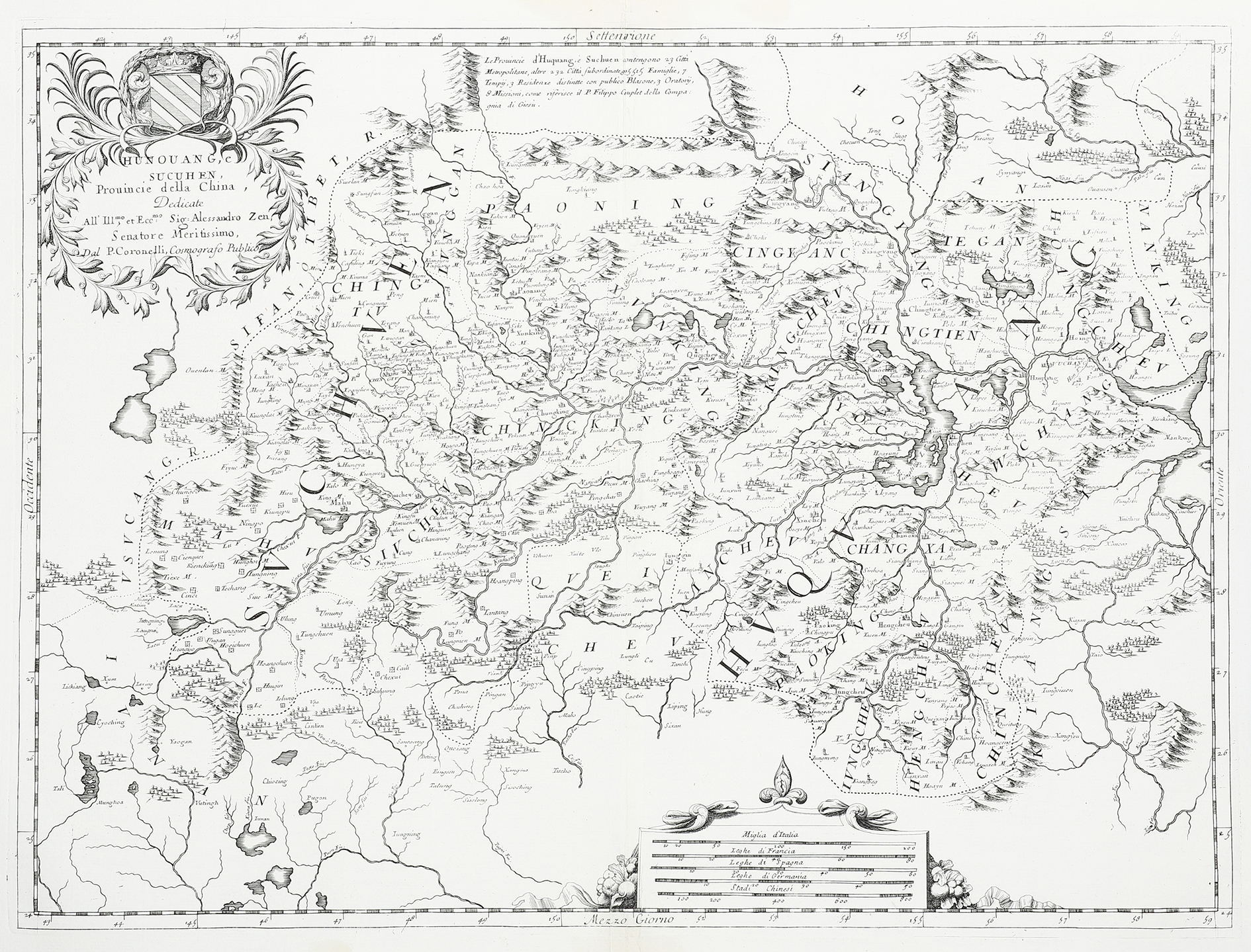
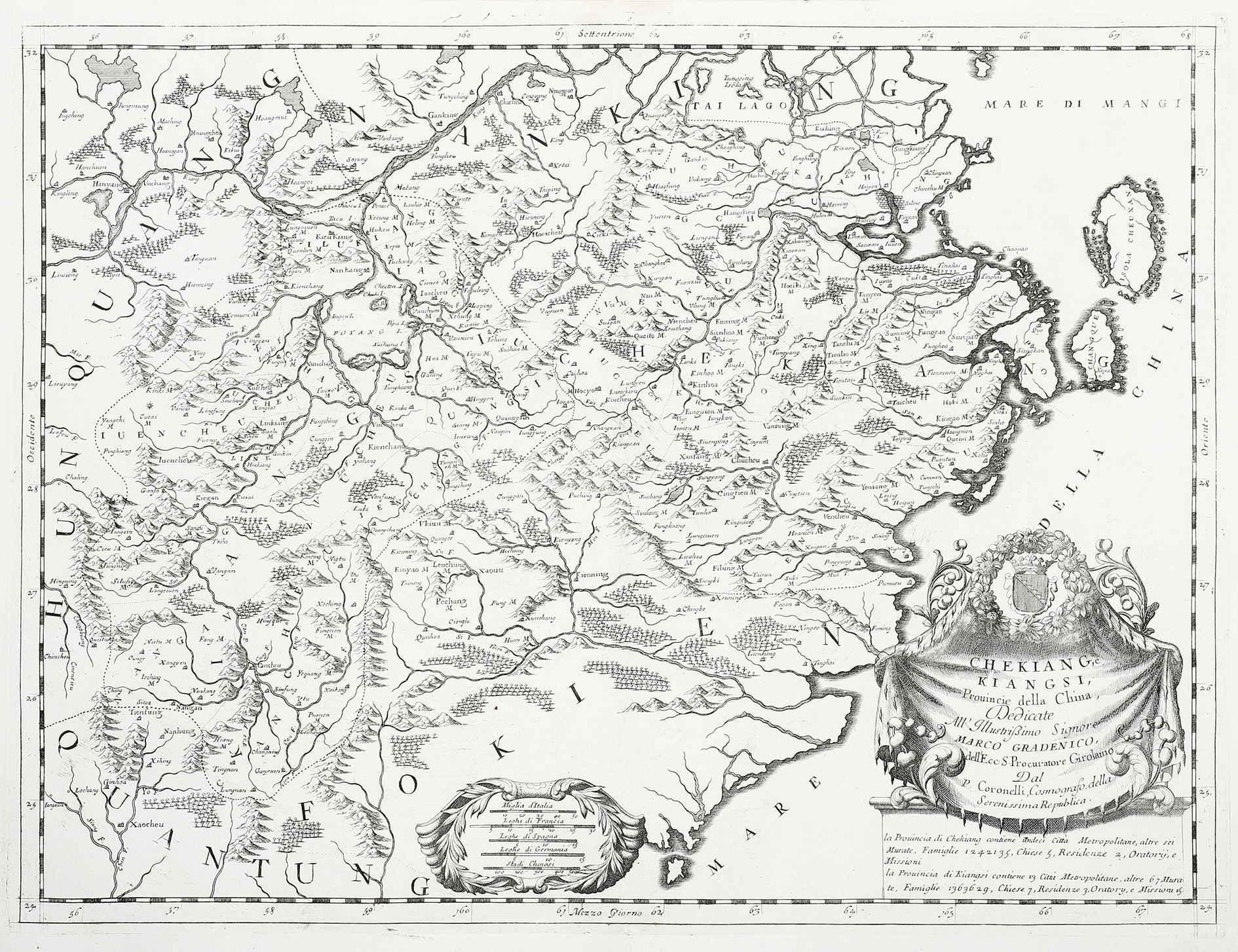
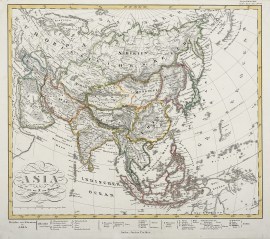
A complete set of the most sought-after c.18th maps of China by Vincenzo Coronelli (1650–1718), based on information obtained from Jesuit sources.
The Jesuits made their first attempt to reach China in 1552, led by St. Francis Xavier, a Navarrese priest and missionary and a founding member of the Society of Jesus. Although Xavier never set foot on the mainland and died after a year on the Chinese island of Shangchuan, his efforts marked the beginning of Jesuit mission work in the region. Three decades later, in 1582, the Jesuits resumed their mission, spearheaded by notable figures such as the Italian Matteo Ricci. They introduced Western science, mathematics, astronomy, and visual arts to the Chinese imperial court, engaging in significant intercultural and philosophical discussions with Chinese scholars, particularly those representing Confucianism. At the height of their influence, members of the Jesuit delegation were regarded as some of the emperor’s most esteemed and trusted advisors, occupying prestigious positions within the imperial government. Many Chinese, including former Confucian scholars, embraced Christianity and became priests and members of the Society of Jesus.
The first Western map published of China was drawn directly from the findings of the Portuguese mapmaker Luis Jorge de Barbuda, a Jesuit who created a manuscript map of China based on information gathered by the Jesuit mission there. This map was then handed to Benito Arias Montanus (1527–1598) and subsequently to Abraham Ortelius, who published it for the first time in the 1584 edition of his atlas, Theatrum Orbis Terrarum. It became the standard map of China for over fifty years.
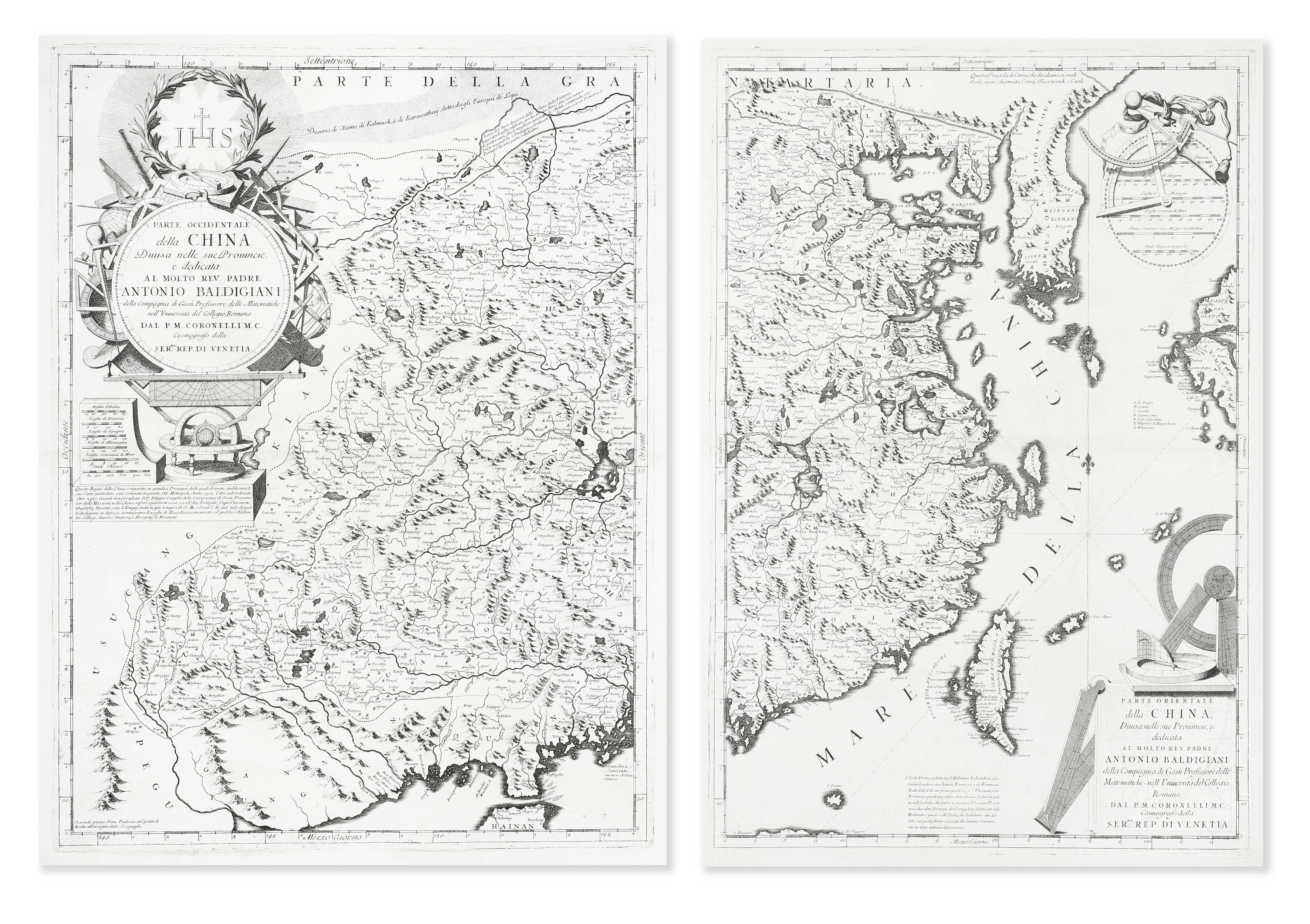
The set includes the striking two-sheet map of all of China and the Korean peninsula.
The ornate cartouche in the upper left is adorned with laurels and various navigational, mathematical, and cartographical instruments, symbolising the Jesuit contribution to global knowledge and exploration. The IHS symbol at the top of this cartouche further attests to the significant role the Jesuit order played in gathering and disseminating information about China during the late 17th century. The IHS monogram, featuring an H surmounted by a cross above three nails and surrounded by a sun, serves as the emblem of the Jesuits and was, according to tradition, introduced by Ignatius of Loyola in 1541. The two maps extend north to the Great Wall and feature notable geographic landmarks such as Formosa (Taiwan) and northern Hainan Island. The cities of Peking (Xuntien) and Shanghai (Xanghei) are prominently marked, alongside Macao and Guangzhou (Quangcheu or Canton) in the south. The map is divided into provinces, demonstrating exceptional accuracy, particularly along the coastlines and interior. Key geographical features, including rivers, lakes, mountains, and even canals, are finely rendered. Towns, fortresses, and other settlements are marked, reflecting the cartographer’s keen attention to both the natural and human landscape. The northern region is represented as a barren desert, contrasting with the mountainous terrain depicted in the south.
In addition to its geographic detail, the maps are enhanced by various decorative embellishments that frame the composition. In the upper right, an elaborate compass circle includes scale bars, a quadrant, and dividers, underscoring the map’s navigational purpose. Another cartouche in the lower right contains a dedication flanked by further navigational instruments, emphasising the scientific and exploratory intentions of the map. The maps are dedicated to Antonio Baldigiani (1647–1711), a prominent Jesuit and Professor of Mathematics at the Roman College. Baldigiani played a key role in the intersection of Catholic doctrine and emerging scientific ideas during the late 17th century, particularly through his involvement with the Congregation of the Index, the church body responsible for reviewing texts condemned by the Inquisition. His interest in China, shared by many Jesuits of his time, is reflected in this map.