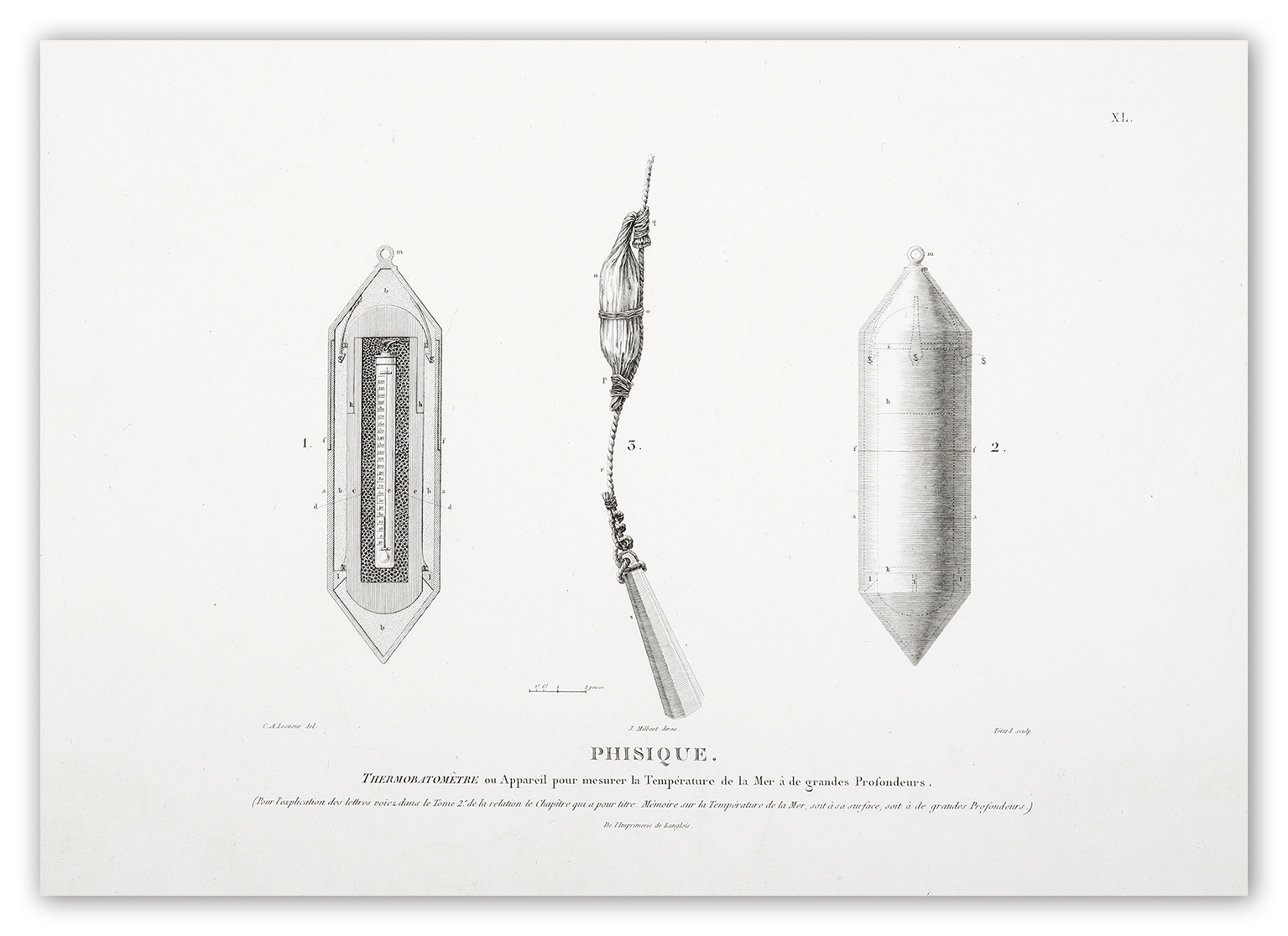
Scarce early c.19th engraving of the thermometer that Francois Peron used on the Nicholas Baudin voyage of exploration in the corvettes le Geographe, le Naturaliste et la goelette le Casuarina, to record. Peron was the expedition’s naturalist who developed a … Read Full Description
$A 145
Within Australia
All orders ship freewithin Australia
Rest of the World
Orders over A$300
ship free worldwide
Full Title:
Date:
Condition:
Technique:
Image Size:
Paper Size:

Genuine antique
dated:
Description:
Scarce early c.19th engraving of the thermometer that Francois Peron used on the Nicholas Baudin voyage of exploration in the corvettes le Geographe, le Naturaliste et la goelette le Casuarina, to record.
Peron was the expedition’s naturalist who developed a new “less sensitive as possible” thermometer so that the depth measurement varied as little as possible with the ascent of the measuring device attached to a probe line. On the strength of his invention, Péron guaranteed “the superiority of [my] device over all those used to date“, and this even if the instrument in question was often reassembled flooded or broken due to pressure: “if the water pressure, always stronger than my means, would not have allowed it to still enter the interior of our device. Despite these serious disadvantages [sic], always the same result, always the sea temperature decreasing as we sink into the abyss … “.
If the heart of the device consisted of “a mercury thermometer on an ivory ruler”, the naturalist transformed, for his measurements, his thermometers into “thermobatometers” by covering them with different layers of insulators supposed to prevent variation of temperature during the ascent to the surface 181. To make these layers, he successively used glass, wood, coal, tallow and tar. Such an insulated thermometer required prolonged immersion at the measured depth. However, the author did not detail the method used to do this. Likewise, he did not expand on the type of thermometer he used to develop his thermobatometers.
Ultimately, in his summary table of “general results of all the experiments made to date on the temperature of sea water either on its surface or at various [sic] depths”, Péron analysed the temperature of the seas as colder in depth than on the surface: “this cooling seems to be in some relation to the depth itself since it is all the greater, as the experiments were made by considerable depths”. Then he synthesised knowledge using the analogy with mountains: “all the results of observations made to date on this object come together to prove that the deepest abysses of the seas, as well as the summits of our highest mountains, are eternally frozen, even under the equator “
In October 1800, Nicolas Baudin commanded an expedition to the south seas to complete the French survey of the Australian coastline, and make scientific observations. The two ships, Le Geographe and Le Naturaliste, arrived near Cape Leeuwin in May 1801. Following instructions issued in France, both ships sailed north along the western coast of the continent. After staying at Timor, the French then sailed south to survey Van Diemen’s Land [Tasmania]. In following this itinerary, they missed the opportunity to be the first Europeans to survey the unknown southern coast. By early April 1802 Baudin in Le Geographe was in South Australian waters. He sailed westwards along the southern coastline, meeting Flinders at Encounter Bay, and continuing to Golfe de la Mauvaise [Gulf St Vincent] and Golfe de la Melomanie [Spencer Gulf], giving French names to many locations already named by Flinders. At Cape Adieu the survey was abandoned and Baudin sailed for Port Jackson where Le Naturaliste had already arrived. After wintering at Port Jackson, Baudin returned to the southern coast for a more detailed survey, and in January 1803 circumnavigated Ile Borda [Kangaroo Island]. While Baudin anchored at Nepean Bay, Freycinet and the geographer Boullanger explored the two gulfs in Casuarina – Le Naturaliste had been sent back to France with its scientific collections. By the end of February Le Geographe and Casuarina rendezvoused at King George Sound, and then explored the west and northwest coasts of ‘New Holland’, before heading home via Timor.
Baudin died in 1803 on the homeward voyage, so publication of the account and charts of his voyage was undertaken by Francois Peron, the expedition’s naturalist. The first volume of Voyage de decouvertes aux Terres Australes and Volume I of Atlas, which included plates, was released in 1807.
From Peron/Freycinet, Voyage de decouvertes aux Terres Australes, fait par ordre du Government, sur les corvettes le Geographe, le Naturaliste et la goelette le Casuarina, pendant les annees 1800, 1801, 1802, 1803 et 1804 … Paris. 1807
References:
Dunmore, J. French Explorers in the Pacific. Oxford 1965-69 : vol. II, pp. 9-40
Ferguson, J. A. Bibliography of Australia Volumes 1-8, Canberra 1976 : 978, 979
Hill, J. The Hill Collection of Pacific Voyages. San Diego 1974 : 1329 (1st edition only)
Sharp, A. The Discovery of Australia. Oxford 1963 : pp. 232-39
Wantrup, J. Australian Rare Books. Sydney 1987 : pp. 158-159, [82]
Collections:
Bibliotheque Nationale de France: ark:/12148/bpt6k74602q
National Gallery Victoria: Accession Number2010.96.1-69
National Library Australia: Bib ID:87123
National Library New Zealand: RFr PERON Voya 1824
State Library New South Wales: Record Identifier 74VvELoyKEJy
State Library South Australia: 919.4 P453.2
State Library Victoria: RARELTBF 919.4 P42V
Charles Alexander Lesueur (1778 - 1846)
French natural history and topographical artist on board the lavishly equipped scientific expedition prepared by the Institut de France with the ambitions to explore the southern parts of the Eastern Hemisphere, in two corvettes, Geographe and the Naturaliste. Lesueur was taken on not as an artist or scientist but as an assistant gunner. Nichloas Baudin the commander of the expedition soon discovered Lesueur's talents and employed him as an illustrator for his private journal. His prolific output and the quality of his drawings during this important voyage is a testament to his artistic talents.
Exchange rates are only indicative. All orders will be processed in Australian dollars. The actual amount charged may vary depending on the exchange rate and conversion fees applied by your credit card issuer.
Join our exclusive mailing list for first access to new acquisitions and special offers.