C1812

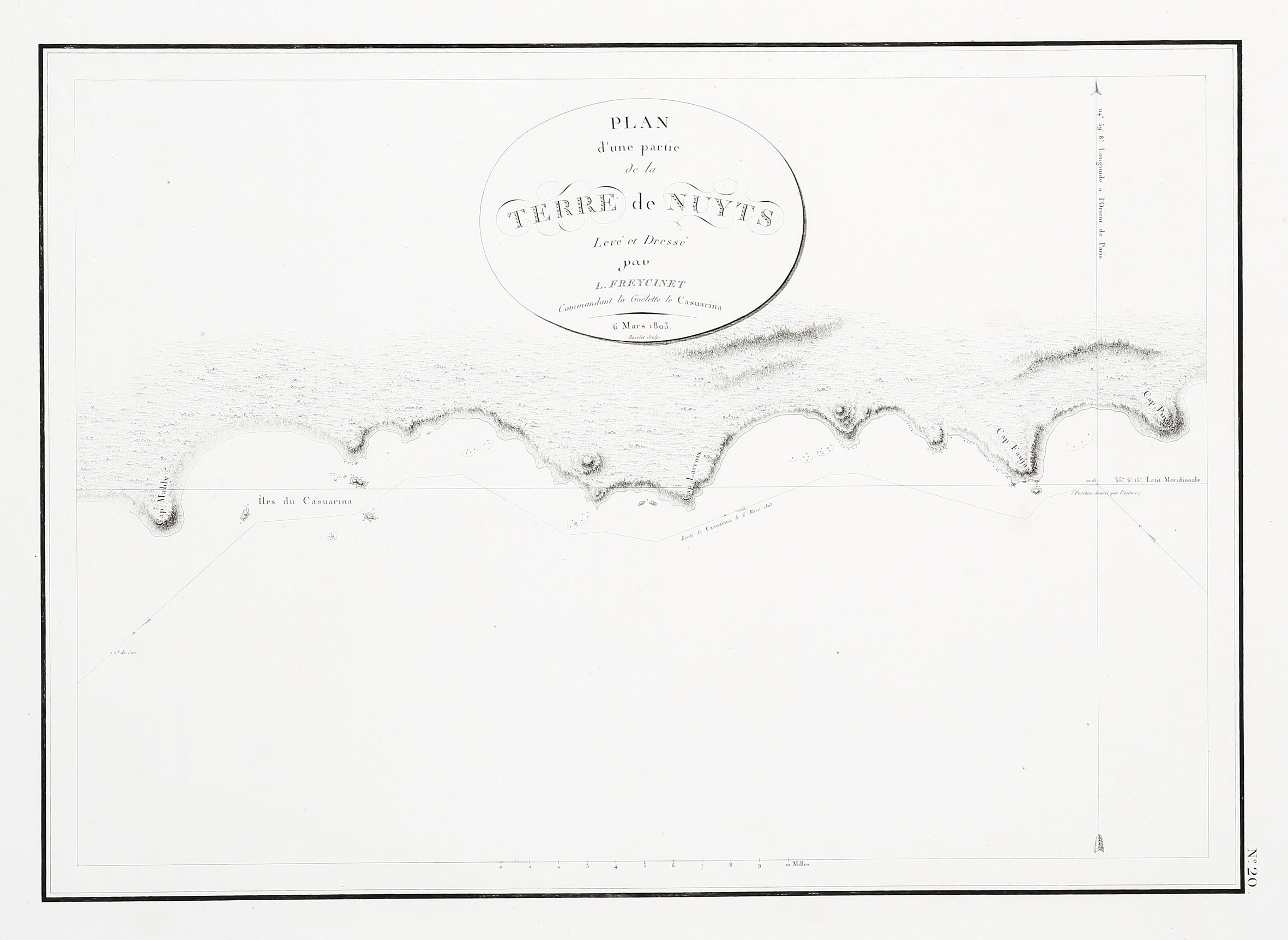
Plan d’une Partie de la Terre de Nuyts Leve …

Rare, early c.19th engraved map of the south coast of Western Australia, from Point Irwin to Casuarina Isles, showing the tracks of Le Casuarina in 1803. The French expedition led by Nicolas Baudin surveyed the coastline and natural history of … Read Full Description

$A 1,350

In stock

S/N: FVDDATA-AM-WA-020–186710
(RW)
Free Shipping
Whale Beach – Sydney N.S.W Australian photographs

Within Australia

All orders ship freewithin Australia

Whale Beach – Sydney N.S.W Australian photographs

Rest of the World

Orders over A$300
ship free worldwide

See Shipping page for Terms & Conditions

Details

Full Title:

Plan d’une Partie de la Terre de Nuyts Leve et dresse par L. Freycinet Commandant de la Goelette de Casuarina.

Date:

C1812

Condition:

Small repaired to left sheet edge, otherwise in good condition. With wide untrimmed margins.

Technique:

Copper engraving.

Image Size: 

490mm 
x 348mm

Paper Size: 

607mm 
x 418mm
AUTHENTICITY
Plan d'une Partie de la Terre de Nuyts Leve et dresse par L. Freycinet Commandant de la Goelette de Casuarina. - Antique Map from 1812

Genuine antique
dated:

1812

Description:

Rare, early c.19th engraved map of the south coast of Western Australia, from Point Irwin to Casuarina Isles, showing the tracks of Le Casuarina in 1803.

The French expedition led by Nicolas Baudin surveyed the coastline and natural history of what is now south-west Western Australia. The Géographe and Naturaliste, undertook detailed coastal surveys between Cape Leeuwin and Cape Naturaliste, extending their observations to Geographe Bay, Shark Bay, and the lower reaches of the Swan River.  The zoologists, botanists, mineralogists, and artists carried out extensive fieldwork. Under the leadership of François Péron and Charles-Alexandre Lesueur, shore parties documented flora and fauna, collected geological and botanical specimens, and produced some of the earliest systematic European observations of the region’s ecosystems. Their work contributed significantly to the scientific record, particularly in marine biology and terrestrial zoology, for which the south-west proved remarkably rich.  The French made several landfalls along the coast, including at present-day Busselton, where they interacted cautiously with Noongar groups.

The 1803 surveys in south-west Western Australia formed a crucial component of the broader Baudin expedition, which, despite internal tensions and Baudin’s death on the return voyage, achieved one of the most substantial scientific outputs of any early c.19th voyage to Australia. The published Voyage de découvertes aux terres australes, drawing heavily on the results of the 1803 work, cemented the expedition’s reputation and ensured that the French contribution to the exploration of the Australian coastline.

From: Peron, Voyage de decouvertes aux terres australes .

References:
Tooley, R.V. The Mapping of Australia. London 1979 :: 643.
Bonnemains, J. Baudin in Australian Waters: The Artwork of the French Voyage of Discovery to the Southern Lands, 1800-1804. Melbourne 1988 ::.
Hill, J. The Hill Collection of Pacific Voyages. San Diego 1974 :: p. 1329.
Ferguson, J. A. Bibliography of Australia Volumes 1-8, Canberra 1976 :: 449, 563, 603.
Wantrup, J. Australian Rare Books. Sydney, 2nd ed. 2023:: 80a, 81.
ABA The Davidson Collection I, II, III : 2005-7 Melbourne:: pp. 108-110.
Dunmore, J. French Explorers in the Pacific. Oxford 1965-69 :: II, pp.9-40.


Collections:
National Library Australia: Bib ID: 2347255
David Rumsey Collection: List No: 14352.130
Art Gallery of Western Australia: (Call number: MAPR0000475
National Library Australia: Bib ID: 2347255 (French Hydro graphic issue later date)
Art Gallery of Western Australia: Accession number 1974/0Q87

Louis Claude de Saulces de Freycinet (1779 - 1841)

Louis de Freycinet (1779-1841) Freycinet made the published the first map to show a full outline of the coastline of Australia. He was in command of the Uranie, which left Toulon on 17 September 1817. His wife Rose had been smuggled aboard, and her presence was acknowledged by the time they reached Gibraltar. They made the usual French passage via Tenerife, Rio, the Cape of Good Hope and Mauritius, where Louis was reunited briefly with his brother Henri, then serving as the Governor. The Uranie reached Shark Bay on 12 September 1818 and spent some time there, setting up an observatory and making further thorough surveys of the inlets and coast; it was during this visit that Freycinet also finally removed the Vlamingh plate. From Western Australia they headed to Coupang in Timor, and crossed to Dili, where the expedition was received in great state by the Governor. The vessel then picked its way northeast via Amboina, Pisang, Rawak and the coast of New Guinea, reaching Guam in mid-March 1819. The expedition stayed in Guam for eleven weeks before heading to Hawaii, which was first sighted on 5 August; they anchored in Kealakekua Bay three days later. They spent an important fortnight in the islands, making stays at Lahaina and Honolulu, and meeting any number of important figures there. From Honolulu they headed towards New South Wales, passing Samoa and the Cook Islands and naming “Rose Island”, which Freycinet erroneously thought a new discovery. They anchored in Port Jackson on 18 November, and spent a busy month in the bustling town, the growth of which astonished Freycinet. All of his savants set off to make surveys, including the important group of Quoy, Pellion and Gaudichaud, who crossed the Blue Mountains. It became a hectic social visit for Louis and Rose, who were fêted by Sydney society, and who cemented friendships with local luminaries like Barron Field and William Bland. The visit confirmed Freycinet’s interest in the region, which he would later make the subject of a detailed section in his voyage account. Leaving Port Jackson on Christmas Day, Freycinet sailed around the southern coast of New Zealand, making a fast passage to Cape Horn, where boisterous weather drove him into the southern Atlantic, and he made the decision to make urgently-needed repairs to the Uranie at “French Bay” (now Berkeley Sound) on the eastern coast of the Falklands. While entering the harbour on 14 February 1820 he struck submerged rocks, compelling him to beach the vessel, which was found to be irreparably damaged. Salvaging as much as they could from the wreck, the French set about sending a longboat to Montevideo for assistance, but before they could the sealing vessel General Knox, Captain Horn, came into sight. Reluctant negotiations were begun but before an agreement was reached, another vessel the Mercury, Captain Galvin, arrived, and it was on this second vessel that a passage to Rio de Janeiro was booked. Conflict between the French and the existing passengers, a group of Chilean rebels, meant that the deal changed, and Freycinet actually purchased the Mercury and agreed to disembark Galvin and the Chileans in Montevideo. On 8 May Freycinet took command, immediately and renamed the ship the Physicienne, and it was on this vessel that the expedition returned to Le Havre on 13 November 1820, after around three years at sea. Freycinet spent the next two decades co-ordinating and writing the official narrative of the voyage.

View other items by Louis Claude de Saulces de Freycinet

Related Products

Choose currency

Exchange rates are only indicative. All orders will be processed in Australian dollars. The actual amount charged may vary depending on the exchange rate and conversion fees applied by your credit card issuer.

Account Login

The List

Join our exclusive mailing list for first access to new acquisitions and special offers.