C1958

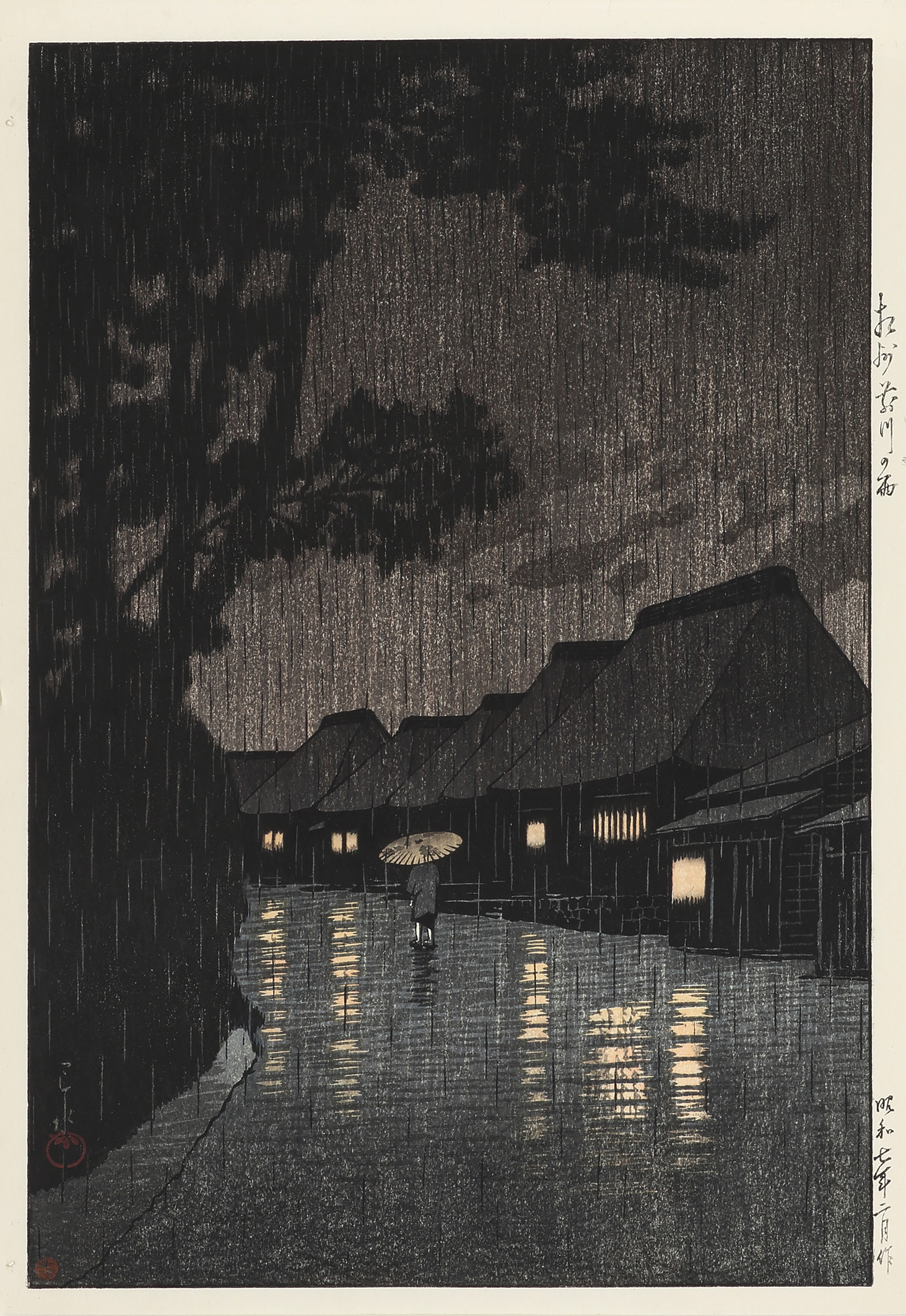
Rain in Maekawa, Soshu

Scarce c.20th coloured woodblock by Kawase Hasui (1883–1957) with his signature Kawase seal. Hasui is widely regarded as the foremost artist of Japan’s shin-hanga (“new print”) movement in the early c.20th. Publisher: Watanabe Shōzaburō with his seal at lower left: … Read Full Description

Sold

S/N: JWB-HASUI-042–507899
(C117)
Free Shipping
Asia China

Within Australia

All orders ship freewithin Australia

Asia China

Rest of the World

Orders over A$300
ship free worldwide

See Shipping page for Terms & Conditions

Details

Full Title:

Rain in Maekawa, Soshu

Date:

C1958

Condition:

In good condition.

Technique:

Colour woodblock

Image Size: 

242mm 
x 361mm

Paper Size: 

263mm 
x 391mm
AUTHENTICITY

Guaranteed Vintage Item
dated:

Rain in Maekawa, Soshu - Vintage Print from 1958
1958

Description:

Scarce c.20th coloured woodblock by Kawase Hasui (1883–1957) with his signature Kawase seal.

Hasui is widely regarded as the foremost artist of Japan’s shin-hanga (“new print”) movement in the early c.20th.

Publisher: Watanabe Shōzaburō with his seal at lower left: see Visions of Japan pg. 33 – I (7mm)

He is now recognised as “Japan’s best print landscapist since Hiroshige.” Initially obliged to work in his family’s rope and thread business, Hasui only turned seriously to art after persistent efforts to study with Kiyokata Kaburagi. Rejected at first, he was encouraged to pursue Western painting, before finally being accepted as Kaburagi’s pupil. In 1917, inspired by Shinsui Itō’s Eight Views of Ōmi, he approached the publisher Watanabe Shōzaburō, for whom he designed three trial prints. Over the next four decades he created more than 600 woodblock prints, some in editions of up to 3,000, achieving lasting commercial and critical success. Hasui’s atmospheric fūkeiga (“landscape pictures”) gained wide international popularity. His celebrated image of a lone figure walking at night in heavy rain epitomises his preference for quiet, melancholy scenes, of which he wrote: “I love quiet scenes with the shadow of loneliness hanging over them.” That mood was shaped by his manipulation of scale and depth, and by his mastery of bokashi (tonal gradation), learned from Kobayashi Kiyochika’s kōsen-ga (“pictures of light”).

From the series Tokaido fukei senshu, Soshu Maekawa no ame (Selected views of the Tokaido)


References:
Brown, K. Visions of Japan. Kawase Hasui's Masterpieces. Amsterdam 2004: 47. ill. pg. 83.

Collections:
Art Institute Chicago: Reference Number 1990.607.713
Museum of Fine Arts Boston: Accession Number 49.702

Kawase Hasui 川瀬巴水 (1883 - 1957)

Pre-eminent Japanese woodblock print artist of the twentieth century, celebrated as one of the foremost exponents of the shin-hanga (“new prints”) movement. Born in Tokyo in 1883, Hasui originally aspired to a career in Western-style painting, studying under the painter Okada Saburōsuke. His artistic direction changed after encountering the prints of Kaburaki Kiyokata, who encouraged him to pursue design for woodblock prints. Under Kiyokata’s guidance, Hasui adopted the name “Hasui” and began producing designs for the publisher Watanabe Shōzaburō in 1918, a collaboration that would define his career. Hasui’s prints are distinguished by their lyrical depictions of the Japanese landscape—tranquil temples, snow-covered villages, and moonlit harbours—rendered with a refined sensibility to atmosphere and light. His mastery lay in translating fleeting moments of weather and time into woodblock form, combining Western techniques of perspective and shading with the traditional ukiyo-e idiom. Many of his works were produced following extensive sketching tours across Japan, which he undertook throughout the 1920s and 1930s. In 1923, the Great Kantō Earthquake destroyed much of his early work, yet Hasui continued to create prolifically thereafter, contributing to the revitalisation of the woodblock print tradition in the modern era. His series, including Souvenirs of Travel (Tabi miyage), Snow, Moon and Rain (Setsugekka), and Views of Tokyo, are among the most admired achievements of shin-hanga. Recognised nationally, Hasui was designated a Living National Treasure (Ningen Kokuhō) in 1956, one year before his death. His prints, characterised by poetic serenity and technical precision, stand as enduring expressions of modern Japanese romanticism and continue to influence landscape artists worldwide.

View other items by Kawase Hasui 川瀬巴水

Related Products

Choose currency

Exchange rates are only indicative. All orders will be processed in Australian dollars. The actual amount charged may vary depending on the exchange rate and conversion fees applied by your credit card issuer.

Account Login

The List

Join our exclusive mailing list for first access to new acquisitions and special offers.