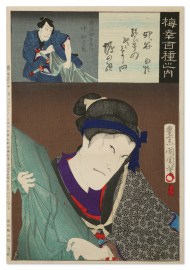
Utagawa Kuniyoshi (1797–1861) Shionata, Post Station no. 24, Kisokaidō Road
Rare c.19th-century ōban tate-e colour woodblock print, signed Ichiyūsai Kuniyoshi ga within the red gourd-shaped cartouche at lower left, with the artist’s Yoshi kiri (paulownia flower) seal.
From the series Sixty-Nine Post Stations of the Kisokaidō Road, (Kisokaidō rokujūku tsugi no uchi), 1852–53.
The Sixty-Nine Post Stations of the Kisokaidō Road depicts the inland highway linking Edo (modern Tokyo) with Kyoto, which comprised sixty-nine official waystations in addition to the termini at Edo and Kyoto. For this ambitious series, Kuniyoshi created one design for each post station, combining a small inset landscape view of the location with a larger dramatic scene from history, legend, or theatre.
This print illustrates the tragic tale of Torii Matasuke, a loyal retainer deceived by the villain Mochizuki Genzō. In a torrential storm at the Chikuma River near Shionata, Matasuke mistakes his lord, Yasuda of Taga, for the villain and decapitates him while submerged in the river. Emerging from the waters, he is shown wringing his soaked garments while clenching his master’s head between his teeth, as Yasuda’s bewildered retainers scramble on the far shore. The subject derives from the kabuki play Stories Heard in the Pleasure Quarter at Mirror Mountain (Kagamiyama sato no kikigaki), first staged in Kyoto in 1780. Though ostensibly centred on the fictional Yasuda family of Taga, the drama was widely understood as an allegory of a real political struggle in the Maeda clan of the Kaga domain. In Kuniyoshi’s design, stirrups and horse trappings frame the title cartouche, while the floral medallion around the inset landscape recalls the form of a bronze mirror, alluding to the play’s title Mirror Mountain.
Shionata, located on the eastern bank of the Chikuma River in Shinshū province, was a notable station where ferry crossings were often interrupted due to the river’s breadth and swift currents. Nearby, the celebrated Fudō waterfall provided weary travellers a place of rest and refreshment.
Size: ōban tate-e
Date seals: 1852 (Kaei 5)
Publisher: Minatoya Kohei
Censor seal: Double nanushi – Fuku- Muramatsu (II ic/1852–XI/53)
History of censor seals.
Restrictive edicts for print publishers by the shogunate were issued over many years:
1790 – The shogunate issued a new edict to control the print industry, it demanded that single-sheet prints with text were required to be checked by censors prior to publication.
1796 – No images that named and depicted unlicensed prostitutes (who worked outside the Yoshiwara district)
1800 – Large head portraits of women or pictures of luxurious dresses were unacceptable
1804 – Named warriors dating from after 1573 were regarded as inappropriate
1842 – Banned prints of actors and beauties and only allowed prints focusing on loyalty and filial piety.
1842 – Restricted the use of colour to no eight and the price to 16 mon (equal to a bowl of noodles)
1868 – Removal of the ban of depicting contemporary events