Within Australia
All orders ship freewithin Australia
Rest of the World
Orders over A$300
ship free worldwide
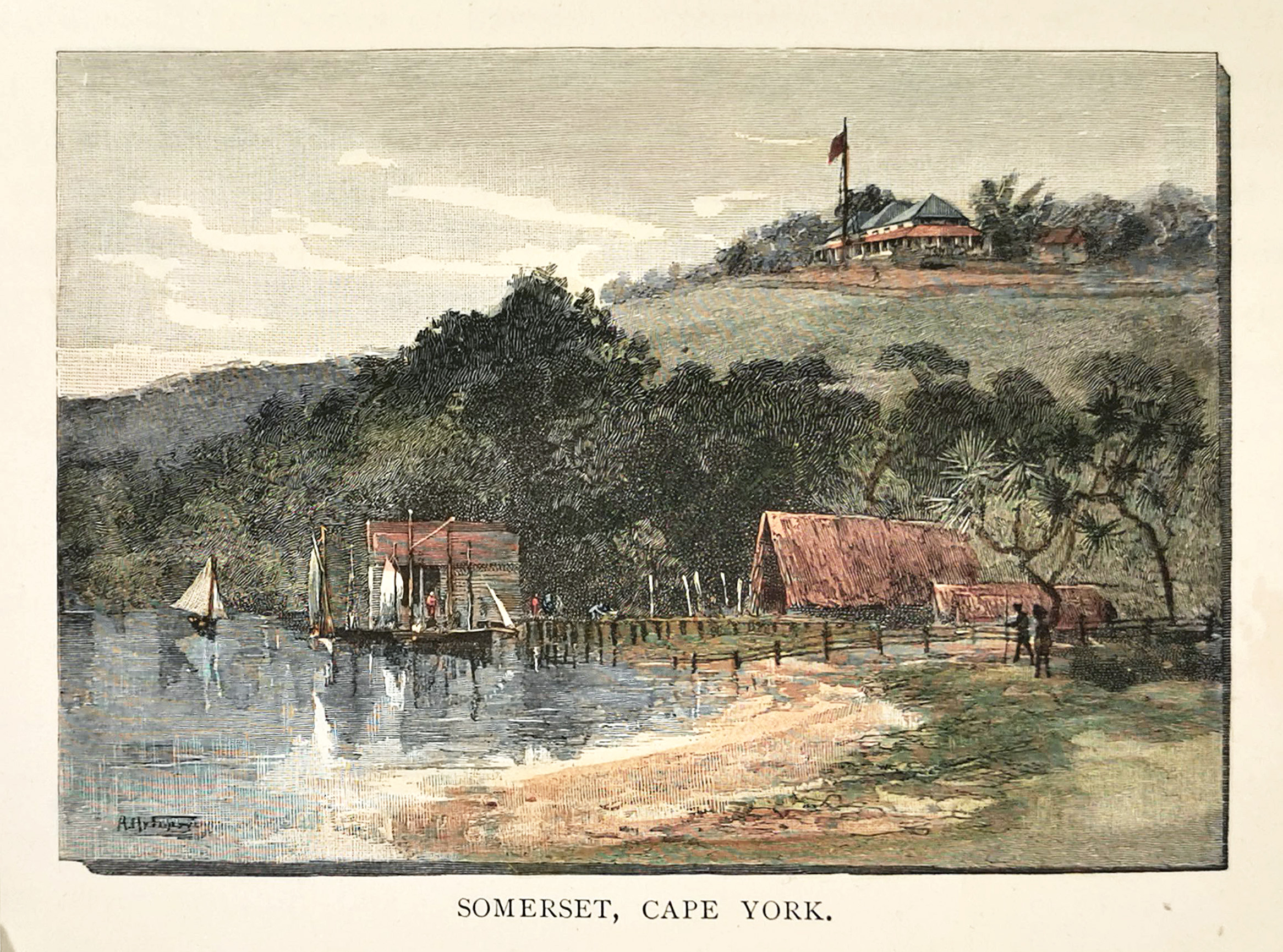
Scarce c.19th hand coloured engraving of Somerset, Queensland. With Queensland’s separation from New South Wales on 10 December 1859, the new colony assumed control of more than 5,000 kilometres of coastline, stretching northwards to Cape York Peninsula. In 1860 the … Read Full Description
$A 55
Within Australia
All orders ship freewithin Australia
Rest of the World
Orders over A$300
ship free worldwide
Full Title:
Date:
Condition:
Technique:
Image Size:
Paper Size:
Genuine antique
dated:
Description:
Scarce c.19th hand coloured engraving of Somerset, Queensland.
With Queensland’s separation from New South Wales on 10 December 1859, the new colony assumed control of more than 5,000 kilometres of coastline, stretching northwards to Cape York Peninsula. In 1860 the first parliament of Queensland adopted a resolution advocating a direct maritime link with Britain through the Torres Strait. In December 1861 Sir George Ferguson Bowen, Governor of Queensland, outlined the need for an outpost in the far north. From a naval and strategic perspective, a station at or near Cape York was considered essential, particularly in light of the recent establishment of a French colony and naval base in New Caledonia. Bowen advised the Secretary of State for the Colonies, the Duke of Newcastle, that Queensland was prepared to establish and administer such a settlement and to maintain a civil presence there.
On 27 August 1862 Bowen departed Brisbane aboard HMS Pioneer to identify a suitable location. The site selected, situated opposite Albany Island, was named Somerset in honour of the First Lord of the Admiralty, the Duke of Somerset.
References:
Ferguson, J. A. Bibliography of Australia Volumes 1-8, Canberra 1976 : 9829g.
Hughes-d’Aeth, T. Paper Nation : The Story of the Picturesque Atlas of Australia. Melbourne 2001 :.
Collections:
National Library Australia: Bib ID 1654251
National Gallery Australia: LEGACY ID 34588
Royal Collection Trust UK: RCIN 1046852
Getty Museum Los Angeles: Object name: 1218593
State Library New South Wales: RECORD IDENTIFIER 74VvDRQZXzWd
State Library Victoria: CCF 919.4 G19
Albert Henry Fullwood (1863 - 1930)
English artist trained at the Birmingham School of Art before emigrating to Sydney in 1883.
He initially worked for John Sands Ltd and as an illustrator for Henry Parkes Garran, while travelling widely across northern Australia, New Guinea, and New Zealand. In the 1880s he associated with leading colonial artists, including Tom Roberts and Arthur Streeton, and, encouraged by Livingston Hopkins, developed a strong interest in etching. He contributed illustrations to prominent British and Australian periodicals and was active in the Art Society of New South Wales, later helping to establish the Society of Artists. In 1900 Fullwood relocated abroad, spending a year in New York before settling in London, where he worked as an illustrator and exhibited at the Royal Academy of Arts and the Salon de la Société des Artistes Français. A member of the Chelsea Arts Club, he served during the World War I with the Allied Arts Corps and later the Royal Army Medical Corps. In 1918 he was appointed an official artist with the Australian Imperial Force in France, depicting the Western Front. Returning to Sydney after demobilisation in 1919, he co-founded the Australian Painter-Etchers’ Society with John Shirlow and became a member of the Australian Watercolour Institute. He died of pneumonia on 1 October 1930.
Exchange rates are only indicative. All orders will be processed in Australian dollars. The actual amount charged may vary depending on the exchange rate and conversion fees applied by your credit card issuer.
Join our exclusive mailing list for first access to new acquisitions and special offers.