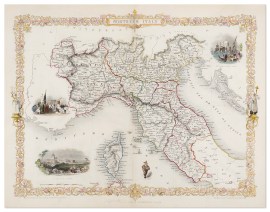
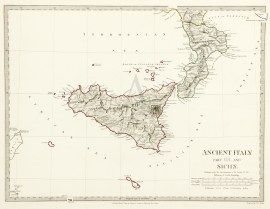
Rare c.18th Dutch period map of Italy, adorned with an elaborate title cartouche at top right with the central figure is Italia Turrita e Stellata, the allegorical personification of Italy, wearing a castle-crown and a star, symbolizing Italy’s royalty, nobility, … Read Full Description
Minor worming on sheet edge not affecting image and small repairs to centre fold, otherwise in good condition.
Technique:
Hand coloured copper engraving.
Image Size:
540mm
x 435mm
Paper Size:
620mm
x 517mm
AUTHENTICITY
Genuine antique dated:
1670
Description:
Rare c.18th Dutch period map of Italy, adorned with an elaborate title cartouche at top right with the central figure is Italia Turrita e Stellata, the allegorical personification of Italy, wearing a castle-crown and a star, symbolizing Italy’s royalty, nobility, and “stellar” destiny. She is seated with a cornucopia, representing Italy’s agricultural abundance. The figure on the right Saint Paul, representing his writings (the book) and the instrument of his martyrdom by beheading (the sword) while on the left is Saint Peter holding a book and keys. As the first Pope and a leader of the Apostles, he was entrusted with the keys of the Kingdom of Heaven by Jesus Christ, symbolizing the authority to bind and loose on Earth as it would be bound and loosed in heaven. While the keys are his most prominent attribute, he is also frequently shown holding a book, representing the teachings and authority of the Church he led. A decorative scale of distances is at lower right.
This map was produced and published before de Wit was granted privilege in 1689, after which all his maps were marked with the annotation ‘cum privilegio’.
De Wit was an apprentice of Willem Blaeu, Frederick de Wit founded his own printing house in Amsterdam in 1648 and after the decline of the Blaeu and Jansson firms, became one of the most successful map publishers in the Netherlands. This map was engraved by Joannes L’hilier and extends from Persia to northern Australia including the Philippine archipelago, Borneo (Celebes) and Taiwan (Formosa). Northern Australia is shown with the following names given by Abel Tasman on his second voyage in 1644: ‘Van Diemens Landt’, ‘Baya van Diemen’ and ‘Vuyle hoeck’. The map is embellished with a superb decorative title cartouche surrounded by four oriental figures and a compass rose. The overall understated effect is typical of de Wit’s stylish maps.
From De Wit’s, Atlas Major. Amsterdam.
References:
Phillips, P. A List of Geographical Atlases in the Library of Congress. Washington 1973 549.
Frederick de Wit (1630 - 1706)
De Wit was born Frederik Hendriksz was born to a Protestant family in Gouda, Netherlands. Frederik was married on 29 August 1661, to Maria van der Way (1632–1711), the daughter of a wealthy Catholic merchant in Amsterdam and from about 1648 until his death in 1706 lived and worked in Amsterdam. By 1654 he had opened a printing office and shop under the name "De Drie Crabben" (the Three Crabs), in 1655, he changed the name to, "Witte Pascaert" (the White Chart).
By 1654 he began to publish his first charts and by 1662 he issued his first complete atlas. By 1671, he was publishing a large folio atlas with as many as 100 maps. In 1689, De Wit received a 15 year privilege from the states of Holland and West Friesland that protected his right to publish and sell his maps. After De Wit's death in 1706, his wife Maria continued the business for four years printing and editing De Wit's maps until 1710 when she sold the firms stock at auction. Most of the atlas plates and some of the wall map were sold to Pieter Mortier (1661–1711).
Exchange rates are only indicative. All orders will be processed in Australian dollars. The actual amount charged may vary depending on the exchange rate and conversion fees applied by your credit card issuer.
Account Login
The List
Join our exclusive mailing list for first access to new acquisitions and special offers.