C1846

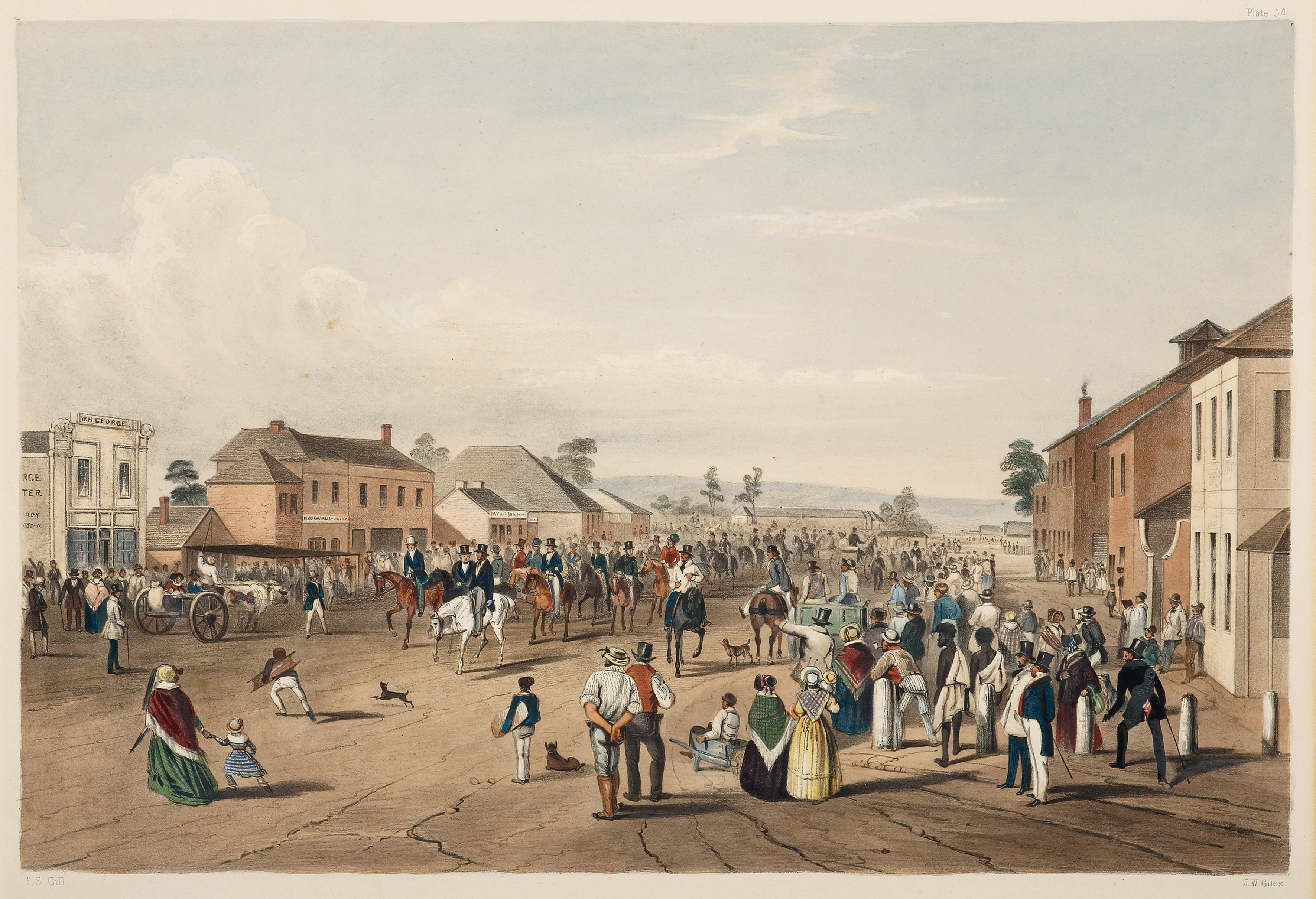
The Departure of Captn Sturt. August, 1844.

Rare hand coloured lithograph of the largest and best depiction of Captain Sturt’s large party departing Adelaide on August 1844 on his exploration journey north. On August 1844, Captain Charles Sturt (1795–1869) accompanied by a well-equipped party of fifteen men, … Read Full Description

$A 3,250

In stock

Free Shipping
[ASIA-Carte Hydro-Geo-Graphique Des Indes Oriental… ASIA

Within Australia

All orders ship freewithin Australia

[ASIA-Carte Hydro-Geo-Graphique Des Indes Oriental… ASIA

Rest of the World

Orders over A$300
ship free worldwide

See Shipping page for Terms & Conditions

Details

Full Title:

The Departure of Captn Sturt. August, 1844.

Date:

C1846

Condition:

In good condition with wide margins.

Technique:

Lithograph with original hand colouring and gum Arabic highlights.

Image Size: 

404mm 
x 270mm

Paper Size: 

538mm 
x 359mm
AUTHENTICITY
The Departure of Captn Sturt. August, 1844. - Antique View from 1846

Genuine antique
dated:

1846

Description:

Rare hand coloured lithograph of the largest and best depiction of Captain Sturt’s large party departing Adelaide on August 1844 on his exploration journey north.

On August 1844, Captain Charles Sturt (1795–1869) accompanied by a well-equipped party of fifteen men, set out from Adelaide on one of the most ambitious exploratory expeditions of the nineteenth century. Sturt’s mission was to determine the existence of an inland sea or dividing mountain range in the heart of the Australian continent. Supported by the South Australian Government and fitted with drays, provisions, and livestock, the expedition departed from Adelaide with considerable public attention. Sturt’s party travelled north through the Flinders Ranges, establishing a depot at Depot Glen near present-day Milparinka, and continued into the arid interior under extreme conditions of heat and drought. Although Sturt failed to discover the hypothesised dividing range or inland sea, his exploration yielded valuable geographical observations, charted new territory, and greatly advanced contemporary understanding of Central Australia’s desert interior.

Drawn by Samuel Thomas Gill during his time in South Australia 1839 to 1852.

Angas’s description;
‘The annexed plate will convey some idea of the busy and animated scene the city of Adelaide presented on the eventful morning the gallant Sturt set out on his late expedition to penetrate into the centre of the vast continent of Australia: he was attended by a large concourse of his friends and fellow colonists, who accompanied him out of town, mounted upon horseback, and the day was a gala for the citizens of Adelaide.’

From George French Angas’s, South Australia Illustrated.

References:
Abbey, J.R. Travel in Aquatint and Lithography 1770-1860. London 1972: II, 577.
Ferguson, J. A. Bibliography of Australia Volumes 1-8, Canberra 1976: 4457
Gill, T. Bibliography of South Australia. Adelaide. (1886) 1976: p.16.
Tooley, R.V. English books with coloured plates, 1790 to 1860. Folkstone 1973: 62.
Tregenza, J. George French Angas. Artist, Traveller and Naturalist 1822-1886. Adelaide 1980: ill. front cover.
Wantrup, J. Australian Rare Books. Sydney 1987: P.309-316.
Wantrup, J. Australian Rare Books. Sydney 2023: c237, pp.407-409

Collections:
National Library Australia: Bib ID 1842283
National Gallery Australia: ACCESSION NUMBER 66.7.3.4
National Gallery Victoria: Accession Number 2011.338
Royal Collection Trust UK: RCIN 1070959
State Library South Australia: 994.2T A581 d
State Library Victoria: RARELTEF 919.42 AN4S
University Library Melbourne: 919.42302 ANGA

Samuel Thomas Gill (1818 - 1880)

Samuel Thomas Gill (1818-1880) S.T. Gill as he is often now known, was born at Somerset, England, the son of Rev. Samuel Gill, Baptist minister, and educated at Plymouth in a school kept by his parents, and later at Dr Seabrook's academy. His father taught him drawing and he was later employed in London as 'Draftsman and Water Colour Painter' by the Hubard Profile Gallery, an establishment which produced silhouettes. He arrived in South Australia in 1839 and by March 1840 had established a studio in Gawler Place, Adelaide, which was open from 'eleven till dusk'; he offered to produce portraits of human beings, horses and dogs, and to sketch houses and transfer the sketches 'to paper suited for home conveyance'. In 1846 he accompanied the Horrock's expedition which reached the head of Spencer Gulf.  In 1852 Gill travelled to the Victoria and in the next twenty years produced drawings, watercolours and lithographs of scenes of the Victorian and New South Wales gold fields. After 1870 Gill fell into obscurity and on 27 October 1880 he collapsed in Post Office Place, Melbourne, and was found to be dead when taken to hospital. Gill's legacy is a large body of work which portrayed life during the greatest gold boom the world had ever seen.

View other items by Samuel Thomas Gill

Related Products

Choose currency

Exchange rates are only indicative. All orders will be processed in Australian dollars. The actual amount charged may vary depending on the exchange rate and conversion fees applied by your credit card issuer.

Account Login

The List

Join our exclusive mailing list for first access to new acquisitions and special offers.