C1881

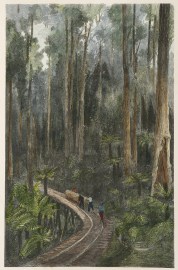
The Lost Track

Rare c.19th hand coloured engraving of a lost bushman and border collie.  A small township developed which was initially known as Mount Sturgeon, after the European name for the mount behind the town. A post office opened on 1 July … Read Full Description

$A 145

In stock

S/N: IAN-AA-810312060–192232
(B010)
Free Shipping
Lord’s Mill Botany Bay. NSW - Sydney

Within Australia

All orders ship free
within Australia
Lord’s Mill Botany Bay. NSW - Sydney

Rest of the World

Orders over A$300
ship free worldwide

See Shipping page for Terms & Conditions

Details

Full Title:

The Lost Track

Date:

C1881

Condition:

In good condition.

Technique:

Hand coloured engraving.

Image Size: 

228mm 
x 164mm

Paper Size: 

269mm 
x 198mm
AUTHENTICITY
The Lost Track - Antique Print from 1881

Genuine antique
dated:

1881

Description:

Rare c.19th hand coloured engraving of a lost bushman and border collie.

 A small township developed which was initially known as Mount Sturgeon, after the European name for the mount behind the town. A post office opened on 1 July 1852 (Dunkeld from 1 January 1854)  and as the early settlers were predominantly Scottish, it was renamed Dunkeld after a Scottish town which was the principal locality of the Caledonian picts in Roman times.

From the original edition of the Illustrated Australian News.

Collections:
University Queensland: Identifier 991000982479703131
State Library Victoria: PCINF IAN 04-09-76 P.133
National Library Australia: Bib ID 2495305
State Library New South Wales: CALL NUMBERS F079/55, TN380
Royal Geographic Society SA: RGS Special Coll. 079.94 I29d

References:
Syme, E. & D, Illustrated Australian News. ISSN 2208-5386.

Samuel Thomas Gill (1818 - 1880)

Samuel Thomas Gill (1818-1880) S.T. Gill as he is often now known, was born at Somerset, England, the son of Rev. Samuel Gill, Baptist minister, and educated at Plymouth in a school kept by his parents, and later at Dr Seabrook's academy. His father taught him drawing and he was later employed in London as 'Draftsman and Water Colour Painter' by the Hubard Profile Gallery, an establishment which produced silhouettes. He arrived in South Australia in 1839 and by March 1840 had established a studio in Gawler Place, Adelaide, which was open from 'eleven till dusk'; he offered to produce portraits of human beings, horses and dogs, and to sketch houses and transfer the sketches 'to paper suited for home conveyance'. In 1846 he accompanied the Horrock's expedition which reached the head of Spencer Gulf.  In 1852 Gill travelled to the Victoria and in the next twenty years produced drawings, watercolours and lithographs of scenes of the Victorian and New South Wales gold fields. After 1870 Gill fell into obscurity and on 27 October 1880 he collapsed in Post Office Place, Melbourne, and was found to be dead when taken to hospital. Gill's legacy is a large body of work which portrayed life during the greatest gold boom the world had ever seen.

View other items by Samuel Thomas Gill

Choose currency

Exchange rates are only indicative. All orders will be processed in Australian dollars. The actual amount charged may vary depending on the exchange rate and conversion fees applied by your credit card issuer.

Account Login

The List

Join our exclusive mailing list for first access to new acquisitions and special offers.