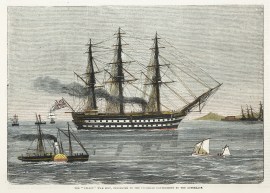
British born in England in 1828, Calvert trained in the demanding craft of wood engraving, a medium essential to nineteenth-century illustrated books and newspapers.
He emigrated to Australia during the great period of colonial expansion and settled in Melbourne, where a growing press and publishing industry created strong demand for skilled reproductive artists capable of translating drawings into printable blocks.
By the 1850s and 1860s Calvert had established himself as a leading engraver in Victoria. He worked for major colonial publications, most notably the Illustrated Australian News and other illustrated papers that documented civic ceremonies, public buildings, exhibitions, shipping, exploration, and social life. His engravings helped shape the visual record of early Melbourne and the Australian colonies, rendering architecture, landscapes, and historical events with clarity and technical assurance.
Calvert was particularly associated with large commemorative and documentary projects, including views connected with Melbourne’s international exhibitions and other displays of colonial progress. His work bridged art and reportage: while based on artists’ drawings, his engravings required interpretive skill to convey depth, texture, and atmosphere within the linear language of the wood block. Through this process he played a central role in transforming colonial events into widely circulated images.
In addition to his professional practice, Calvert was active in artistic circles in Victoria and contributed to the establishment of professional standards in the graphic arts. He also trained or influenced younger engravers, helping to localise a craft that had previously depended heavily on British production.
Samuel Calvert died in 1913, leaving a substantial body of work that today serves as an important visual archive of nineteenth-century Australia. His engravings are represented in major Australian libraries and collections and remain valued for both their artistic quality and their documentary significance.