Within Australia
All orders ship freewithin Australia
Rest of the World
Orders over A$300
ship free worldwide
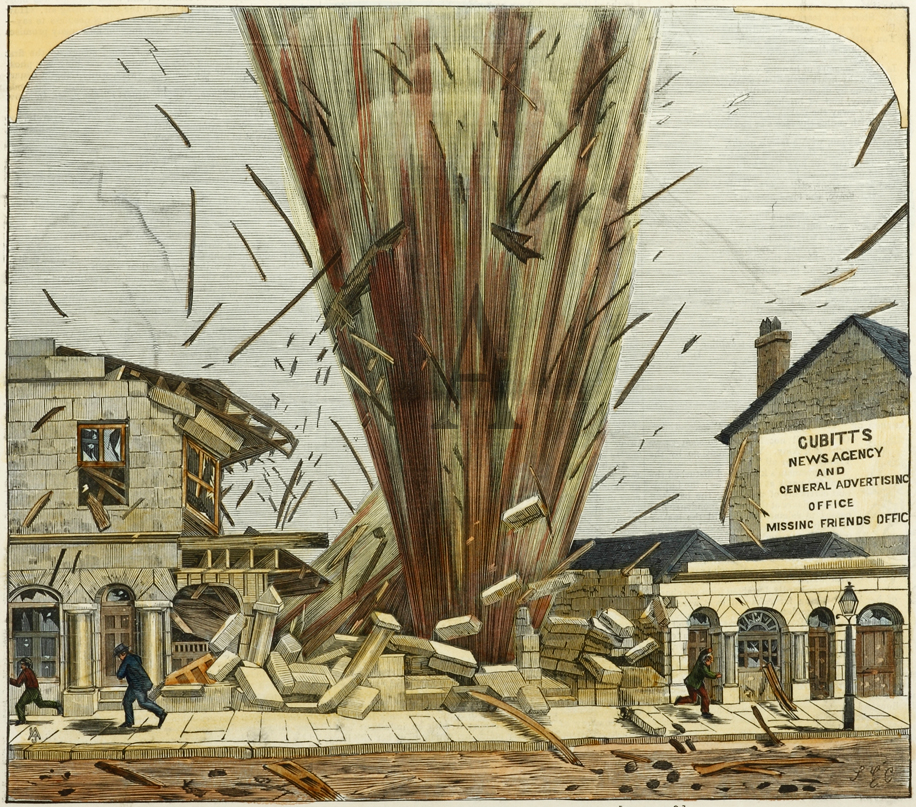
Rare colonial engraving of the famous nitro-glycerine explosion in the Bridge Street warehouse of Messrs Molison and Black. In March 1866 a 100lb shipment of a new material, nitro-glycerine, arrived in Sydney and was stored in the Bridge Street warehouse … Read Full Description
$A 245
Within Australia
All orders ship freewithin Australia
Rest of the World
Orders over A$300
ship free worldwide
Full Title:
Date:
Condition:
Technique:
Image Size:
Genuine antique
dated:
Description:
Rare colonial engraving of the famous nitro-glycerine explosion in the Bridge Street warehouse of Messrs Molison and Black.
In March 1866 a 100lb shipment of a new material, nitro-glycerine, arrived in Sydney and was stored in the Bridge Street warehouse of Messrs Molison and Black. The substance, also known as Nobel’s Blast Oil, was to be tested by the importer as a means of blasting rock.
From the original edition of The Illustrated Sydney News.
References:
Gibbs & Shallard. Illustrated Sydney News. ISSN 2203-5397.
Collections:
State Library New South Wales: F8/39-40
State Library Victoria: PCINF SLVIC=1853-1872
National Library Australia: Bib ID 440095
Arthur Levett Jackson (1834 - 1888)
Documentary detail on Jackson’s personal life is comparatively sparse, a common situation for c.19th engravers, whose labour underpinned illustrated publishing but who rarely received the individual attention given to painters or draughtsmen. What can be reconstructed places him firmly within the skilled artisan class that supported Sydney’s expanding print culture in the mid to late Victorian period.
Born in 1834, likely in Britain, Jackson would have served a formal apprenticeship in wood engraving, a trade demanding precision, patience, and close collaboration with publishers. Training involved mastering engraving tools (burins and gravers), working on dense end-grain boxwood blocks, and learning to translate tonal wash drawings into systems of line, hatch, and stipple. Such training suggests a background in an urban craft environment rather than an academic art school.
His migration to New South Wales probably occurred during the great waves of skilled British emigration to Australia in the 1850s–60s, when the colonial press was expanding rapidly.
Exchange rates are only indicative. All orders will be processed in Australian dollars. The actual amount charged may vary depending on the exchange rate and conversion fees applied by your credit card issuer.
Join our exclusive mailing list for first access to new acquisitions and special offers.