C1846

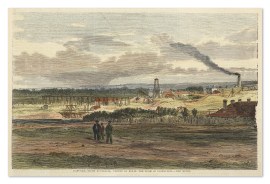
The River, Murray, Near Lake Alexandrina.

Rare c.19th hand coloured lithograph of George French Angas’s view of the River Murray at Lake Alexandrina, from the largest and earliest series of lithographs of the infant colony of South Australia. Angas’s account; ….. the subject of the annexed … Read Full Description

$A 750

In stock

S/N: ASAIL-025-SC–217638
(C098F)
Free Shipping
Imperio del Giappone MAPS & GLOBES

Within Australia

All orders ship free
within Australia
Imperio del Giappone MAPS & GLOBES

Rest of the World

Orders over A$300
ship free worldwide

See Shipping page for Terms & Conditions

Details

Full Title:

The River, Murray, Near Lake Alexandrina.

Date:

C1846

Engraver:

J.W.Giles 

Condition:

In good condition.

Technique:

Lithograph with original hand colouring and gum Arabic highlights.

Image Size: 

320mm 
x 230mm

Paper Size: 

538mm 
x 362mm
AUTHENTICITY
The River, Murray, Near Lake Alexandrina. - Antique View from 1846

Genuine antique
dated:

1846

Description:

Rare c.19th hand coloured lithograph of George French Angas’s view of the River Murray at Lake Alexandrina, from the largest and earliest series of lithographs of the infant colony of South Australia.

Angas’s account; ….. the subject of the annexed plate is taken from the limestone cliffs that border upon the left bank of the river, about halfway between the crossing place at Wirrum, and the junction of the Murray with the Lake. A fine view of the river is obtained from this high ground, from whence the eye may trace its course, winding in a succession of the most graceful sweeps, between vast flats of reeds. the vivid green of which is truly refreshing to the eye. Its current is here so gentle as at times to be hardly perceptible: deep, and broad, and smooth as a glassy mirror, it flows tranquilly and majestically onwards in silent grandeur to the ocean. The hills rising from this valley, or basin of the Murray, are clothed with belts of pine; and beyond is an extensive country of scrub. A few scattered gum trees grow along the margin of the river, which are the resort of multitudes of shags, or less abundant white ibis, which roost on their decayed branches. The natives are numerous on both banks of the river; their encampments being scattered along the narrow strip of ground that intervenes between the limestone cliff’s and the water’s edge; they derive various sustenance from the fish, mussels, cray-fish, bulrush-root, and other productions of this large river. The smoke proceeding from the reeds, as represented in the plate, arises from the native women in search of bulrush root, who kindle fires to cook their food, beneath the cover of these lofty reeds.

From George French Angas’s, South Australia Illustrated. London.

References:
Gill, T. Bibliography of South Australia. Adelaide. (1886) 1976 : p.16.
Wantrup, J. Australian Rare Books. Sydney 1987 : P.309-316..
Ferguson, J. A. Bibliography of Australia Volumes 1-8, Canberra 1976 : 4457, Volume IV.
Tregenza, J. George French Angas. Artist, Traveller and Naturalist 1822-1886. Adelaide 1980 : ill. front cover +.
Abbey, J.R. Travel in Aquatint and Lithography 1770-1860. London 1972: II, 577.
Tooley, R.V. English books with coloured plates, 1790 to 1860. Folkstone 1973 : 62.
Colas, R. Bibliographie generale du Costume et de la Mode. Paris 1933 : 133.

Collections:
National Library Australia: Bib ID 1842283
State Library South Australia: 994.2T A581 d
National Gallery Australia: ACCESSION NUMBER 66.7.3.4
Royal Collection Trust UK: RCIN 1070959
University Library Melbourne: 919.42302 ANGA
National Gallery Victoria: Accession Number2011.338
State Library Victoria: RARELTEF 919.42 AN4S


References:
Ferguson, J. A. Bibliography of Australia Volumes 1-8, Canberra 1976 :: Volume IV, 4457.
Gill, T. Bibliography of South Australia. Adelaide. (1886) 1976 :: P.16.
Wantrup, J. Australian Rare Books. Sydney, 1987 :: p. 309-316.


Collections:
National Gallery Australia: NGA 66.7.5.1
National Library Australia: Bib ID 1842566
State Library South Australia: B 15276/25
Art Gallery South Australia: Accession number 455G15

George French Angas (1822 - 1886)

Angas was a painter, lithographer, engraver and naturalist, fourth child and eldest son of George Fife Angas, a merchant and banker. As the eldest son he was expected to join his father's firm, but some months in a London counting house proved a disillusioning experience. In 1841 he took art lessons for four months from Benjamin Waterhouse Hawkins, a natural history painter and lithographer, and armed with this instruction set out to see the world. He began in the Mediterranean publishing, A Ramble in Malta and Sicily in the Autumn of 1841.......Illustrated with Sketches Taken on the Spot, and Drawn on the Stone by the Author, the following year. Angas's father had established the South Australian Company in 1836 and had large areas of land as well as banking interests in the province. George French sailed for South Australia in 1843 in the Augustus, arriving in Adelaide on 1st January 1844. Within days he had joined an exploring party selecting runs for the South Australia Company. They traveled through the Mount Lofty Ranges to the Murray River and down to Lake Coorong and Angas sketched views of the countryside, native animals and the customs and dwellings of the Narrinyerri people. Later he drew scenes on his father's land - 28,000 acres in the Barossa Valley - and accompanied George Grey's expedition to the then unknown south-east as unofficial artist. In July 1844 Angas visited New Zealand. Guided by two Maoris, he traveled on foot and by canoe through both islands, painting portraits of Maoris and views. Angas's father died in 1879, leaving a vast estate from which George French received only a annuity of 1000 pounds. In 1884 he went to Dominica on a collecting expedition, finding shells, moths, butterflies and birds. Dogged by rheumatism and neuralgia during his last years, Angas died in London on 4 October 1886.

View other items by George French Angas

James William Giles (1801 - 1870)

Giles was a painter and lithographer born in Glasgow , the son of a designer at the local calico. The family moved to Aberdeen around 1805 where his father worked in a printing factory at Aberdeen and was an artist of some repute. His father's early death threw his son at an early age upon his own resources and at 13 he maintained himself, his mother and sister by painting, and before he was 20 was teaching private classes in Aberdeen. At 21 he married a widow Clementina Farquharson. He then became a member of the Royal Scottish Academy and elected to the council of the Spalding Club. He first exhibited at the "Royal Institution for the Encouragement of the Fine Arts in Scotland", and in 1829 became an academician of the Royal Scottish Academy, and contributed numerous works to its exhibitions from that time until near the close of his career. He also exhibited frequently at the British Institution in London, and occasionally at the Royal Academy and the Society of British Artists.

View other items by James William Giles

Choose currency

Exchange rates are only indicative. All orders will be processed in Australian dollars. The actual amount charged may vary depending on the exchange rate and conversion fees applied by your credit card issuer.

Account Login

The List

Join our exclusive mailing list for first access to new acquisitions and special offers.