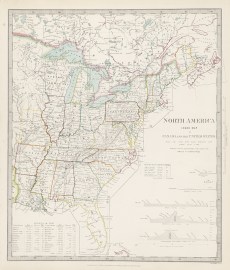
William Faden’s rare and important c.18th map showing the newly recognised boundaries of the United States, the short-lived state of Franklinia, one of the first recorded references to Tennessee and the Federal capital, Washington. Additionally, it is one of the first maps to mention native title rights and records numerous locations of American Indian tribes: a note states, “The Whole of the Countries not actually settled by Europeans should belong by right to the Aborigines”.
The original territory of the United States, as defined by the treaties of November 30, 1782, and September 3, 1783, with Great Britain, was bounded on the north by Canada, on the south by the Spanish Colonies of East and West Florida, on the east by the Atlantic Ocean, and on the west by the Mississippi River. It included the Thirteen Original Colonies and the areas claimed by them.
Faden first issued this map in 1777 and published thirteen further updated editions or states, the last being in 1843. This map represents one of the most historically important cartographic depictions of the newly recognised independent republic.
This edition, published 11 February 1796, states in the title that the map depicts the United States’s boundaries according to the Treaty of 1784. The Treaty of Paris was originally signed on 3 September 1783 but was not ratified by the Congress of the Confederation and the King of Great Britain until 1784. The parties exchanged the ratified documents in Paris on 12 May 1784, which formally ended the American Revolutionary War between Great Britain and the United States of America. The map is partly based on John Mitchell’s A Map of the British and French Dominions in North America, used by delegates during the treaty’s negotiations that made the former Thirteen Colonies independent from the British Crown. Inaccuracies in Mitchell’s map were later to cause problems in clearly defining the agreed borders. One such example stated that the boundary between U.S. territory and the British possessions to the north would run “through the Lake of the Woods to the northwestern most point thereof, and from thence on a due west course to the river Mississippi”. A note at the top left states “Due West Course to the Missisipi”, based on the wording of the Treaty. It was not known at the time that the source of the river, Lake Itasca, was in fact further south.
Faden notes numerous interesting pieces of information and includes the region of “Franklinia” or the “New State of Franklin”, which is placed between “Tannessee Government” (Tennessee) and North Carolina. Franklinia was a short-lived attempt by settlers in the Great Smoky Mountains to secede from North Carolina and form a new state. Along the coast, coloured in yellow, is “The Twenty League Line”, which marks the United States’ maritime boundary. The map is beautifully hand-coloured, with a key on the right for the colouring.
The map is embellished with a finely engraved decorative title cartouche, comprising a rocky landscape with sailors unloading barrels from a small boat.