C1841

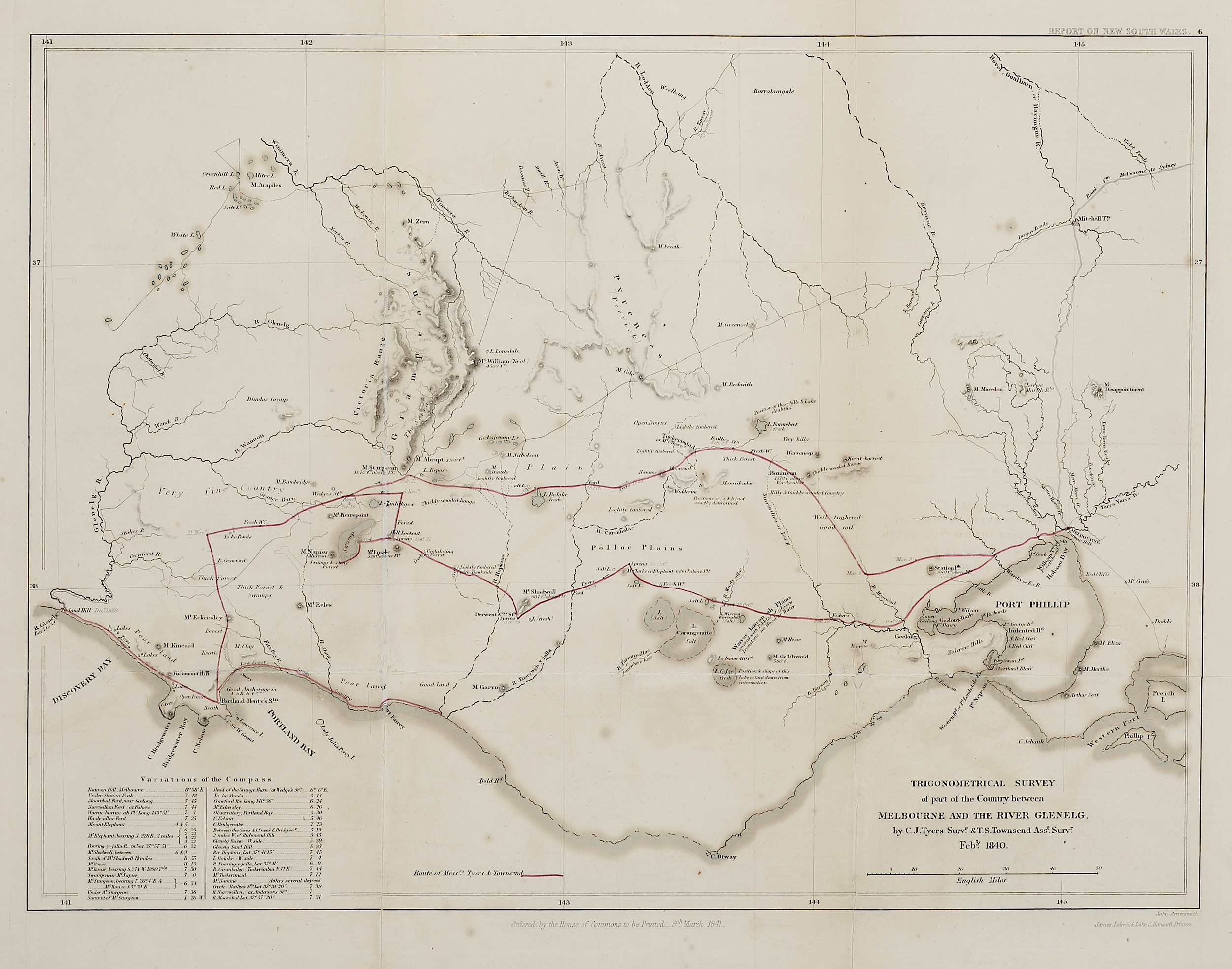
Trigonometrical Survey of part of the Country betw…

Rare and important early c.19th map showing Charles Tyers survey to fix the position of the Victorian and South Australian border. In 1839 Tyers was transferred from the Royal Navy to the Colonial Service and given the title of ‘Commissioner … Read Full Description

Sold

S/N: VIC-1841-ARRO-001–188225
(RW02E)
Free Shipping
Asia China

Within Australia

All orders ship freewithin Australia

Asia China

Rest of the World

Orders over A$300
ship free worldwide

See Shipping page for Terms & Conditions

Details

Full Title:

Trigonometrical Survey of part of the Country between Melbourne and the River Glenelg by C.J.Tyers Survr. & T.S.Townsend Asst. Survr.

Date:

C1841

Condition:

Minor spotting to outer margins, lined with Japanese paper, folds as issued, small areas of minor loss at folds as often found, otherwise in good condition.

Technique:

Copper engraving with original hand colouring

Image Size: 

435mm 
x 325mm

Paper Size: 

510mm 
x 432mm
AUTHENTICITY
Trigonometrical Survey of part of the Country between Melbourne and the River Glenelg by C.J.Tyers Survr. & T.S.Townsend Asst. Survr. - Antique Map from 1841

Genuine antique
dated:

1841

Description:

Rare and important early c.19th map showing Charles Tyers survey to fix the position of the Victorian and South Australian border.

In 1839 Tyers was transferred from the Royal Navy to the Colonial Service and given the title of ‘Commissioner for Crown Lands for Portland’ and instructed by Governor Sir George Gipps to fix the 141st meridian east longitude, the declared boundary between Port Phillip and South Australia, to ascertain in which colony the mouth of the Glenelg River was situated.

On 1 October 1839 Tyers arrived in Melbourne from Sydney on the ‘Pyramus’ and set about assembling a party which was to include Thomas Townsend, Assistant Surveyor. The party set out westwards for Portland on 13 October 1840, crossed the Moorabool River north of Geelong near Buckley’s Falls then proceeded to cross the Nuriwillum or Lea River. He then went north of Lake Corangamite and Lake Colac, unable to directly go to Portland because of swampy country, he continued northwest towards the Grampians. On the 29th he ascended Mount Shadwell and a day later Mount Rouse. The found party were faced with more by swampy land so headed north to Mount Abrupt finally arriving at Portland on 14 November 1840.

Tyers had made a triangulation and a chain traverse to Portland from Melbourne, thus fixing the longitude of Portland at 141° 35′ 52″, and made chronometer readings from Sydney and lunar observations. Taking a mean from these three calculations he fixed the meridian, but because of differing opinions on the longitude of Sydney, Captain Lort Stokes placed it 57 chains (1147 m) west and Captain Owen Stanley and Sir Thomas Mitchell at positions farther west again. Thus Tyers’s position was most favourable to South Australia. Governor Gipps wrote to the Colonial Office: ‘I have to explain that I have caused Mr Tyers’ report to be printed in order that by being circulated amongst the officers of the departments it might stimulate them to exertion, and serve as a model in future operations of this nature’. However, after long disputes the boundary was not finally settled until 1914 when documents had to be sought from Tyers’s descendants.

Collections:
University Library Melbourne: Call No. 820 a 1840
National Library Australia: Bib ID 1942431
State Library Victoria: FACSIMILE 1976 /MAPS 825 BJ 1840 TYERS:

John Arrowsmith (1790 - 1873)

English mapmaker, the last of a family of map makers that produced maps during the period 1790 to 1870. His uncle Aaron (1750 - 1823) left the north of England and went to work in London as a land surveyor where he surveyed the Great Post Roads between London and Falmouth which was engraved and published by John Cary an engraver in 1782 (Verner, 1971, p.1). In the 1790s he decided to establish his own map making business. He published about 200 maps and achieved great eminence being appointed Hydrographer to the King in 1820. John Arrowsmith, Aaron's nephew, who was born in Winston, county Durham, England (1790 - 1873) came to work for him in 1810. During the next thirteen years he learned from his uncle the art of map making, including engraving and printing. His two cousins, Aaron junior (1802-54) and Samuel (1805-39) (Verner, 1971, p.2) both worked in the business and inherited jointly the house, business, copper plates, presses etc. as stated in their father's will. By the time of his uncle's death John had established his own business which operated out of 33 East Street, Red Lion Square, although he still worked with his two cousins Aaron and Samuel. All three produced individual works, although Samuel was in charge of the business at 10 Soho Square. Aaron the younger, lost interest in map making and ceased producing maps in 1832 (Verner, 1971, p.2). In 1839 Samuel died and John bought the business including plates, MSS and copyrights at auction of December 1839 (Herbert, 1983) and continued operating from 10 Soho Square. In 1834 he produced his magnum opusThe London Atlas of Universal Geography, which he continued to revise and reissue until the last 1858 edition. However his atlas contains maps of later dates into the 60s (Herbert, 1989). He became a founding member of the Royal Geographical Society in London (1830) and a member of its council. He remained an active member for over forty years during which time he met many explorers and persons of influence who were instrumental in supplying him with information for his maps. In 1831 the society's Journal was established and Arrowsmith began producing maps for it from 1832 until 1870. He received the Gold medal of the Society in 1863 (Tooley, 1999). After his death his plates were bought by Edward Stanford of London who continued to issue the atlas with the name of Stanford's London Atlas of Universal Geography. This atlas continued into the 1920s. (Dorothy Prescott, 2010-2015)

View other items by John Arrowsmith

Related Products

Choose currency

Exchange rates are only indicative. All orders will be processed in Australian dollars. The actual amount charged may vary depending on the exchange rate and conversion fees applied by your credit card issuer.

Account Login

The List

Join our exclusive mailing list for first access to new acquisitions and special offers.