Mapmaker:
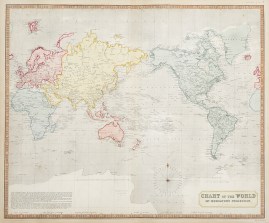
Stunning c.16th (1579 / State 4) world map by Abraham Ortelius (1527-1598) issued in Ortelius’s Theatrum Orbis Terrarum, the first true modern atlas which is of fundamental importance in the history of cartography. As the first world map occurring in … Read Full Description
Sold
Within Australia
All orders ship freewithin Australia
Rest of the World
Orders over A$300
ship free worldwide
Full Title:
Date:
Mapmaker:
Condition:
Technique:
Image Size:
Paper Size:
Genuine antique
dated:
Description:
Stunning c.16th (1579 / State 4) world map by Abraham Ortelius (1527-1598) issued in Ortelius’s Theatrum Orbis Terrarum, the first true modern atlas which is of fundamental importance in the history of cartography.
As the first world map occurring in the first regular atlas, this map is of fundamental importance in the history of cartography. van den Broeck
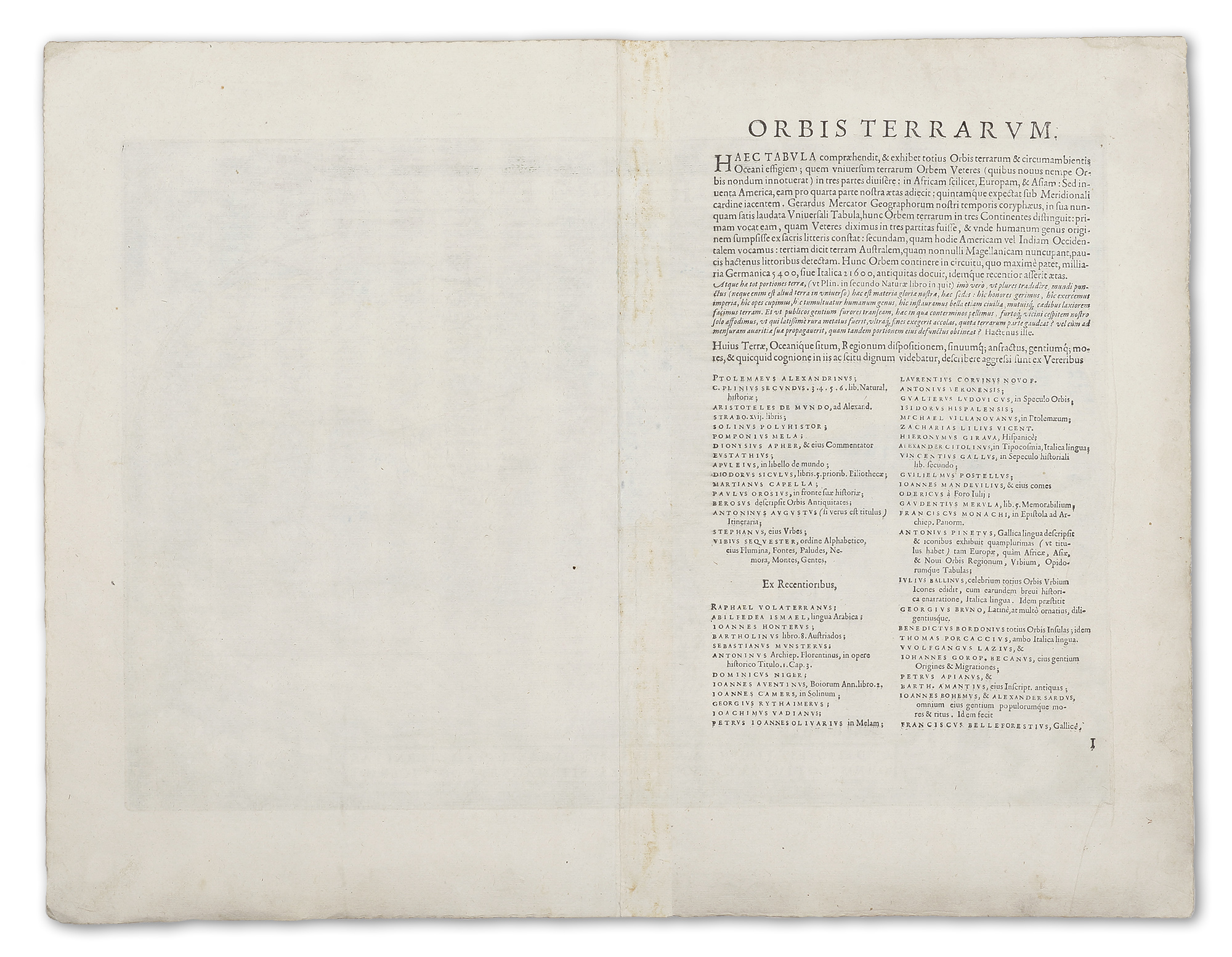
1579L(B)1 last line, left column: PETRVS IOANNES OLIVARIVS in Melam; right column: FRANCISCVS BELLEFORESTIVS, Gallicè) (Note: there are three maps with very similar text on the verso, the only difference between them is this one has an acute ‘è’ in Gallicè whereas the other two have Gallice (without the acute).
State 4 as described below.
These are the four states of this world map:
1.1 1.2 In 1574L the hachuring around the Cicero quote which obliquely goes from upper left to lower right is augmented under the “clasps” which are found at the left and right of the cartouche, not quite at its ends, by a different hachuring going from lower left to upper right.
1.3 In 1575L, bolt impressions appear in the lower left corner, to repair a crack. According to Shirley, this is already the case in 1570L.
1.4 In 1579, the crack is somewhat mended and less visible. Some reworking of the clouds.
1.5 In 1584 the date “1584” is added to the right of “Hogenbergus sculpsit”. 1.6 After 1584, this date is amended to “1585”.
Ortelius important world map is based on Mercator’s large wall map which was published 1569. He has removed the legends, textual panels and decorative features and added formations of clouds around the map and a quotation by Cicero, the Roman writer. From surviving correspondence it is known that Mercator generously encouraged Ortelius to make use of his published corpus of research: he also provided him with co-ordinates of places in America. South America retains the unusual bulge to the south-west coast drawn by Mercator. A large predominant ‘Terra Australis Nondum Cognita’ occupies much of the southern hemisphere while is shown as an island. There is a note adjacent to New Guinea querying whether this large island is part of the southern continent or not. On the northern promontory of the Southland just below Java are three place names derived from the scribed accounts of Marco Polo; ‘Beach’, ‘Lucach’ and ‘Maleur’.
Translation of text;
Centre bottom panel: QVID EI POTEST VIDERI MAGNVM IN REBVS HVMANIS, CVI AETERNITAS OMNIS, TOTIVSQVE MVNDI NOTA SIT MAGNITVDO. CICERO: [Who can consider human affairs to be great, when he comprehends the eternity and vastness of the entire world. Cicero.
Lower left note: “Hanc continentem Australem, nonnulli Magellanicam regionem ab eius inuentore nuncupant”. [This Southern continent is by some called the Magellan region after its discoverer].
Lower left: “Noua Guinea nuper inuenta quæ an sit insulaan pars continentis|Australis incertû est” [New Guinea, recently discovered. Whether this is an island or part of the Southern continent is uncertain.]
Lower right: “Vastißimas hic eße regiones ex M Pauli Ven:et Lud.Vartomann. scriptis pe:|regrationibus constat”. [These regions are very extended, as can be seen in the writings of Paulus Venetus and the travels of Ludovicus Vartomannus.]
Lower right: “Psitacorum regio sic a Lusitanis appellata ob incredibilem earum auium ibidem magnitudem”. [This region is by the Portuguese called “of the Psitaci” because of the incredible number of birds of the same size].
Abraham Ortelius (1527 - 1598)
Flemish cartographer, geographer, and publisher, born in Antwerp on 14 April 1527. He is celebrated as the creator of the Theatrum Orbis Terrarum (Theatre of the World), first published in 1570, widely regarded as the first modern atlas and one of the most influential cartographic works of the sixteenth century.
Trained as a map colourist and illuminator, Ortelius joined the Antwerp Guild of St Luke as a map illuminator in 1547, initially working in partnership with his sister, Anne. He began his career as a map and print dealer, trading in geographical materials and decorative prints across Europe. His extensive travels—to France, Germany, Italy, and notably to London where he met the English cartographer John Dee and the great mapmaker Gerardus Mercator—broadened his intellectual and professional network. Mercator’s work and ideas profoundly influenced Ortelius’s approach to geography and cosmography.
Ortelius’s Theatrum Orbis Terrarum was first issued in Antwerp in 1570 by the printer Gilles Coppens de Diest. Comprising seventy engraved maps with accompanying text, it presented a consistent format and unified design, with maps engraved chiefly by Frans Hogenberg. Each map was carefully attributed to its original source, a practice that reflected Ortelius’s scholarly integrity and established an early model for bibliographic citation in cartography. The Theatrum was an unprecedented success, appearing in more than forty editions and seven languages over the next four decades.
In 1573 Ortelius issued the Additamentum, the first supplement to the atlas, introducing new maps and expanding its global scope. Among his other important works were the Synonymia Geographica (1578), a geographical dictionary of ancient and modern place names, and Thesaurus Geographicus (1596), both significant contributions to Renaissance geographical scholarship.
Ortelius was also among the first to propose, in marginal notes to his maps, that the continents might once have been joined before drifting apart—an early precursor to modern theories of continental drift. His combination of scientific precision, humanist learning, and aesthetic refinement made him a central figure in the golden age of Netherlandish cartography.
He maintained close associations with leading scholars and artists of his time, including Justus Lipsius, Christopher Plantin, and the cartographers Gerard de Jode and Petrus Plancius. His friendship with Mercator remained of great importance throughout his life, and Mercator dedicated several works to him.
Ortelius was appointed Royal Geographer to King Philip II of Spain in 1575, in recognition of his contributions to geography and the prestige his atlas brought to the Spanish Netherlands. He continued to reside in Antwerp, where he also acted as a patron to younger scholars and artists.
Abraham Ortelius died in Antwerp on 28 June 1598 and was buried in the Church of St Michael’s Abbey. His epitaph reads Quietis cultor sine lite, uxore, prole—“A worshipper of tranquillity, without dispute, wife, or children.” His maps and atlases remain milestones in the history of cartography, bridging medieval cosmography and the emerging scientific geography of the early modern world.
Exchange rates are only indicative. All orders will be processed in Australian dollars. The actual amount charged may vary depending on the exchange rate and conversion fees applied by your credit card issuer.
Join our exclusive mailing list for first access to new acquisitions and special offers.