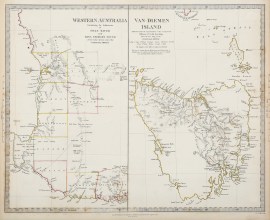
Very detailed c.19th hand coloured engraved chart of Tasmania recording the progress of the colony to 1834 by John Arrowsmith the most important colonial period British cartographer.
Police districts: Launceston, Norfolk Plains, Campbell Town, Oatlands, Oyster Bay, Clyde, New Norfolk, Richmond And Hobart Town V.d.l. Co’s Grants: Woolnorth, Circular Head, Hampshire Hills, Middlesex Plains, Surrey Hills And Land In Three Islands Named Trefoil, Walker’s & Robbins Islands
Table: The following arrangements for the Grants to the Van Diemen’s Land Company have been determined upon. Acreages are given for the above listed areas in all totalling 350 000 acres.
At this stage Arrowsmith had only prepared two maps of Australian interest for his London Atlas. When however he decided to introduce this third map of Van Diemens Land he placed it before the previos plate 36 of Van Diemens Land, the plate number for that had to be changed to ’37’. The sources Arrowsmith gives for his map are the original manuscript surveys held in the Colonial Office and information from the Van Diemen’s Land Company which occupied offices at 55 Broad Street, London. Although Arrowsmith reissued the map through until the year 1842 he made no changes whatsoever to the information contained in the map itself. The various states identified therefore are a record only of reissues of the original map.
This third map of Van Diemens Land at a scale of 1:633 360, shows the present State of Tasmania an island to the south of the mainland which was discovered and named by the Dutch in 1642. It was one of the earliest Australian plates to feature in Arrowsmith’s first issue of his London Atlas and has been found in six states. In the very early issues of the Atlas it is shown as plate 36 and with the imprint ’15th Feb 1832′). Arrowsmith reissued the map through until the year 1842 he made no change whatsoever to the information contained in the map itself. The various states identified therefore are a record only of reissues of the original map.
This issue is identified by the change in the publication line imprint: The address has been erased and the imprint now reads; London, Pubd. 15 Feby. 1834 by J. Arrowsmith
The map provides an explanation of the grants made to the Van Diemen’s Land Company, totaling 350,000 acres which are listed at the top and also coloured on the map. Much of the western side of the island is shown unexplored. Arrowsmith was a founder of the Royal Geographical Society and served on its council until he retired. In 1863, he received the patron’s gold medal for his contribution to geographic sciences.
Francis Herbert, curator of maps at London’s Royal Geographical Society listed the date of the title pages of all the editions of Arrowsmith’s Atlas in, Imago Mundi, Vol. 41, pp. 98-123. The date of publication on the title page is subsequently the date of publication of the individual maps in that atlas and not the date that appears in the publication of each map:
Editions: 1st 1834, 2nd 1835, 3rd 1838, 4th 1839, 5th 1840, 6th 1842 7th 1858.
From: Arrowsmith, J. The London atlas of universal geography, exhibiting the physical & political divisions of the various countries of the world, constructed from original materials, is most…