Within Australia
All orders ship freewithin Australia
Rest of the World
Orders over A$300
ship free worldwide
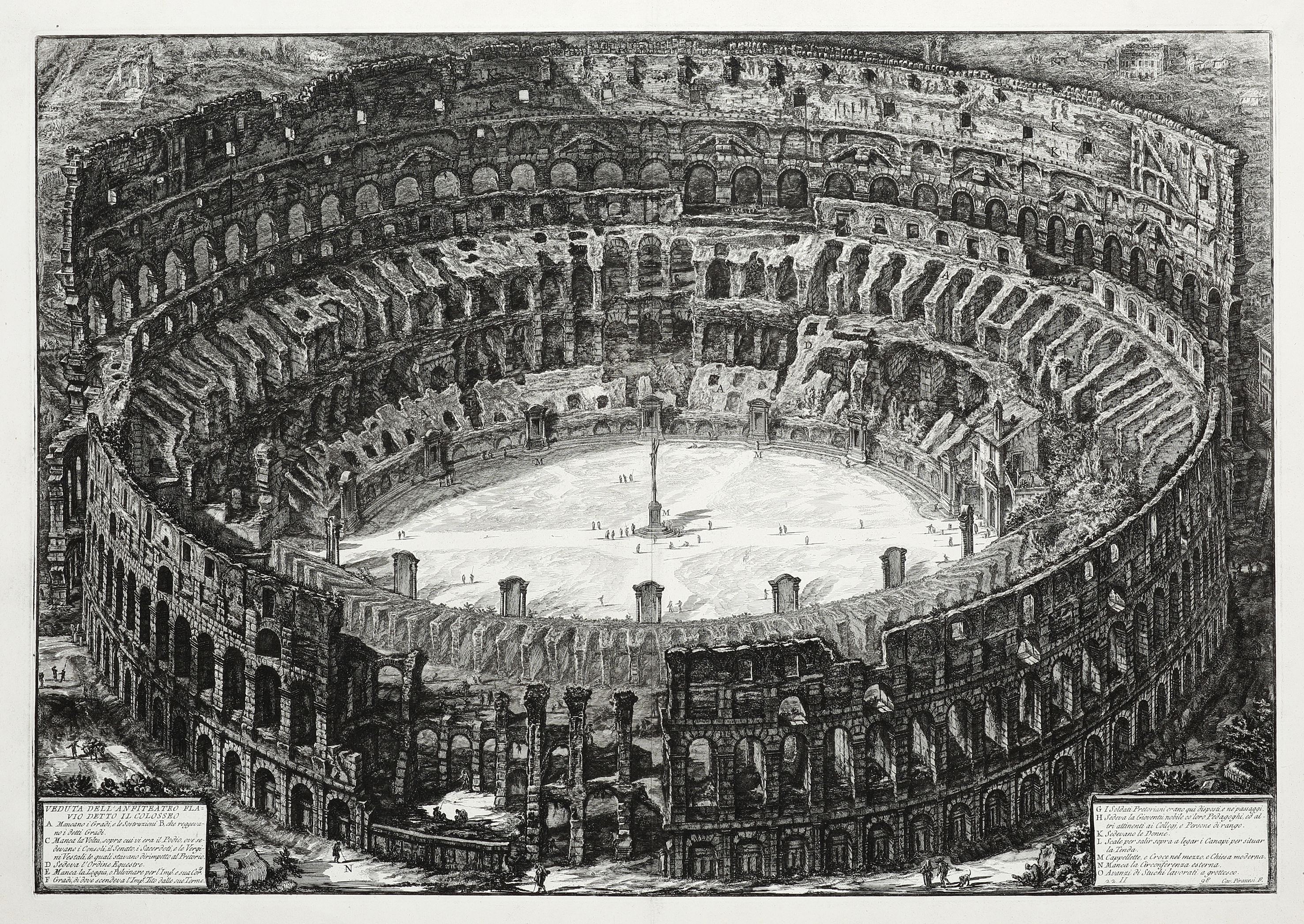
Rare early issue of Piranesi’s famous view of the Colosseum. Piranesi had previously created three views of the Colosseum, Rome’s most iconic ruin, and his mastery of perspective allowed him to capture this extraordinary aerial view of the ancient amphitheater. … Read Full Description
$A 4,750
Within Australia
All orders ship freewithin Australia
Rest of the World
Orders over A$300
ship free worldwide
Full Title:
Date:
Condition:
Technique:
Image Size:
Paper Size:
Genuine antique
dated:
Description:
Rare early issue of Piranesi’s famous view of the Colosseum.
Piranesi had previously created three views of the Colosseum, Rome’s most iconic ruin, and his mastery of perspective allowed him to capture this extraordinary aerial view of the ancient amphitheater. By filling the entire sheet with the monument and placing tiny figures at its center, Piranesi powerfully conveys the immense scale of the ruin, while the bird’s-eye perspective unveils its architectural layout and structural form. His detailed labels reflect his meticulous antiquarian research, indicating the seating arrangements for various ranks of Roman society, from the emperor and his court to the young nobles with their tutors. The overall dark tone of the image, characteristic of Piranesi’s later Vedute, evokes the mood of moonlight illuminating the Colosseum—a setting he often studied during his explorations of ruins at night. Only the center of the arena, where small figures gather around the monumental cross, is bathed in light. This crucifix, along with the stations of the cross surrounding the arena, was installed by Pope Benedict XIV in 1743 to consecrate the space, believed to be the site where many early Christians were martyred.
From: Piranesi,G. Vedute di Roma.
Giovanni Battista Piranesi (1720 - 1778)
Piranesi was an Italian Classical archaeologist, architect, and artist, famous for his etchings of Rome and his series on prisons, Le Carceri d'Invenzione. His father was a stonemason. His brother Andrea introduced him to Latin literature and ancient Greco-Roman civilization, and later he was apprenticed under his uncle, who was a leading architect in Magistrato delle Acque, the state organization responsible for engineering and restoring historical buildings. From 1740, he had an opportunity to work in Rome as a draughtsman for Marco Foscarini, the Venetian ambassador of the new Pope Benedict XIV. He resided in the Palazzo Venezia and studied under Giuseppe Vasi, who introduced him to the art of etching and engraving of the city and its monuments.
Exchange rates are only indicative. All orders will be processed in Australian dollars. The actual amount charged may vary depending on the exchange rate and conversion fees applied by your credit card issuer.
Join our exclusive mailing list for first access to new acquisitions and special offers.