Within Australia
All orders ship freewithin Australia
Rest of the World
Orders over A$300
ship free worldwide
Artist:
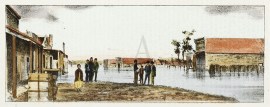
The first engraved view of Bowen, Queensland, made by William Westall (1781-1850), the artist on board Matthew Flinders important voyage of exploration on H.M.S. Investigator. On 18th July 1801, the H.M.S Investigator with 88 men and two cats, including the famous Trim … Read Full Description
$A 750
Within Australia
Rest of the World
Orders over A$300
ship free worldwide
Full Title:
Date:
Artist:
Condition:
Technique:
Image Size:
Paper Size:
Genuine antique
dated:
Description:
The first engraved view of Bowen, Queensland, made by William Westall (1781-1850), the artist on board Matthew Flinders important voyage of exploration on H.M.S. Investigator.
On 18th July 1801, the H.M.S Investigator with 88 men and two cats, including the famous Trim set sail. The Investigator sighted Cape Leeuwin, Western Australia on 6th December 1801 and in February 1802, they entered Spencer’ Gulf, which Flinders named for the second Earl Spencer. Flinders, and his hungry crew members, discovered Kangaroo Island on 21 March 1802 after landing near Kangaroo Head on the north coast of Dudley Peninsula. Flinders wrote in his journal that the whole ships company was employed in the skinning and cleaning of kangaroos. In gratitude for such a supply, he named it Kangaroo Island.
FRIDAY 20 AUGUST 1802 [EAST COAST. PORT BOWEN].
Instead of a bight in the coast, we found this to be a port of some extent; which had not only escaped the observation of captain Cook, but from the shift of wind, was very near being missed by us also. I named it PORT BOWEN, in compliment to captain James Bowen of the navy; and to the hilly projection on the south side of the entrance (see the sketch), I gave the appellation of Cape Clinton, after colonel Clinton of the 85th, who commanded the land, as captain Bowen did the sea forces at Madeira, when we stopped at that island.
Flinders sailed from England on 18 July 1801, and during the next two years he surveyed the entire south coast of Australia from Cape Leeuwin to Bass Strait, the east coast, and the Gulf of Carpentaria. He returned to Port Jackson in 1803 having completed the first circumnavigation of Australia. On the return journey, Flinders was detained by the French in Mauritius for six and a half years and was not released until June 1810. He devoted the remainder of his life to the publication of this work, which was formally published one day before his death on 19 July 1814.
William Westall (1781 - 1850)
Westall was a landscape artist born at Hertford, England. He was taught to draw by his elder half-brother Richard (1765-1836), a water-colour painter, Royal Academician and painting teacher to Princess Victoria. In 1799 he was admitted to the Royal Academy School, where he was studying when at 19 he was appointed landscape artist with Matthew Flinders' Investigator expedition to Australia, at a salary of 300 guineas. During the voyage he made a large number of pencil-and-wash landscapes in places visited by the Investigator and a series of coast profiles in pencil. When the Porpoise ran aground on Wreck Reef his sketches were 'wetted and partly destroyed' and, while Westall travelled in China, the drawings, regarded as part of the official record of the voyage, were taken by Lieutenant Robert Fowler to England. There, at the suggestion of Sir Joseph Banks, they were handed to Richard Westall to be 'restored to a proper state'. After spending some time in China and India Westall returned to London in February 1805 and sought access to the sketches to paint a picture for exhibition at the Royal Academy and showed a View of the Bay of Pines at the academy later in the year. In the summer of 1805 Westall went to Madeira and twelve months later to Jamaica. After returning to England he painted a series of water-colour views of the places he had visited and these were shown in a Brook Street gallery and at the Associated Artists' exhibition in 1808. Later he received commissions from the Admiralty to paint nine pictures to illustrate Flinders' A Voyage to Terra Australis … (1814), and was engaged by several London publishers to paint water-colours to be reproduced as aquatints.
Exchange rates are only indicative. All orders will be processed in Australian dollars. The actual amount charged may vary depending on the exchange rate and conversion fees applied by your credit card issuer.
Join our exclusive mailing list for first access to new acquisitions and special offers.