Within Australia
All orders ship freewithin Australia
Rest of the World
Orders over A$300
ship free worldwide
Artist:
Very rare and historically important, early c.18th separately issued hand coloured aquatint of Sydney Cove. This the very rare 2nd state of two, identified by the much shorter pennant and the visible shadowing where the aquatint plate was altered. The … Read Full Description
$A 18,500
Within Australia
All orders ship freewithin Australia
Rest of the World
Orders over A$300
ship free worldwide
Full Title:
Date:
Artist:
Engraver:
Condition:
Technique:
Image Size:
Frame Size:
Genuine antique
dated:
Description:
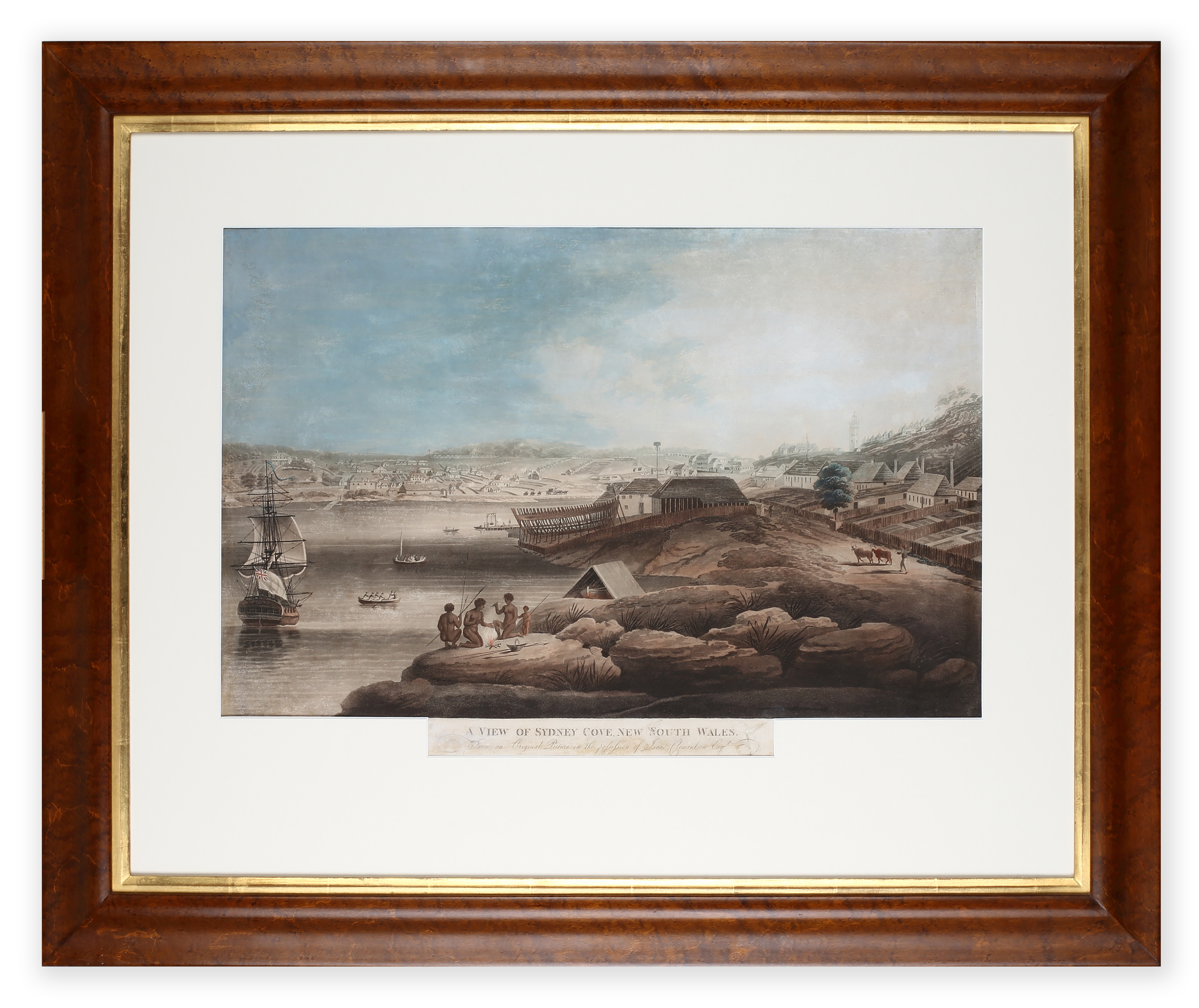
Very rare and historically important, early c.18th separately issued hand coloured aquatint of Sydney Cove.
This the very rare 2nd state of two, identified by the much shorter pennant and the visible shadowing where the aquatint plate was altered. The publication details; London Published April 10. 1804, by F. Jukes, No. 10, Howland Street. are the same in both states.
We have located only one other example of this 2nd state in an institutional collection, held at the British Library, with provenance to Baroness Lucas of Crudwell.
The original drawing for this aquatint, now lost, was most likely produced in the colony by the convicted artist Thomas Watling in about 1800 and re-drawn by Edward Dayes for the London engraver Francis Jukes. This is one of the largest and most detailed of all early colonial printed views, often illustrated and cited for its historic depiction of the dwellings, commercial buildings and activities in Sydney’s early years.
The view is taken from Dawes Point looking eastward across Sydney Cove (present day Circular Quay), with houses to the right and in the background across the water. A group of Aborigines are seated around a fire in the foreground. On the eastern foreshore, Governor King can be seen driving towards the Tank Stream in his coach, the tanks which gave the stream its name are visible just above the ship in dry dock in the mid foreground. This is the brig Portland, the first attempt at local ship building, initiated by Governor Hunter in 1797, the ship was not launched until 1816 and renamed Henrietta Elizabeth.
Sold with a modern copy of the rare key which identifies numerous buildings and places of interest.
Reference
Hunt & Davidson Sydney Views 1788-1888 2007 Plates 34 & 35 page 632/63
Thomas Watling (1762 - 1806)
Watling was a convict and artist, born in Dumfries, his parents died during his infancy and he was brought up by a maiden aunt. His education, which was well above average, obviously included a thorough grounding in art and eventually he formed his own 'academy'. In 1788 he was charged with forging guinea notes on the Bank of Scotland. He denied his guilt, but rather than risk conviction and execution he asked to be transported and was sentenced to fourteen years. In July 1791 Watling was one of 410 convicts who sailed in the convict transport the Pitt for New South Wales. He escaped at Cape Town, but was soon arrested by the Dutch, imprisoned and taken aboard the Royal Admiral, in which he reached Sydney on 7 October 1792. He appears to have been assigned almost immediately to the surgeon-general, John White, an ardent naturalist, who made extensive use of his artistic skill. When White left the colony in December 1794 it is thought that Watling may have been assigned to the judge-advocate, David Collins. Watling's prospects improved with the arrival of Governor John Hunter, himself an enthusiastic and able artist. Within a year, in September 1796 Watling was given a conditional pardon and on 5 April 1797 it was made absolute. While in the colony Watling had a son, presumably by a convict woman, and when he left Sydney he took the child with him. From 1801 to 1803 he lived in Calcutta, earning a precarious living as a miniature painter. He returned to Scotland and on 10 January 1806 was tried at Edinburgh for a series of forgeries allegedly committed at Dumfries between November 1804 and March 1805. He was discharged on a verdict of 'not proven'. Later he moved with his son to London where, in indigent circumstances and suffering from cancer of the left breast, he applied to Hunter, now an admiral, for help and received some assistance from members of the Royal Academy. Neither the date nor place of his death are known. Ref: Source ADB
Exchange rates are only indicative. All orders will be processed in Australian dollars. The actual amount charged may vary depending on the exchange rate and conversion fees applied by your credit card issuer.
Join our exclusive mailing list for first access to new acquisitions and special offers.