Capt. Robert Westmacott (1801 - 1870)
Artist and army officer born in England in 1801, a member of the noted Westmacott family of artists and sculptors. His uncle, Sir Richard Westmacott (1775–1856), was one of the leading British sculptors of the early nineteenth century, and the family circle included several artists of distinction. Robert pursued a military career, receiving a commission in the 4th (King’s Own) Regiment of Foot, in which he eventually attained the rank of captain.
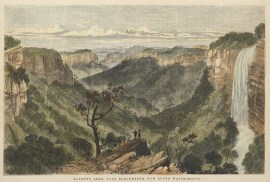
Westmacott was posted to New South Wales in the mid-1830s, at a time when the colony was expanding rapidly and European settlement was spreading inland. He developed a talent for sketching, particularly landscapes and topographical views. During his residence in Australia he travelled through both New South Wales and Van Diemen’s Land (Tasmania), recording harbour scenes, townships, and surrounding countryside. His drawings capture Sydney Cove, Hobart Town, Parramatta, and other early colonial sites at a formative period in their development.
On his return to England, Westmacott arranged for a selection of his sketches to be published as lithographs. The resulting series, Views in Australia, appeared in London between 1838 and 1840, issued in several parts. Hand-coloured examples, marketed through subscription, presented to a British audience the landscapes, architecture, and life of the colonies. Although modest in number, these prints are regarded as significant both artistically and historically. They provide some of the earliest published pictorial records of colonial Sydney and Hobart, predating the wider circulation of works by Conrad Martens and others.
Westmacott’s work stands in the tradition of the soldier-artist, combining accurate observation with picturesque composition. His lithographs, often delicately coloured, were aimed at a metropolitan public curious about distant settlements. While not as prolific or technically refined as Martens, his views are valued for their rarity and their directness of vision. They remain important documentary sources for historians of early Australia.
Westmacott returned permanently to England after his Australian service. He does not appear to have pursued an extensive artistic career thereafter, though examples of his prints survive in major institutional collections, including the National Library of Australia and the State Library of New South Wales. He died in 1870.
View other items by Capt. Robert Westmacott