C1878

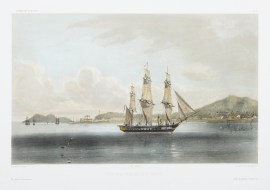
Wreck of The Loch Ard Near Sherbrook River

Scarce c.19th engraving of the Loch Ard just before it was shipwrecked near Sherbrook River, Victoria. The Loch Ard left Gravesend, Kent on 1 March 1878, bound for Melbourne, commanded by Captain George Gibb and with a crew of 36 men and … Read Full Description

$A 125

In stock

S/N: IAN-SHIPS-AA-780708120–496579
(DRW 06)
Free Shipping
Bookplate: Alice Mary Sharp BOOK PLATES

Within Australia

All orders ship freewithin Australia

Bookplate: Alice Mary Sharp BOOK PLATES

Rest of the World

Orders over A$300
ship free worldwide

See Shipping page for Terms & Conditions

Details

Full Title:

Wreck of The Loch Ard Near Sherbrook River

Date:

C1878

Condition:

In good condition.

Technique:

Engraving.

Image Size: 

350mm 
x 215mm

Paper Size: 

400mm 
x 282mm
AUTHENTICITY
Wreck of The Loch Ard Near Sherbrook River - Antique Print from 1878

Genuine antique
dated:

1878

Description:

Scarce c.19th engraving of the Loch Ard just before it was shipwrecked near Sherbrook River, Victoria.

The Loch Ard left Gravesend, Kent on 1 March 1878, bound for Melbourne, commanded by Captain George Gibb and with a crew of 36 men and 18 passengers, a total of 54 people. She was loaded with a general mixed cargo weighing 2275 tons. On 1 June she was approaching Melbourne. The crew expected to sight land but encountered heavy mist. The inquest determined that, unable to see the Cape Otway lighthouse; having faulty chronometers on board; and not having been able to take a reading to establish his exact position due to bad weather conditions over the previous few days, Captain Gibb was unaware how close he was running to the coast. The mist lifted around 4am, revealing breakers and cliff faces. The lookout called “breakers ahead!” Capt Gibb quickly ordered sail to be set to wear ship and get clear of the coast, but they were unable to do so in time, and ran aground on a reef. The masts and rigging came down, killing some people on deck and preventing the lifeboats from being launched effectively. The ship sank within 10 or 15 minutes of striking the reef.

From the original edition of the Illustrated Australian News. Depicting the Wreck of The Loch Ard Near Sherbrook River.

Collections:
University Queensland: Identifier 991000982479703131
State Library Victoria: PCINF IAN 04-09-76 P.133
National Library Australia: Bib ID 2495305
State Library New South Wales: CALL NUMBERS F079/55, TN380
Royal Geographic Society SA: RGS Special Coll. 079.94 I29d

References:
Syme, E. & D, Illustrated Australian News. ISSN 2208-5386.

J.W.C. - James Waltham Curtis (1839 - 1901)

Curtis was a painter, illustrator and photographic colourist. A regular exhibitor at the Black and White exhibitions, Victorian Academy of Arts, in the 1880s. painter, illustrator and photographic colourist, was born in Devonshire. He had worked on the London Graphic and Sketcher before coming to Victoria, probably with the goldrush. In Melbourne he worked first as a colourist for Johnstone, O’Shannessy and Co., then as an illustrator on the Illustrated Australian News succeeding O.R. Campbell. He often signed his works with the monogram.

View other items by J.W.C. - James Waltham Curtis

Samuel Calvert (1828 - 1913)

British born in England in 1828, Calvert trained in the demanding craft of wood engraving, a medium essential to nineteenth-century illustrated books and newspapers.

He emigrated to Australia during the great period of colonial expansion and settled in Melbourne, where a growing press and publishing industry created strong demand for skilled reproductive artists capable of translating drawings into printable blocks.

By the 1850s and 1860s Calvert had established himself as a leading engraver in Victoria. He worked for major colonial publications, most notably the Illustrated Australian News and other illustrated papers that documented civic ceremonies, public buildings, exhibitions, shipping, exploration, and social life. His engravings helped shape the visual record of early Melbourne and the Australian colonies, rendering architecture, landscapes, and historical events with clarity and technical assurance.

Calvert was particularly associated with large commemorative and documentary projects, including views connected with Melbourne’s international exhibitions and other displays of colonial progress. His work bridged art and reportage: while based on artists’ drawings, his engravings required interpretive skill to convey depth, texture, and atmosphere within the linear language of the wood block. Through this process he played a central role in transforming colonial events into widely circulated images.

In addition to his professional practice, Calvert was active in artistic circles in Victoria and contributed to the establishment of professional standards in the graphic arts. He also trained or influenced younger engravers, helping to localise a craft that had previously depended heavily on British production.

Samuel Calvert died in 1913, leaving a substantial body of work that today serves as an important visual archive of nineteenth-century Australia. His engravings are represented in major Australian libraries and collections and remain valued for both their artistic quality and their documentary significance.
View other items by Samuel Calvert

Related Products

Choose currency

Exchange rates are only indicative. All orders will be processed in Australian dollars. The actual amount charged may vary depending on the exchange rate and conversion fees applied by your credit card issuer.

Account Login

The List

Join our exclusive mailing list for first access to new acquisitions and special offers.