Within Australia
All orders ship freewithin Australia
Rest of the World
Orders over A$300
ship free worldwide
Artist:
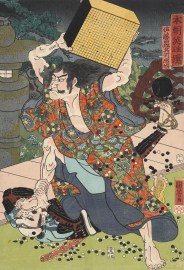
Utagawa Kuniyoshi (1797–1861) Rare c.19th-century ōban tate-e colour woodblock print, signed Ichiyūsai Kuniyoshi ga within the red gourd-shaped cartouche at lower right, with the artist’s Yoshi kiri (paulownia flower) seal. The print depicts the warrior Yamamoto Kansuke Haruyuki mortally wounded at the Battle … Read Full Description
$A 950
Within Australia
Rest of the World
Orders over A$300
ship free worldwide
Full Title:
Date:
Artist:
Condition:
Technique:
Image Size:
Paper Size:
Genuine antique
dated:
Description:
Utagawa Kuniyoshi (1797–1861)
Rare c.19th-century ōban tate-e colour woodblock print, signed Ichiyūsai Kuniyoshi ga within the red gourd-shaped cartouche at lower right, with the artist’s Yoshi kiri (paulownia flower) seal.
The print depicts the warrior Yamamoto Kansuke Haruyuki mortally wounded at the Battle of Kawanakajima, being given a drink of water by a retainer.
From: The series; Honchô yeiyû kagami (Mirror of our Country’s Heroes.)
Size: ōban tate-e
Date seals: 1858 (Ansei 5), 6th month
Publisher: Kaga-ya Kichiemon
Censor seal: Censor seals were abolished and only a date seal was required.
History of censor seals.
Restrictive edicts for print publishers by the shogunate were issued over many years:
1790 – The shogunate issued a new edict to control the print industry, it demanded that single-sheet prints with text were required to be checked by censors prior to publication.
1796 – No images that named and depicted unlicensed prostitutes (who worked outside the Yoshiwara district)
1800 – Large head portraits of women or pictures of luxurious dresses were unacceptable
1804 – Named warriors dating from after 1573 were regarded as inappropriate
1842 – Banned prints of actors and beauties and only allowed prints focusing on loyalty and filial piety.
1842 – Restricted the use of colour to no eight and the price to 16 mon (equal to a bowl of noodles)
1853 – Last month of 1853 the two nanushi name seals were replaced with a new aratame seal indicating the cyclic date of the year and the month of inspection.
1868 – Removal of the ban of depicting contemporary events
Utagawa Kuniyoshi (1797 - 1861)
Born in Edo (present-day Tokyo) in 1797, Kuniyoshi was the son of a silk dyer, Yanagiya Kichiemon, and was given the childhood name Yoshisaburō. At the age of fourteen, he entered the Utagawa School of ukiyo-e under the direction of Utagawa Toyokuni I (1769–1825). It was Toyokuni who bestowed on him the name Utagawa Kuniyoshi, combining elements of “Toyokuni” and “Yoshisaburō.” Although Kuniyoshi is now universally known as Utagawa Kuniyoshi he also used the names: Ichiyûsai Kuniyoshi, Chô-ô-rô Kuniyoshi, Ikusa Kuniyoshi, and Saihôsa Kuniyoshi. Kuniyoshi completed his apprenticeship in 1814 and began his career as an independent artist, initially producing actor portraits in the manner of his teacher, though with limited success. His breakthrough came in 1827 with the publication of the first six designs from The 108 Heroes of the Suikoden, inspired by a c.14th Chinese novel recounting the exploits of a band of 108 righteous bandits and rebels. The series established Kuniyoshi’s reputation and remains among his most celebrated works. In 1843, he produced the famous triptych In Minamoto’s Residence the Earth Spider Appears as a Monster, a work widely understood as a satire of Mizuno Tadakuni, the shogun’s chief councillor and enforcer of strict censorship policies. Its immense popularity, evidenced by the multiple editions brought Kuniyoshi both acclaim and official censure, cementing his place as one of the most dynamic and politically engaged ukiyo-e masters of the c.19th.
Exchange rates are only indicative. All orders will be processed in Australian dollars. The actual amount charged may vary depending on the exchange rate and conversion fees applied by your credit card issuer.
Join our exclusive mailing list for first access to new acquisitions and special offers.