Within Australia
All orders ship freewithin Australia
Rest of the World
Orders over A$300
ship free worldwide
Mapmaker:
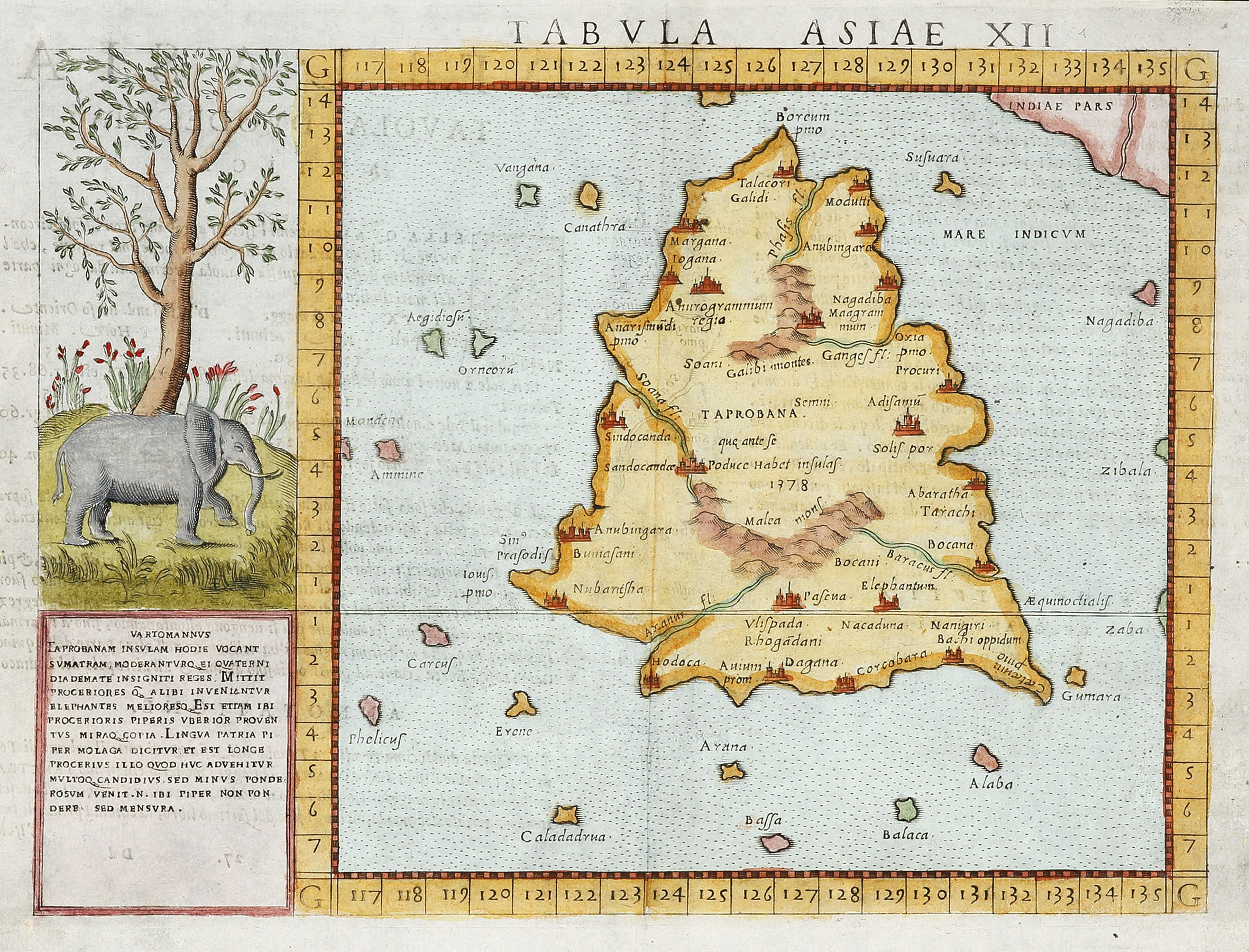
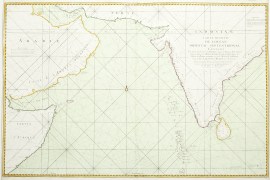
Very early c.16th map of Ceylon with a superb woodcut of the ‘Pascua Elephantum’ (an elephant at pasture) which Ptolemy wrote of in his Geographia, of seeing at the base of the Malli Mountains. In the lower left is a … Read Full Description
Sold
Within Australia
All orders ship freewithin Australia
Rest of the World
Orders over A$300
ship free worldwide
Full Title:
Date:
Mapmaker:
Condition:
Technique:
Image Size:
Paper Size:
Genuine antique
dated:
Description:
Very early c.16th map of Ceylon with a superb woodcut of the ‘Pascua Elephantum’ (an elephant at pasture) which Ptolemy wrote of in his Geographia, of seeing at the base of the Malli Mountains.
In the lower left is a decorative cartouche which includes a note indicating that the island was a rich source of ivory. In ancient times, Sri Lanka was known by various names, Ptolemy named it Taprobana, the Arabs Serendib, the Portuguese called it Ceilo and the British, Ceylon. Much confusion existed among medieval mapmakers as to the identities of the islands of Taprobana and Sumatra which arose primarily from the descriptions in the ancient texts which stated that Taprobana was the largest island in the world. This was later contradicted by Marco Polo in his Il Milione in which he stated that it was Java Minor (Sumatra) that was in fact the largest island. As Sumatra was virtually unknown to most medieval mapmakers their primary concern was the placement of Taprobana on maps. Invariably it was incorrectly positioned off the southeast coast of Arabia but once the accounts of Marco Polo were revealed at the end of the thirteenth century, the eastern limits of the Indian Ocean were greatly expanded and the question as to the identity of the islands became more critical for mapmakers. The Portuguese arrived on the island in 1505 and by 1518 had built a fort in Colombo, enabling them to control strategic coastal areas they had previously captured. Once Portuguese information and charts were copied, the position of Ceylon and the confusion with Sumatra was corrected.
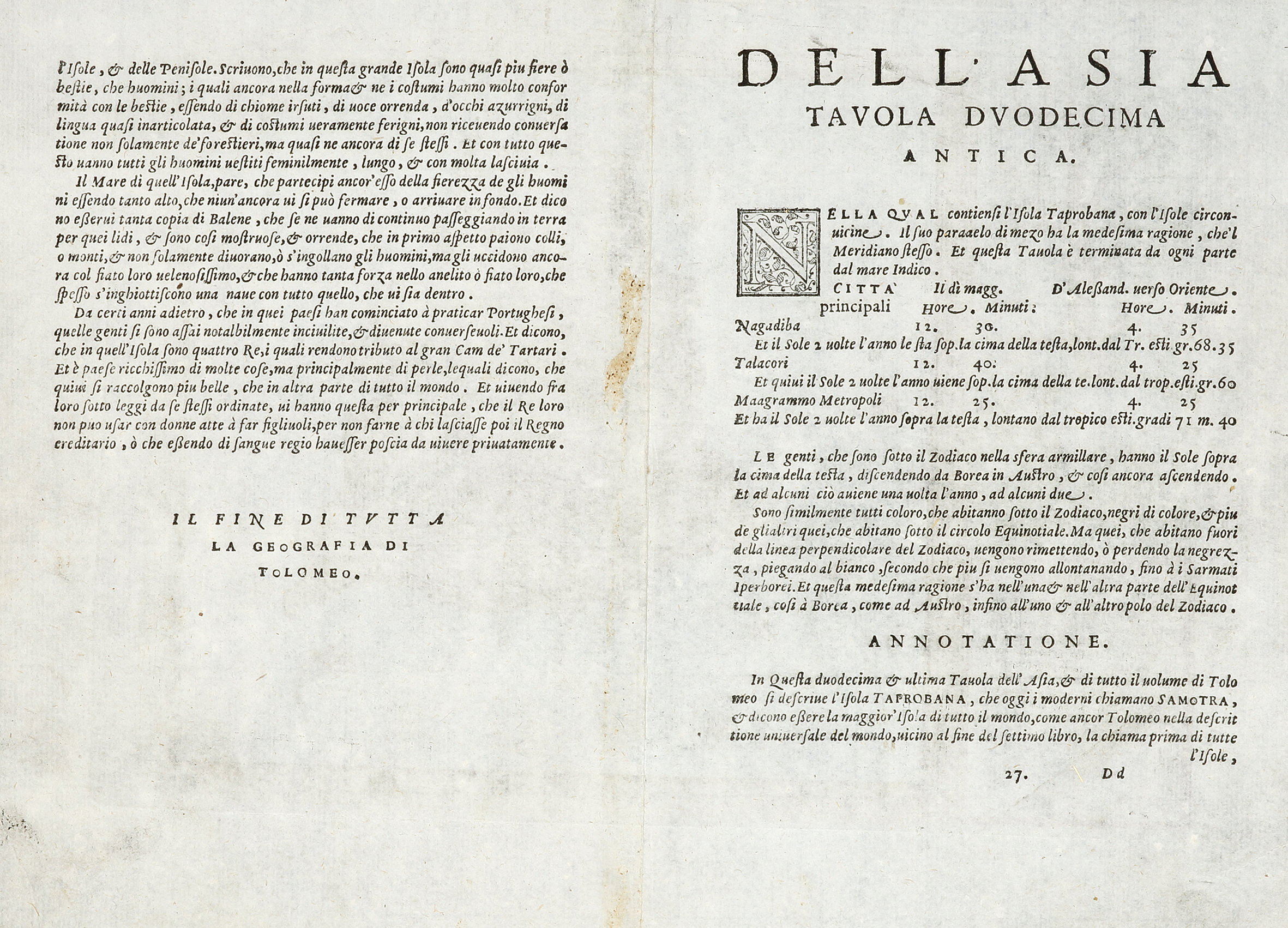
This issue of the map is from the third edtion of Ruscelli’s translation of the Venice edition of 1561.
From, Ptomley, Malombra. La Geografia di Claudio Tolomeo Alessandrino, gia Tradotta di Greco in Italiano da M. Giero Ruscelli
Ref: Stevens
Girolamo Ruscelli (1504 - 1566)
Girolamo Ruscelli was a prominent c.16th Italian polymath, mathematician, cartographer, and alchemist. Born in Viterbo and lived in various cities during his life including; Aquilea, Padua, Rome, Naples, and finally settled in Venice until his death.He wrote on a wide range of subjects and often worked on behalf of third parties, including a partnership with publisher Plinio Pietrasanta until 1555 when he was tried by the Inquisition for the unlicensed publication of a satirical poem. Most of his later works were published by Vincenzo Valgrisi. He wrote an immensely popular book on alchemy under the pseudonym Alessio Piemontese, published in 1555. The book, De Secreti Del Alessio Piemontese, included recipes for alchemical compounds, cosmetics, dyes, and medicines and was translated into numerous languages. Ruscelli's translations of various classics, including the Decameron and Orlando Furioso, were also popular. His translation of Ptolemy's, Geografia included 69 maps, 40 of which were contemporary and based on maps compiled by Giacomo Gastaldi in 1548. Ruscelli also compiled a Rimario (rhyming dictionary) that remained in use until the 19th century.
Exchange rates are only indicative. All orders will be processed in Australian dollars. The actual amount charged may vary depending on the exchange rate and conversion fees applied by your credit card issuer.
Join our exclusive mailing list for first access to new acquisitions and special offers.