Within Australia
All orders ship freewithin Australia
Rest of the World
Orders over A$300
ship free worldwide
Artist:
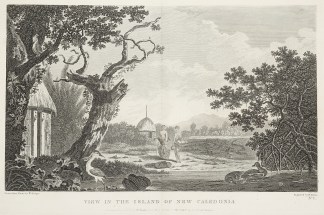
Rare c.18th engraving from the official British Admiralty sanctioned edition of the accounts of Cook’s third and final voyage. While on Tongatapu from 10 June to 10 July 1777, Cook and his men recorded Tongan life, ceremonies and culture. They … Read Full Description
Sold
Within Australia
All orders ship freewithin Australia
Rest of the World
Orders over A$300
ship free worldwide
Full Title:
Date:
Artist:
Condition:
Technique:
Image Size:
Paper Size:
Genuine antique
dated:
Description:
Rare c.18th engraving from the official British Admiralty sanctioned edition of the accounts of Cook’s third and final voyage.
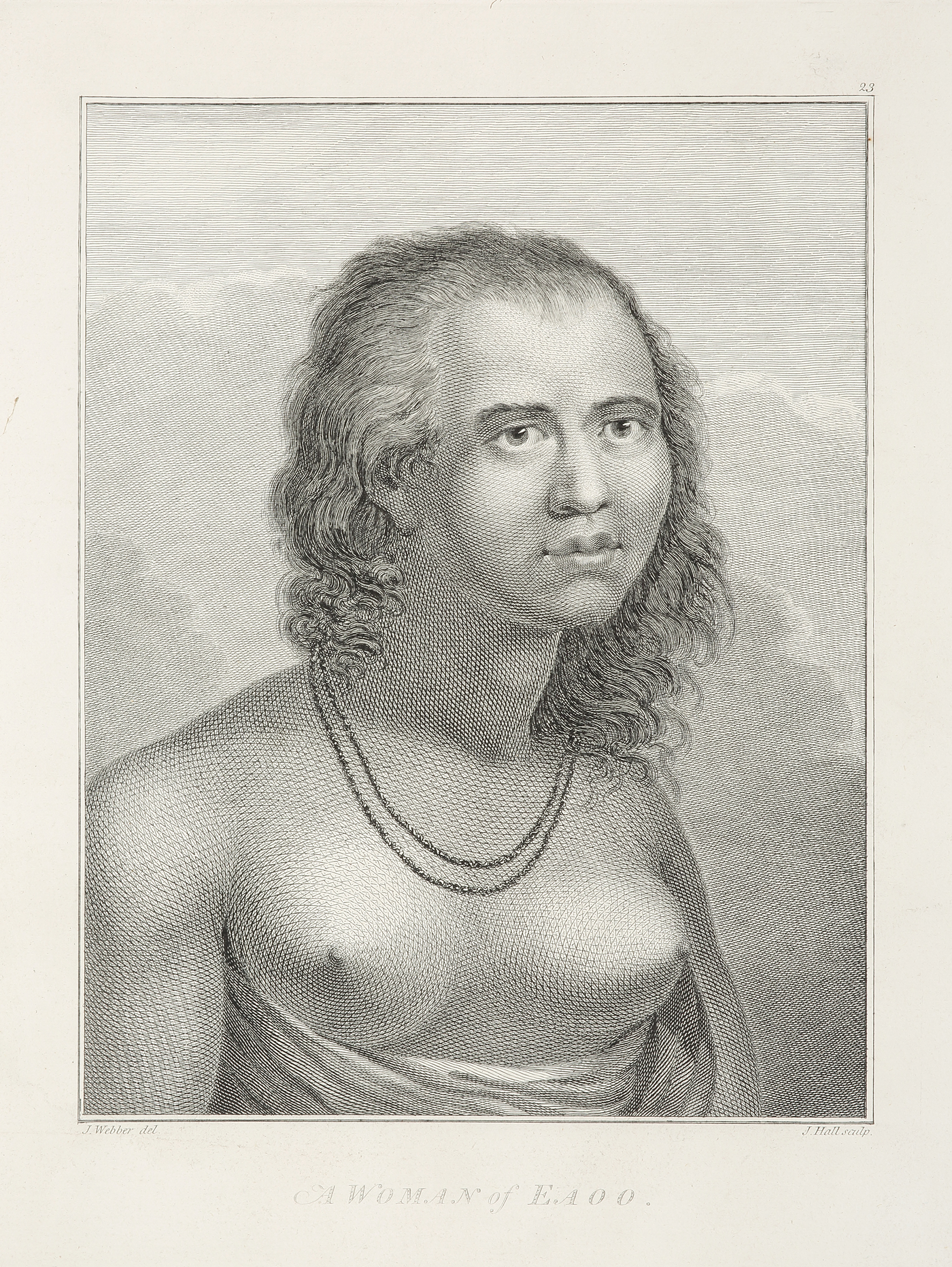
While on Tongatapu from 10 June to 10 July 1777, Cook and his men recorded Tongan life, ceremonies and culture. They arrived at the island of Eaoo (Eua) on 12th June, 1777 where Webber made this portrait.
‘The Women are in General handsome tho’ many among them somewhat masculine…They wear much the same kind of Clothing as the men & wear necklaces of Shells and the Legs of Fowls & some made of a small black Seed. They are clothed from the Waist to the Knees & all the other parts are exposed. The lower Class of young women have their Hair cut short, while those of the Agee order wear it long & flowing down their Shoulders which had a graceful and a truly elegant Appearance..’ Cooks Journals III, 2, 1042.
John Webber’s first encounter with the people of the Pacific came in January 1777 when Cook arrived at Adventure Bay, Van Diemen’s Land (Tasmania). He was astonished at their unashamed nakedness. In his first painted version of this portrait, Webber included the man’s full torso, covered with ceremonial scars. Cook described the appearance of the Tasmanian’s as ‘far from disagreeable‘. ‘The keloid scars so typical of the Australian aboriginal adult male; came from cuts incised with a flint or other sharp stone knives, which were often rubbed with ashes of clay to enlarge the effect. They denoted initiation into manhood, but other functions were totemistic and aesthetic.’ Cook, Journals III, I, 52.
From Cook & King, A Voyage to the Pacific Ocean, for making Discoveries in the Northern Hemisphere. Performed under the Direction of Captains Cook, Clerke, and Gore, in His Majesty’s Ships the Resolution and Discovery; in the Years 1776, 1777, 1778, 1779, and 1780.
References:
Beddie, M. Bibliography of Captain James Cook, RN,FRS, Circumnavigator. Sydney 1970: 743-23, p.359A
Joppien,R. & Smith, B. The Art of Captain Cook’s Voyages; Vol. I, II & III. Melbourne 1985-1987 : 3.64A, ill.p.328.2.
Forbes, D. Hawaiian National Bibliography 1780- 1830. Honolulu /Sydney, 1999/2003 62; cf.
Carter, J. & Muir, P. Printing and the Mind of Man London 1983 223.
Sabin, J. A Dictionary of Books Relating to America, from its Discovery to the Present Time. New York. (1936) 1967. 16250.
Hill, J. The Hill Collection of Pacific Voyages. San Diego 1974 321.
Collections:
State Library New South Wales: CALL NUMBERS RB/F990A/9
State Library Victoria: RARELT 910.41 C773VS
State Library South Australia: Special Collection: 919 C771
John Webber (1752 - 1793)
Born in London in 1752, the son of a Swiss sculptor. He received his early artistic training in London before continuing his studies in Paris under Jean-Georges Wille, where he developed the precise draughtsmanship that later distinguished his work. By the early 1770s he had returned to Britain and established himself as a promising young artist.
In 1776 Webber was appointed official artist to James Cook's 3rd and final voyage of exploration. The expedition, undertaken in HMS Resolution and HMS Discovery, sought a northern passage between the Pacific and Atlantic Oceans. During the voyage, which lasted until 1780, Webber produced an extensive visual record of the regions visited, including the Pacific Islands, the northwest coast of North America, and parts of eastern Asia. His drawings documented landscapes, settlements, flora, fauna, and the inhabitants encountered by the expedition, particularly in places such as Tahiti, Hawai‘i, and Nootka Sound. Webber was present during the final stages of the voyage, including the events surrounding Cook’s death at Kealakekua Bay in 1779. His work from this period includes some of the earliest European visual representations of Hawaiian society. Throughout the expedition he worked under demanding conditions, often producing rapid sketches in the field which were later refined into finished compositions.
Following his return to Britain, Webber prepared many of his drawings for engraving for the official account of the voyage, A Voyage to the Pacific Ocean, published in 1784. These images played a central role in shaping European understanding of the Pacific and its peoples. His work combined empirical observation with the compositional conventions of late eighteenth-century European art, and it contributed to the visual culture of exploration. Webber exhibited at the Royal Academy in London and continued to produce paintings and drawings based on his travels, as well as other subjects. He was elected an Associate of the Royal Academy in 1785, reflecting his professional standing. His later work included both exhibition pieces and commissioned works, though he remained best known for his Pacific imagery.
John Webber died in London in 1793 at the age of forty-one. His surviving drawings and paintings are held in major collections, including the British Museum and other institutions, and they remain an important visual record of Cook’s Third Voyage.
Exchange rates are only indicative. All orders will be processed in Australian dollars. The actual amount charged may vary depending on the exchange rate and conversion fees applied by your credit card issuer.
Join our exclusive mailing list for first access to new acquisitions and special offers.