C1814

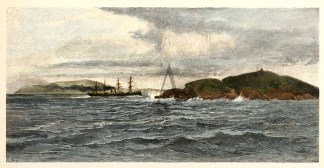
Cape Chatham: taken Dec.8.1801 at 7 a.m.

Rare c.19th engraved coastal profile of Cape Chatham, present day Mandalay Beach, Western Australia by William Westall, artist on board Matthew Flinders seminal survey of the Australia on the Investigator. First discovered by George Vancouver aboard the HMS Discovery in … Read Full Description

Sold

S/N: FAVTTA-CP-1702-WC–218295
(C097)
Free Shipping
[AUSTRALIA-SA] Gulf of St.Vincent Backst… South Australia

Within Australia

All orders ship freewithin Australia

[AUSTRALIA-SA] Gulf of St.Vincent Backst… South Australia

Rest of the World

Orders over A$300
ship free worldwide

See Shipping page for Terms & Conditions

Details

Full Title:

Cape Chatham: taken Dec.8.1801 at 7 a.m.

Date:

C1814

Condition:

In good condition.

Technique:

Hand coloured copper engraving.

Image Size: 

400mm 
x 40mm

Paper Size: 

435mm 
x 75mm
AUTHENTICITY
Cape Chatham: taken Dec.8.1801 at 7 a.m. - Antique View from 1814

Genuine antique
dated:

1814

Description:

Rare c.19th engraved coastal profile of Cape Chatham, present day Mandalay Beach, Western Australia by William Westall, artist on board Matthew Flinders seminal survey of the Australia on the Investigator.

First discovered by George Vancouver aboard the HMS Discovery in 1791. The island was subsequently renamed as Chatham Island. Flinders arrived at Cape Chatham on 08.12.1801. At day light, the ship was found to have been carried to the eastward, and neither Point D’Entrecasteaux nor the two white rocks were in sight but in the N. 19E., about eight miles, was a head not far from the extreme set in the evening. It afterwards proved to be a smooth steep rock, lying one mile from the main and is the land first made upon this coast by captain Vancouver who called it Cape Chatham.
Flinders:
Tuesday 8 December 1801  The wind was then at south-west, and we stretched onward until one in the morning, before tacking to the north-west for the land. At daylight the ship was found to have been carried to the eastward, and neither Point D’Entrecasteaux nor the two white rocks were in sight; but in the N. 19° E., about eight miles, was a head not far from the extreme set in the evening. It afterwards proved to be a smooth, steep rock, lying one mile from the main; and is the land first made upon this coast by captain Vancouver, who called it Cape Chatham. Its latitude is very nearly 35° 3′ south, longitude 116° 29′ east, and it was sketched by Mr. Westall.
Whilst stretching in for the shore, with the ship’s head north-west-by-north (magnetic) I took azimuths with two compasses on the binnacle; after which they were immediately placed on a stand near the taffrel and other azimuths taken. The variation resulting from the observations on the binacle was 5° 59′ west, and from those near the taffrel 8° 24′ west; affording another instance of the effect produced by changing the place of the compass. In 1803, and at twenty leagues to the west of Cape Leeuwin, we had 10° 4′ variation on the binnacle, with the head south-east; from which, and the above 5° 59′, the true variation off the cape, or such as would be obtained with the ship’s head at north or south, should be 7° 48′ west.*
[* The mode by which these, and other observations made with the compass on the binnacle, are reduced to what is conceived to be the true variation, is explained in the Appendix No. II, to the second volume.]
At seven o’clock we got sight of the two white rocks, which enabled me to take up the survey of the preceding evening; and we then bore away along the coast at the distance of four or five miles, with a pleasant breeze and fine weather.
Some parts of the shore between Point D’Entrecasteaux and Cape Chatham were not distinctly seen. That which is nearest to the cape lies in the line of N. 38° W. from its outer part, and presents an intermixture of steep cliffs and small sandy beaches, with a back land moderately high, and better covered with wood than that before described. On the east side of Cape Chatham the shore falls back to the northward, and makes a bight in which is a small reef of rocks. It then projects in a cliffy head, which lies S. 75° E. seven miles from the cape, and is called Point Nuyts in the French chart; upon the supposition, probably, that this was the first land seen by Nuyts in 1627. Beyond this point the coast trends very nearly east; but forms several projections, some of which are steep and others low; and between them are sandy bights where small vessels might obtain shelter from all northern winds. The hills lying at the back of the shore seemed to be barren, though trees grew thickly on their eastern sides; they are not high, but it was rare to perceive any thing of the interior country above them.
At noon the nearest parts of the coast were a steep and a more eastern low point, both distant about four miles; and from the bight between them was rising the first smoke seen upon this coast. Our situation at this time, and the principal bearings taken, were as under;
Latitude, observed to the north and south,
85°  7′  5″. Longitude by time keepers,
116  50. Point Nuyts, with Cape Chatham behind,
N. 75 W. Steep point, near the smoke,
N. 15 W. Furthest visible extreme ahead,
N. 84 E.
Soon after two o’clock we passed at the distance of five miles from a steep point which has a broad rock lying near it. This point, being unnamed and somewhat remarkable, I call _Point Hillier_; it lies in 35° 4′ south and 117° 9′ east. The coast extends from thence nearly east-by-south, without any considerable projection except at the furthest extreme then visible; and on coming up with it, at half-past five, it proved to be the Cape Howe of Vancouver. There is another Cape Howe upon this same coast, named by Captain Cook, which makes it necessary to distinguish this by a descriptive adjunct, and I shall therefore call it _West_ Cape Howe. The situation of this projecting cliffy cape is in 35° 8½’ south and 117° 40′ east. Beyond it the land trends north-by-east, four miles, into a sandy bight, in which there is a small islet; and further along the shore, which then stretches eastward and again becomes cliffy, there are two others. When the cape bore N. 10° W. four miles, the highest of the Eclipse Isles was in sight, bearing E. 4° N.; but “the small detached islet,” which Captain Vancouver says (Vol. I p. 32) “lies from Cape Howe S. 68° E., three leagues,” could not be seen; though it should have lain nearly in our track.*
[* This islet, seen by Captain Vancouver in the evening, must have been the highest of the Eclipse Isles; but from the apparent difference of its situation, was thought not to be the same on the following morning. The change in the variation of the compass, which had taken place on altering the direction of the ship’s head, seems to have been the cause of this apparent difference.]

From: Flinders, M. A Voyage to Terra Australis, undertaken for the purpose of completing the discovery of that vast country, and prosecuted in the years 1801, 1802, and 1803, in His Majesty’s Ship The Investigator and subsequently in the armed vessel Porpoise and Cumberland schooner. 

References:
Ferguson, J. A. Bibliography of Australia Volumes 1-8, Canberra 1976 : 756.
Tooley, R.V. The Mapping of Australia. London 1979 : pp. 77-79.
Perry, T. & Prescott, D. A guide to maps of Australia in books published 1780-1830. Canberra 1996 : 1814..
Ferguson, J. A. Bibliography of Australia Volumes 1-8, Canberra 1976 : 576.
Hill, J. The Hill Collection of Pacific Voyages. San Diego 1974 : 614.
Wantrup, J. Australian Rare Books. Sydney, 1987 : 67a.
Ingleton, G. Charting a Continent. Sydney 1944 : 6487.

Collections:
National Library Australia: Bib ID 589314
Royal Collection Trust UK: RCIN 1054637
Silent World Foundation, Sydney.: SKU SF000813
State Library Victoria: CCF 919.4 F64V

William Westall (1781 - 1850)

Westall was a landscape artist born at Hertford, England. He was taught to draw by his elder half-brother Richard (1765-1836), a water-colour painter, Royal Academician and painting teacher to Princess Victoria. In 1799 he was admitted to the Royal Academy School, where he was studying when at 19 he was appointed landscape artist with Matthew Flinders' Investigator expedition to Australia, at a salary of 300 guineas. During the voyage he made a large number of pencil-and-wash landscapes in places visited by the Investigator and a series of coast profiles in pencil. When the Porpoise ran aground on Wreck Reef his sketches were 'wetted and partly destroyed' and, while Westall travelled in China, the drawings, regarded as part of the official record of the voyage, were taken by Lieutenant Robert Fowler to England. There, at the suggestion of Sir Joseph Banks, they were handed to Richard Westall to be 'restored to a proper state'. After spending some time in China and India Westall returned to London in February 1805 and sought access to the sketches to paint a picture for exhibition at the Royal Academy and showed a View of the Bay of Pines at the academy later in the year. In the summer of 1805 Westall went to Madeira and twelve months later to Jamaica. After returning to England he painted a series of water-colour views of the places he had visited and these were shown in a Brook Street gallery and at the Associated Artists' exhibition in 1808. Later he received commissions from the Admiralty to paint nine pictures to illustrate Flinders' A Voyage to Terra Australis … (1814), and was engaged by several London publishers to paint water-colours to be reproduced as aquatints.  

View other items by William Westall

You May Also Like

Choose currency

Exchange rates are only indicative. All orders will be processed in Australian dollars. The actual amount charged may vary depending on the exchange rate and conversion fees applied by your credit card issuer.

Account Login

The List

Join our exclusive mailing list for first access to new acquisitions and special offers.