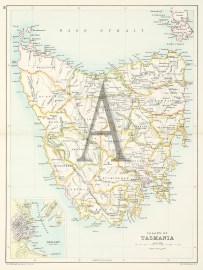
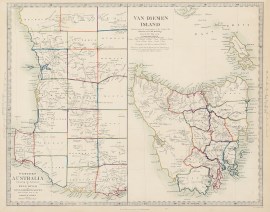
Rare c.19th engraved French map of south eastern Tasmania including, D’Entrecasteaux Channel, North and South Bruny Islands and Storm Bay with the the tracks of Recherche and Esperance and their boats in 1792-1793 made during their stay at Recherche Bay.
Charles-François Beautemps-Beaupré (1766–1854), the expedition’s hydrographer, produced the charts using a method he had developed, which substantially improved the accuracy of coastal surveys. Whereas James Cook had employed the sextant and theodolite for his surveys, Beautemps-Beaupré utilised the reflecting circle, referred to by the British as the “repeating circle” or “full circle.” Invented in 1758 by the German astronomer Tobias Mayer and perfected by the French hydrographer Jean-Charles de Borda in 1772, the reflecting circle allowed multiple horizontal angles to be taken to prominent coastal points with far greater ease than with a sextant, which had a restricted arc, or with the theodolite, which required a stable base and was therefore difficult to use at sea. The resulting charts were vastly superior to anything the British had produced for the region and accurately delineated the details of the d’Entrecasteaux Channel and Storm Bay area for the first time. The success of the expedition in charting southern Tasmania, further enhanced by Baudin’s wide ranging visit in 1802, raised British fears regarding French intentions in southern Australia and directly stimulated the British settlement of Port Phillip and Hobart in 1803, and Launceston in 1804.
Between the two visits to Recherche Bay, d’Entrecasteaux had sailed north-east to New Caledonia and New Britain, then around the northern coast of New Guinea to Timor, and subsequently southward to reach the Western Australian coast at Cape Leeuwin. He then continued along the southern coastline, passing King George Sound, which had been mapped by Vancouver in 1791. The expedition landed at Esperance Bay on 9 December 1792, where Willaumez and Beautemps-Beaupré surveyed the offshore islands by boat. After charting Esperance Bay, the expedition slowly proceeded eastward over the next seven days before coasting along the Great Australian Bight, then turned again toward Tasmania.
From: D’Entrecasteaux, Antoine Raymond Joseph de Bruni, Atlas du voyage de Bruny Dentrecasteaux, contre-amiral de France, commandant les fregates la Recherche et
l’Esperance, fait par ordre du gouvernement en 1791, 1792 et 1793.
References:
Clancy, R. The Mapping of Terra Australia. Sydney 1995: p.137, ill. 9.2
Ferguson, J. A. Bibliography of Australia Volumes 1-8, Canberra 1976: 443
Kissajukian, L.P. Antique Maps 1522-1850. Sydney 2016: p.37
McMahon, L & J. Exploring the South Land / Tasmania emerges from Terra Australis Incognita. 2006 Tasmania: pp. 35-36, Ill. pg. 36
National Library Australia, Mapping Our World. Canberra 2013: p.203
Pearson, M. Great Southern Land / The Maritime Exploration of Terra Australis. 2005 Canberra: pp. 74-81
Perry, T. & Prescott, D. A guide to maps of Australia in books published 1780-1830. Canberra 1996: 1807.03
Tooley, R.V. Printed Maps of Tasmania 1642-1900. 1975 London: 162
Tooley, R.V. The Mapping of Australia. London 1979: 545
Wantrup, J. Australian Rare Books. 2023: Vol. 2, pp. 1038, 64b
Collections:
National Library Australia: Bib ID 2437606
State Library New South Wales: CALL NUMBER MAV/FM4/10897
State Library Victoria: RARELTEF 910.41 en8