C1829

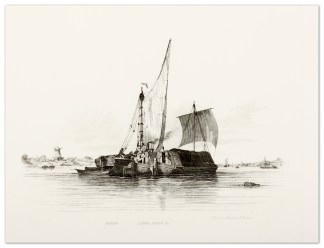
Collier Discharging.

Artist:

Edward William Cooke (1811 - 1880)

Fine etching of a collier, the same style of ship that James Cook selected for his first voyage which he stated would be ideal for coastal exploration especially in shallow waters. A collier is a bulk cargo ship designed to … Read Full Description

Sold

S/N: FPOSAC-013-SHIPS–187364
(C067)
Categories:
Free Shipping
[AUSTRALIA-SA] Gulf of St.Vincent Backst… South Australia

Within Australia

All orders ship freewithin Australia

[AUSTRALIA-SA] Gulf of St.Vincent Backst… South Australia

Rest of the World

Orders over A$300
ship free worldwide

See Shipping page for Terms & Conditions

Details

Full Title:

Collier Discharging.

Date:

C1829

Artist:

Edward William Cooke (1811 - 1880)

Condition:

One small spot on LHS not affecting image, otherwise in good condition.

Technique:

Original etching

Image Size: 

210mm 
x 170mm
AUTHENTICITY
Collier Discharging. - Antique Print from 1829

Genuine antique
dated:

1829

Description:

Fine etching of a collier, the same style of ship that James Cook selected for his first voyage which he stated would be ideal for coastal exploration especially in shallow waters.

A collier is a bulk cargo ship designed to carry coal, especially for naval use by coal-fired warships.Coaling at sea was critical to navies and speed of coal transfer was an important metric of naval efficiency. In 1883, forty tons an hour was considered fast and it would take over twelve hours to restock half the bunkers of a typical ship.

By Edward William Cooke (1811-1880) from Fifty Plates of Shipping and Craft which he drew and etched all the images.

Artist:

Edward William Cooke (1811-1880)

Marine and landscape artist born in Pentonville, London, the son of well-known line engraver George Cooke. From an early age he demonstrated his skills in drawing and at the age of eighteen published his series, Shipping and Craft. He was surrounded by famous artist such as Clarkson Stanfield David Roberts.

Cooke began painting in oils in 1833 and took formal lessons from James Stark in 1834, and first exhibited at the Royal Academy and British Institution in 1835.He travelled often throughout his life, to Holland studying the great Dutch marine artists.

He was also a Fellow of the Linnean Society, Fellow of the Geological Society and Fellow of the Zoological Society, and of the Society of Antiquaries. His geological interests in particular led to his election as Fellow of the Royal Society in 1863 and he became a Royal Academician the following year.
You May Also Like

Choose currency

Exchange rates are only indicative. All orders will be processed in Australian dollars. The actual amount charged may vary depending on the exchange rate and conversion fees applied by your credit card issuer.

Account Login

The List

Join our exclusive mailing list for first access to new acquisitions and special offers.