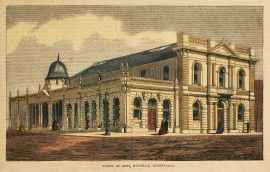
Julian Rossi Ashton (1851 - 1942)
Ashton was born in England, the elder son of a wealthy American, Thomas Briggs Ashton and his wife Henrietta, daughter of Count Carlo Rossi, a Sardinian diplomat. Soon after his birth the family moved to Cornwall, where his father, an amateur painter, encouraged the artistic leanings of Julian and his brother George. About 1862 the Ashtons moved to Totnes on the River Dart, where Julian attended the local grammar school, but his father died and the family, now in financial straits, went to London. Julian had art lessons from an old friend of his father whose teaching he described as 'the most helpful I ever had'. At 15 he took a job in the civil engineering branch of the Great Eastern Railway and attended the West London School of Art at night. After three years he joined a firm of ironmongers as a draftsman, but soon left to become a successful illustrator for such journals as Chatterbox and Cassell's Magazine. In 1873 he spent a few months at the new Académie Julian in Paris, and subsequently had work accepted by the Royal Academy of Arts.
Ashton emigrated to Melbourne in 1878 to work as an artist for the Illustrated Australian News. In 1881 he worked at the Australasian Sketcher and in 1883 moved to Sydney to work on the Picturesque Atlas of Australasia and the Bulletin. Ashton became an influential patron and supporter of Australian through his roles as trustee of the National Art Gallery of New South Wales and numerous associations that he belonged to. He was awarded the Society of Artists' medal for distinguished services to Australian art in 1924, appointed C.B.E. in 1930, and won the Sydney sesquicentennial prize for a water-colour in 1938.
View other items by Julian Rossi Ashton
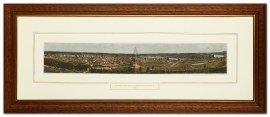
Conrad Martens (1801 - 1878)
English-born landscape painter who achieved prominence in colonial Australia. He was born on 21 March 1801 in London, the son of J. C. H. Martens, a German-born merchant. Trained initially as a topographical draughtsman, Martens studied landscape painting under the watercolourist Copley Fielding, a leading figure of the English watercolour school.
In 1832 Martens secured a position as ship’s artist on HMS Beagle during its surveying voyage under Captain Robert FitzRoy. He joined the vessel shortly before it reached Montevideo, replacing the ailing Augustus Earle. Martens thus sailed in the company of Charles Darwin, recording coastal views of South America and the Galápagos. Although he left the expedition at Valparaíso in 1834, his sketches remain important visual records of the voyage.
After travelling through Tahiti and New Zealand, Martens arrived in Sydney in 1835. He quickly established himself as a professional painter of landscapes and homestead views, producing watercolours and lithographs for the colonial elite. His works, combining European picturesque conventions with the distinctive Australian light and terrain, became highly sought after among settlers eager to commemorate their estates. He undertook numerous commissions across New South Wales and Queensland, and his practice extended to teaching and exhibiting.
Martens’s career spanned more than four decades, during which he became regarded as one of the foremost landscape painters in Australia. His art reflected both the scientific precision of his early training and the romantic sensibility of the English watercolour tradition. He continued to work actively until his death in Sydney on 21 August 1878. His extensive oeuvre, preserved in Australian and British collections, remains a vital record of the colonial landscape and its transformation in the nineteenth century.
View other items by Conrad Martens