C1819

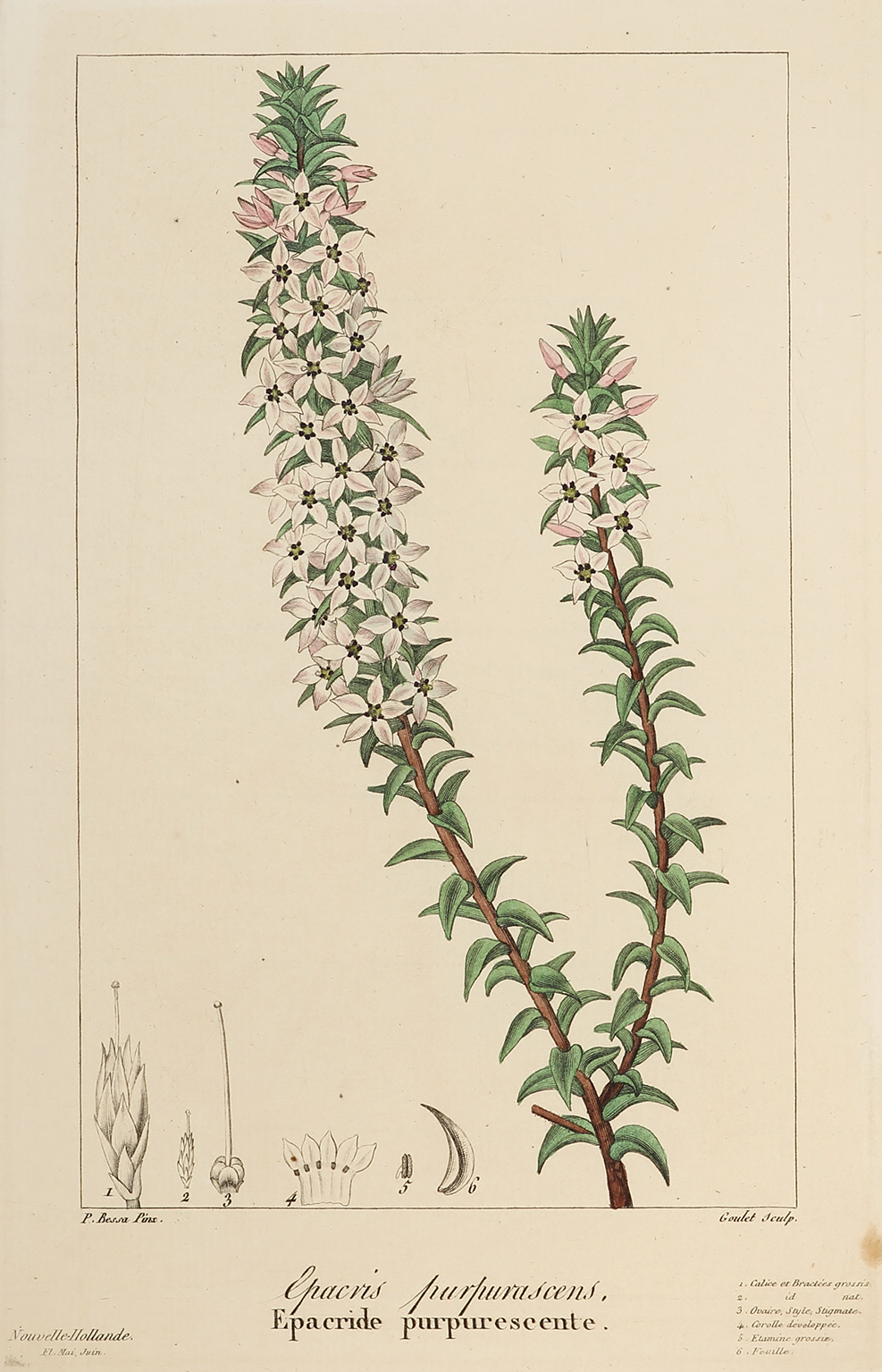
Epacris purpurascens, Epacride purpurescente.

Fine c.19th engraving of the Rigid Epacris by one of the most famous French botanical artists. Other common names: Rigid Epacris Modern binomial name: Epacris purpurascens First described: Banks ex Sims Distribution: NSW From: Mordant de Launay and Loiseleur-Deslongchamps , … Read Full Description

$A 145

In stock

S/N: MHGDA-BOT-AA-03155–481702
(DRW 01)
Free Shipping
[ASIA-Carte Hydro-Geo-Graphique Des Indes Oriental… ASIA

Within Australia

All orders ship freewithin Australia

[ASIA-Carte Hydro-Geo-Graphique Des Indes Oriental… ASIA

Rest of the World

Orders over A$300
ship free worldwide

See Shipping page for Terms & Conditions

Details

Full Title:

Epacris purpurascens, Epacride purpurescente.

Date:

C1819

Condition:

One spot at lower right, otherwise in good condition.

Technique:

Copper engraving with original hand colouring.

Image Size: 

113mm 
x 182mm

Paper Size: 

215mm 
x 290mm
AUTHENTICITY
Epacris purpurascens, Epacride purpurescente. - Antique Print from 1819

Genuine antique
dated:

1819

Description:

Fine c.19th engraving of the Rigid Epacris by one of the most famous French botanical artists.

Other common names: Rigid Epacris
Modern binomial name: Epacris purpurascens
First described: Banks ex Sims
Distribution: NSW

From: Mordant de Launay and Loiseleur-Deslongchamps , General herbarium for amateurs, containing the description, history, properties and cultivation of useful and pleasant plants. 

References:
Nissen, C. Die Botanische Buchillustration. Stuttgart 1966 BBI 2323.

Collections:
University of Chicago Library: 580.4 B46 c.1

Pancrace Bessa (1772 - 1835)

Pancrace Bessa (1772–1835) studied at the Muséum National d’Histoire Naturelle in Paris (commonly known as the Jardin des Plantes) where he came under the artistic influence of the master botanical artist and chair of iconography Gerard van Spaendonck (1746–1822) and the famous flower painter Pierre-Joseph Redouté (1759–1840)—with whom it is thought he directly studied. Bessa was hired as a peintre des fleurs to portray rare plants for the famous collection of vélins—the paintings on vellum begun in the mid-17th century for Gaston d’Orleans, inherited by Louis XIV and transferred to the Jardin du Roi—that was nationalized and renamed the Muséum National d’Histoire Naturelle in 1793. The Muséum was an internationally recognized center for research in the natural sciences with a staff of the leading French botanists and artists and a strong relationship with the Académie Royale des Sciences in Paris. Through the connections he made at the Muséum, Pancrace Bessa illustrated some of the most important botanical publications by the leading French botanists, horticulturists and agriculturists of the day, portraying new species of fruits, flowers and trees from the Americas, Africa, Asia and Australia. For some works he was the sole illustrator, and for others he collaborated with talented artists of the day, such as his teacher Pierre-Joseph Redouté. Many of Bessa’s original paintings were reproduced using the technique of stipple engraving.

View other items by Pancrace Bessa
Related Products

Choose currency

Exchange rates are only indicative. All orders will be processed in Australian dollars. The actual amount charged may vary depending on the exchange rate and conversion fees applied by your credit card issuer.

Account Login

The List

Join our exclusive mailing list for first access to new acquisitions and special offers.