Within Australia
All orders ship freewithin Australia
Rest of the World
Orders over A$300
ship free worldwide
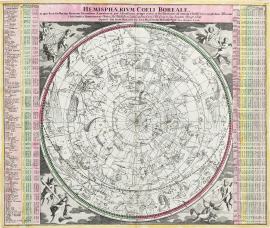
Finely engraved c.18th hand coloured engraved celestial map depicting the southern hemisphere heavens, surrounded by tables listing the stars with their positions and magnitudes, probably given in right ascension and declination. The celestial sphere is richly ornamented with mythological figures … Read Full Description
$A 1,650
Within Australia
All orders ship freewithin Australia
Rest of the World
Orders over A$300
ship free worldwide
Full Title:
Date:
Condition:
Technique:
Image Size:
Paper Size:
Genuine antique
dated:
Description:
Finely engraved c.18th hand coloured engraved celestial map depicting the southern hemisphere heavens, surrounded by tables listing the stars with their positions and magnitudes, probably given in right ascension and declination.
The celestial sphere is richly ornamented with mythological figures illustrating the constellations. A fine example of c.18th celestial cartography, the map exemplifies the synthesis of art and science characteristic of Johann Gabriel Doppelmayr’s work. Issued as part of the Atlas Novus Coelestis, the work reflects the Enlightenment’s fascination with astronomy and navigation, produced in collaboration with the cartographer Johann Baptist Homann.
Classical deities and mythological scenes represent the principal constellations, aiding visual recognition. The surrounding panels record star positions and magnitudes for scholarly and navigational reference. Cherubs and scientific instruments symbolise the intellectual and technical spirit of the age.
From: Doppelmayr, J. G., Atlas Novus Coelestis in quo Mundus Spectabilis, et Eodem tam Errantium quam Inerrantium Stellarum Phoenomena Natabilia
References:
Kanas, N. Star Maps History, Artistry, and Cartography. San Francisco 2009 : 7.8 pp. 209-211, Appendix C.4, p. 503-16..
Shirley, R. Maps in the Atlases of The British Library. London 2004 : 1C.Dop.-1c..
Collections:
David Rumsey Collection: 12129.020
Johann Baptist Homann (1663 - 1724)
Homann was the most important German cartographer of the 18th century. In 1715 the Holy Roman Emperor Charles the VI, appointed him Imperial Cartographer and in the same year he was also appointed a member of the Royal Academy of Sciences in Berlin. Upon his death, the business passed to his son Johann Christolph (1701-1730) and in 1730 the business was continued by the Heirs to Homann up until 1848.
View other items by Johann Baptist Homann
Johann Doppelmayr (1677 - 1750)
Doppelmayr was born in Nuremberg, the son of a merchant who also had an interest in science. He studied at the Aegigien Gymnasium in Nuremberg from 1689 to 1696. After graduating, he attended the University of Altdorf, where his studied law, mathematics, and natural philosophy from 1696 to 1699. He continued his studies in mathematics and physics at the University of Halle until 1700, when he began a two-year period of travel in Germany, Holland, and England. During this time he also learned to speak French, Italian and English. He also studied astronomy and learned to grind and figure his own telescope lenses. In August 1702 he returned to Nuremberg, and in 1704 was appointed Professor of Mathematics at his alma mater, the Aegigien Gymnasium, where he remained the rest of his life. He wrote on a number of topics, including astronomy, geography, spherical trigonometry, and scientific instruments. He also collaborated in the production of terrestrial and celestial globes. He was a member of several scientific societies, including; The Royal Society of London, Berlin and St. Petersburg Academy of Sciences.
Exchange rates are only indicative. All orders will be processed in Australian dollars. The actual amount charged may vary depending on the exchange rate and conversion fees applied by your credit card issuer.
Join our exclusive mailing list for first access to new acquisitions and special offers.