Within Australia
All orders ship freewithin Australia
Rest of the World
Orders over A$300
ship free worldwide
Mapmaker:
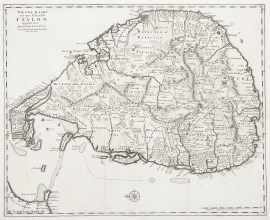
Small c.19th colour lithographed map of the Island of Ceylon (modern Sri Lanka), showing the island divided into its principal provinces and districts, each distinguished by delicate original colour wash. Administrative boundaries are clearly delineated, with provincial names prominently engraved, … Read Full Description
$A 90
Within Australia
All orders ship freewithin Australia
Rest of the World
Orders over A$300
ship free worldwide
Full Title:
Date:
Mapmaker:
Condition:
Technique:
Image Size:
Paper Size:
Genuine antique
dated:
Description:
Small c.19th colour lithographed map of the Island of Ceylon (modern Sri Lanka), showing the island divided into its principal provinces and districts, each distinguished by delicate original colour wash. Administrative boundaries are clearly delineated, with provincial names prominently engraved, including the Northern, Eastern, Western, Central, Southern, and North-Western Provinces. Major towns and centres of administration such as Colombo, Kandy, Galle, Jaffna, and Trincomalee are marked, together with secondary settlements.
The map records the island’s physical geography in detail, indicating rivers, mountain ranges, and coastal features, with particular emphasis on the central highlands and their relationship to surrounding lowlands. Roads and internal routes are shown, reflecting the developing infrastructure of Ceylon under British colonial administration during the c.19th. Coastal waters and harbours are clearly defined, underscoring the strategic and commercial importance of the island within the Indian Ocean.
Edward Weller (1819 - 1884)
Distinguished British cartographer, engraver, and publisher whose work contributed significantly to the popular dissemination of geographic knowledge in the mid to late c.19th. Active during a period of rapid expansion in global exploration and imperial cartography, Weller became one of the foremost mapmakers associated with The Weekly Dispatch Atlas and later the London Atlas of Universal Geography, works that brought high-quality maps to a broad middle-class readership.
Born in London in 1819, Weller trained as a draughtsman and engraver in an era when advances in lithography and steel-plate engraving were transforming the mapmaking industry. By the 1840s, he had established himself at 34 Red Lion Square, Holborn, where he operated as an engraver, draughtsman, and publisher. His early work included finely engraved maps for a variety of publishers and periodicals, but he rose to prominence through his long association with the publisher Cassell, Petter & Galpin.
Edward Weller’s contributions helped standardise mid-Victorian cartographic design and facilitated public engagement with geography through affordable, well-made maps. He remained active in London until his death in 1884. His output represents a bridge between the artisanal engraving traditions of the early nineteenth century and the industrial lithographic production that came to dominate the later Victorian period.
Exchange rates are only indicative. All orders will be processed in Australian dollars. The actual amount charged may vary depending on the exchange rate and conversion fees applied by your credit card issuer.
Join our exclusive mailing list for first access to new acquisitions and special offers.