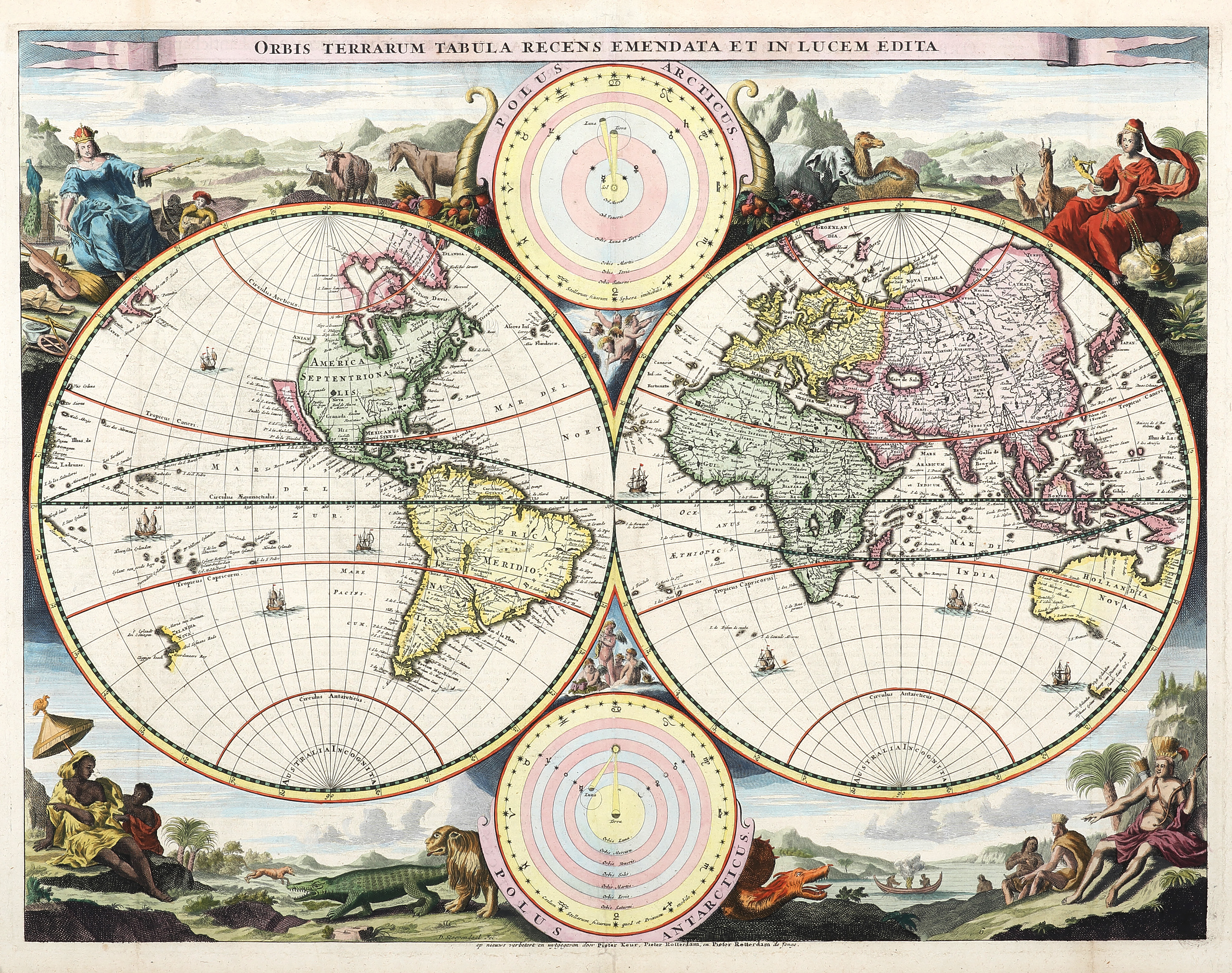
Superb 18th-century double-hemisphere world map from the 1714 edition of the Keur family Bible, embellished in the corners with the four continents shown in allegorical form, featuring examples of their animal life and inhabitants, engraved by Daniel Stoopendaal. This issue … Read Full Description
Minor chips to sheet edge, othewise in good condition, with centre fold as issued.
Technique:
Hand coloured copper engraving.
Image Size:
460mm
x 356mm
Paper Size:
514mm
x 417mm
AUTHENTICITY
Genuine antique dated:
1714
Description:
Superb 18th-century double-hemisphere world map from the 1714 edition of the Keur family Bible, embellished in the corners with the four continents shown in allegorical form, featuring examples of their animal life and inhabitants, engraved by Daniel Stoopendaal.
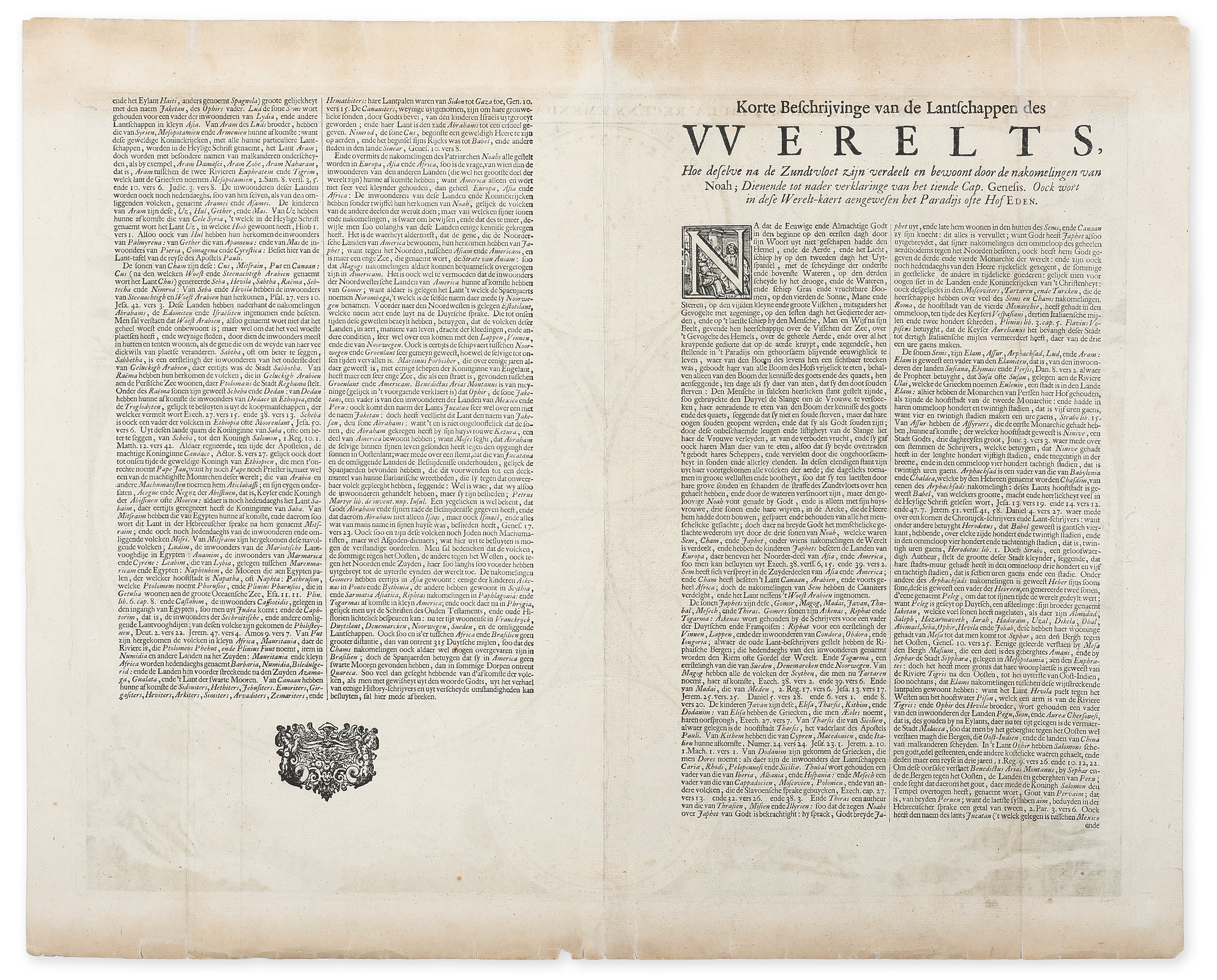
This issue is identified by the publication line below the map; op nieuws verbetert en uytgegeven door Pieter Keur, Pieter Rotterdam en Pieter Rotterdam de Jonge. Dutch text on verso. This map is often found for sale incorrectly dated.
Two circular diagrams depicting the Ptolemaic and Copernican theories of the solar system are depicted at top and bottom between the hemispheres. This map was based on the second world map prepared by Nicolaas Visscher for insertion in a Dutch bible published by Pieter en Jacob Keur.
Australia is shown with the discoveries made by Tasman on his first voyage 1642-3 and second voyage 1644. Earlier Dutch discoveries are noted and these include: Hartog 1616, Houtman 1619, van Leeuwin 1622, Cartensz 1623, Nuyts 1627 and de Wit 1628. The earliest Dutch discovery of the Australian coast by Willem Jansz in 1606 on Cape York Peninsula is not shown. The VOC (Dutch East India Comapny) , in having sent Tasman on two voyages, not only to chart the South Land but importantly to make contact with the natives and to ‘in trade’, were disappointed with the lack of trading opportunities present in the barren and inhospitable land. Consequently, the VOC lost interest in further charting of the Australian continent other than the updating of existing charts. The post-Tasman shape of Australia depicted on maps was to remain unchanged until James Cook discovered and charted the east coast in 1770.
The first Keur family bible was issued in 1666, the last in 1756. Three generations of Keur’s worked on it: the brothers Hendrik and Jacob, Jacob’s son Pieter and Pieter’s two sons Jacob and Hendrik.
Hendrik 1666-1704
Jacob 1666-1714 Pieter 1700-1736
Jacob 1729-1756 Hendrik 1741-1756
References: Shirley, R. The Mapping of the World Early Printed World Maps 1472-1700. London 1987 :: 513. Poortman, W. & Augusteijn, J. Kaarten Bijbels (16e-18e eeuw): p.196, #130 G II-2.
Daniel Stoopendaal (1672 - 1726)
Dutch engraver and mapmaker active in Amsterdam during the early part of the 17th century. He is best known for his engravings of Nicholas Visscher maps.
Exchange rates are only indicative. All orders will be processed in Australian dollars. The actual amount charged may vary depending on the exchange rate and conversion fees applied by your credit card issuer.
Account Login
The List
Join our exclusive mailing list for first access to new acquisitions and special offers.
![[AUSTRALIA-SA] Gulf of St.Vincent Backst… South Australia](https://antiqueprintmaproom.com/wp-content/uploads/2020/03/icon-aust-gold.svg "[AUSTRALIA-SA] Gulf of St.Vincent Backst… South Australia")
![[AUSTRALIA-SA] Gulf of St.Vincent Backst… South Australia](https://antiqueprintmaproom.com/wp-content/uploads/2020/03/icon-world-gg-2.svg "[AUSTRALIA-SA] Gulf of St.Vincent Backst… South Australia")