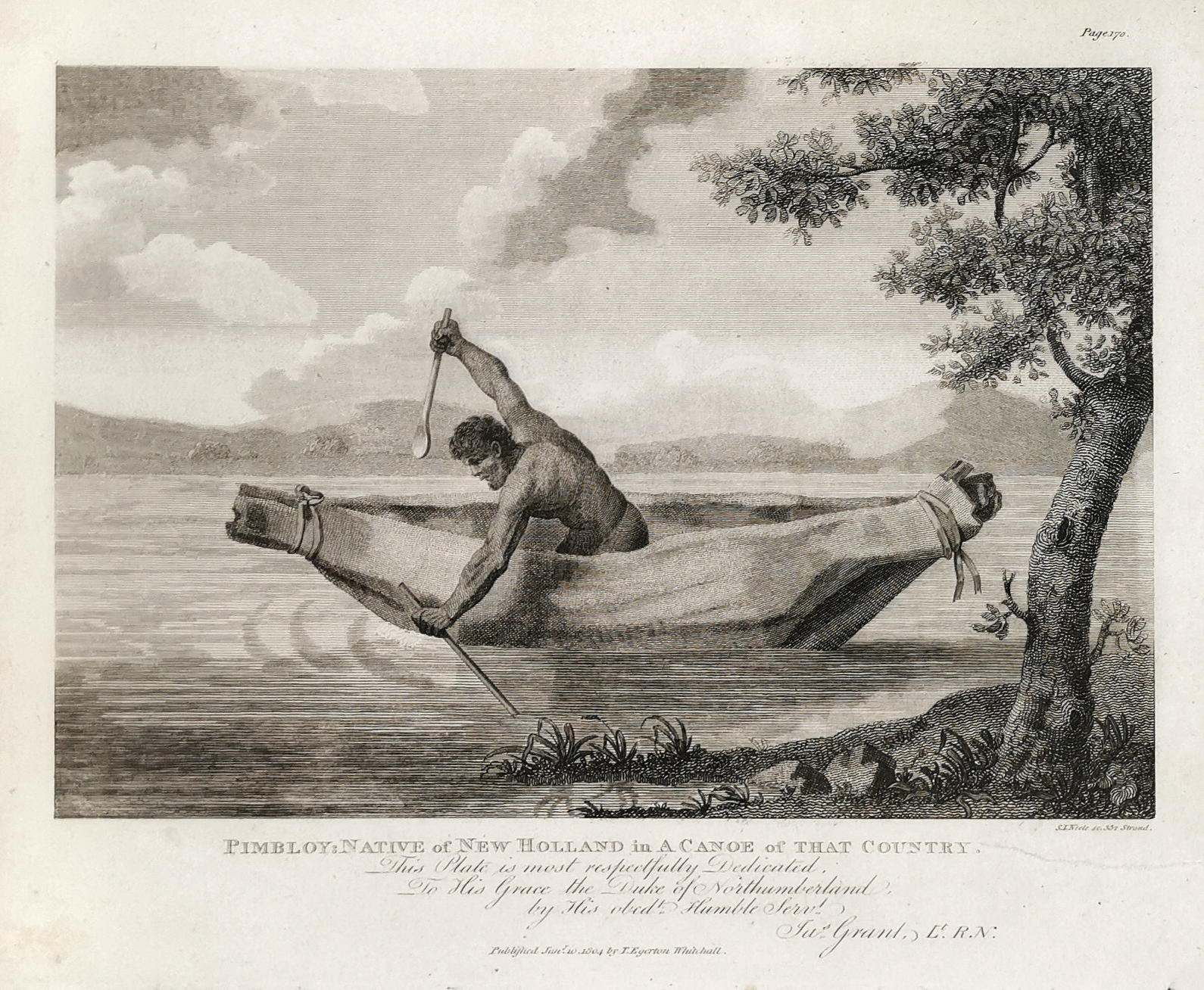
James Grant (1772 - 1833)
British naval officer, son of Robert Grant of Boganduie. He received part of his education at King's College, Aberdeen, where under Dr William Chalmers he learnt the elements of microscopy as applied to botany and anatomy. He entered the navy as a captain's servant in August 1793, became a midshipman in May 1794 and master's mate in September.
Shortly before his promotion to lieutenant in 1800, he was appointed to command the Lady Nelson, thanks to his friendship with Captain John Schanck, a commissioner of the Transport Board, and to the influence of Sir Joseph Banks. The Lady Nelson, of only 60 tons burden, was designed by Schanck for survey work in shallow waters, and was one of the first sea-going vessels built in England on the centre-board, or what was then known as the sliding-keel, system. It was intended that she should proceed to Australia where she would be handed over to Matthew Flinders, while Grant, who lacked technical survey qualifications, should transfer to the Supply.
Grant left Portsmouth on 17 March 1800 and reached the Cape on 8 July. There, while following Philip Gidley King's advice to wait for the summer, he received further orders from the Duke of Portland 'to search for the Strait which separates Van Diemen's Land from New Holland' and if possible to make his passage through it. He did this successfully, but owing to his shortage of water and provisions he could not make a close examination of the coastline. Grant did however distinguish two extinct volcanoes which he named Mount Schanck after his patron and Mount Gambier after the admiral of that name. The city of Mount Gambier in south-east South Australia is adjacent to the volcano rim and its Blue Lake. On 16 December 1800 he arrived in Sydney only to discover that Flinders had left for England and that the Supply had been condemned. There being no other officer to replace Flinders, Grant was continued in his command by Governor King who had earlier described him to Banks as 'a very good seaman but no Artist'.
His first assignment was the survey of the south-western coast of the continent, a task in which he was to be assisted by Francis Barrallier; however, because of the lateness of the season the survey, which took place from March to May 1801, was confined to Bass Strait. Next, King sent Grant to the Hunter River to investigate the possibilities of settlement and the extent of the coal deposits reported by John Shortland in 1797. He was accompanied by Lieutenant-Colonel William Paterson, Dr John Harris, the artist John Lewin and Barrallier. The Lady Nelson reached the Nobbys on 14 June 1801 and the party spent four weeks exploring the Hunter valley, reaching a point a little beyond the modern Maitland. As a result of Paterson's report, King decided to establish a small post at the mouth of the Hunter River, the site of the future city of Newcastle.
Immediately on his return to Sydney Grant found himself the lone naval officer with five officers of the New South Wales Corps and the deputy judge advocate, Richard Atkins on the bench to try Lieutenant Marshall, R.N., for alleged assault on two captains of the corps, Edward Abbott and John Macarthur. Marshall was convicted and in the heated atmosphere generated by the trial and the governor's efforts to have Marshall's trial reopened, Grant found himself squeezed between the irascible governor and the military junta. The subsequent mortifications and disappointments he received caused Grant on 31 August 1801 to ask permission to return to England, ostensibly because of the imminent arrival of Flinders and his own 'little knowledge of nautical surveying'. Reporting his approval of the application, King spoke very favourably of Grant's abilities as an officer and seaman.
Grant left Sydney on 9 November 1801 carrying a copy of King's dispatches on the conduct of John Macarthur, but when he arrived at the Cape, after transhipping at Tristan da Cunha, Grant discovered that the dispatches were missing. He arrived in England in April 1802, and next year published an account of his explorations.
View other items by James Grant

![[AUSTRALIA-SA] Gulf of St.Vincent Backst… South Australia](https://antiqueprintmaproom.com/wp-content/uploads/2020/03/icon-aust-gold.svg "[AUSTRALIA-SA] Gulf of St.Vincent Backst… South Australia")
![[AUSTRALIA-SA] Gulf of St.Vincent Backst… South Australia](https://antiqueprintmaproom.com/wp-content/uploads/2020/03/icon-world-gg-2.svg "[AUSTRALIA-SA] Gulf of St.Vincent Backst… South Australia")