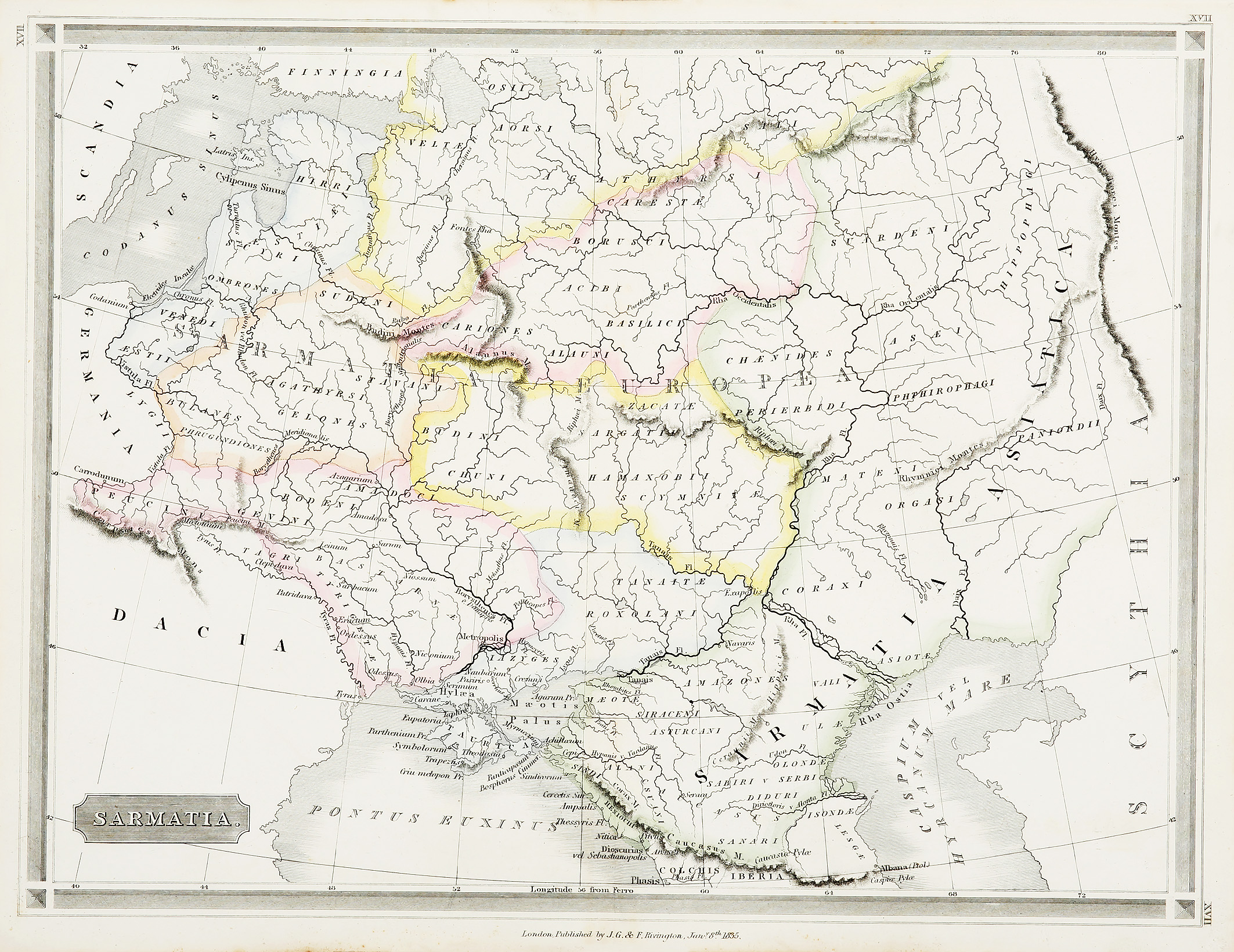
Scarce, c.19th hand coloured engraved map of ancient Sarmatia by the important English map maker John Purdy (1773-1843).
From: Bean, J.B. A New Atlas of Classical Geography. St. Pauls Church Yard, & Waterloo Place. London 1835
In classical geography, especially in the work of Ptolemy, Sarmatia described the immense region north of the Black Sea and stretching across eastern Europe into western Asia, associated with Iranian-speaking nomadic peoples known collectively as the Sarmatians.
Ancient writers generally divided the area into a western and eastern sphere. The western portion, later termed Sarmatia Europaea, covered territories corresponding broadly to parts of modern eastern Poland, Belarus, Ukraine, and western Russia. It was often defined as lying between the Vistula River in the west and the Don (Tanais) River in the east, bounded to the north by the Baltic and to the south by the Black Sea and the Roman Danubian frontier.
East of the Don lay what was described as Sarmatia Asiatica, extending across the steppe toward the lower Volga and the northern Caucasus. These lands formed part of the great Eurasian grasslands that linked eastern Europe with Central Asia.
Classical authors such as Strabo and Pliny the Elder characterised Sarmatia as a sparsely settled zone of mobile pastoral societies, including groups later identified as Roxolani, Iazyges, and Alans, noted for their cavalry warfare and periodic interaction—peaceful and hostile—with Rome along the Danube frontier.
On early modern European maps, the name Sarmatia persisted as a learned, classical label. Sixteenth- and seventeenth-century cartographers often applied it broadly to eastern Europe and parts of Muscovy, blending ancient geographic concepts with contemporary political realities. Consequently, the term on a historical map may reflect classical tradition rather than precise ethnographic or political boundaries of the period in which the map was produce