C1852

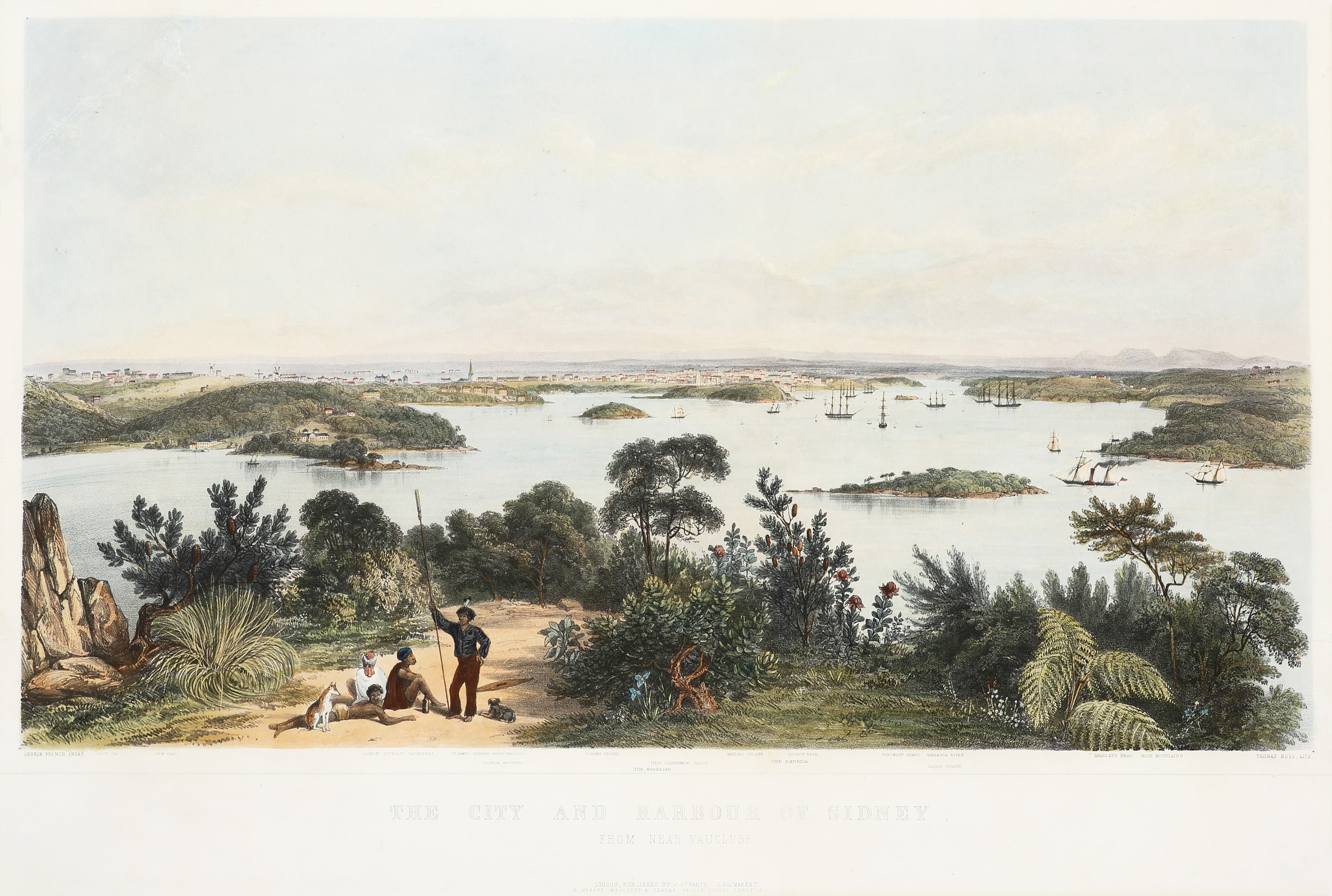
The City and Harbour of Sidney, from Near Vaucluse…

Rare and important, c.19th separately issued hand coloured lithograph view of Sydney looking from Vaucluse by George French Angas (1822-1886). This is the much rarer first issue of this lithograph, identified by the miss-spelling of Sydney as Sidney.  Published by J. … Read Full Description

$A 8,750

In stock

Free Shipping
Laelia anceps Dawsoni. World - Nonindigenous General

Within Australia

All orders ship freewithin Australia

Laelia anceps Dawsoni. World - Nonindigenous General

Rest of the World

Orders over A$300
ship free worldwide

See Shipping page for Terms & Conditions

Details

Full Title:

The City and Harbour of Sidney, from Near Vaucluse…

Date:

C1852

Condition:

Top left corner with a repaired crack, otherwise in good condition.

Technique:

Hand coloured lithograph.

Image Size: 

575mm 
x 335mm

Paper Size: 

593mm 
x 404mm
AUTHENTICITY
The City and Harbour of Sidney, from Near Vaucluse. - Antique Print from 1852

Genuine antique
dated:

1852

Description:

Rare and important, c.19th separately issued hand coloured lithograph view of Sydney looking from Vaucluse by George French Angas (1822-1886).

This is the much rarer first issue of this lithograph, identified by the miss-spelling of Sydney as Sidney

Published by J. Hogarth ; Sydney (George Street): Woolcott & Clarke, 1852. It was not Angas’s fault for the error, as he had sent a letter to his London publisher, William Hogarth on Sept. 30th 1851 giving clear  instructions for the writing for the Plate which included the correct spelling of Sydney. 

Angas masterfully captures the sweeping vista of the city from the elevated vantage of Vaucluse. The scene is enriched by the graceful presence of numerous sailing ships and a single steamer gliding across the harbor, symbols of progress amidst the timeless beauty of the landscape. To the left, four Aboriginal figures stand as silent witnesses to this meeting of cultures, their presence grounding the composition in a deeper historical context. The identified plants: Banksias, Waratahs and Ferns in the foreground add a layer of botanical detail.

References:
Tregenza, J. George French Angas. Artist, Traveller and Naturalist 1822-1886. Adelaide 1980 : pl. 51, p.83.
Evans, S. Historic Sydney as seen by its Early Artists. 1983 Sydney; pl. 81, p.101. (1st issue with title; Sidney)

Collections:

Museums of History NSW, Caroline Simpson: Accession number V2005/5  (2nd issue with title: Sydney)
National Library Australia: Bib ID: 1881590 (1st issue with title;
Sidney)
National Gallery Australia: Not in collection / 2000.615  (2nd issue with title: Sydney)
National Maritime Museum Greenwich: ID: PAI0447  (2nd issue with title: Sydney)
State Library New South Wales: Reference code832456  (2nd issue with title: Sydney)
State Library Victoria: Record ID 9921315783607636
 (1st issue with title; Sidney)

George French Angas (1822 - 1886)

Angas was a painter, lithographer, engraver and naturalist, fourth child and eldest son of George Fife Angas, a merchant and banker. As the eldest son he was expected to join his father's firm, but some months in a London counting house proved a disillusioning experience. In 1841 he took art lessons for four months from Benjamin Waterhouse Hawkins, a natural history painter and lithographer, and armed with this instruction set out to see the world. He began in the Mediterranean publishing, A Ramble in Malta and Sicily in the Autumn of 1841.......Illustrated with Sketches Taken on the Spot, and Drawn on the Stone by the Author, the following year. Angas's father had established the South Australian Company in 1836 and had large areas of land as well as banking interests in the province. George French sailed for South Australia in 1843 in the Augustus, arriving in Adelaide on 1st January 1844. Within days he had joined an exploring party selecting runs for the South Australia Company. They traveled through the Mount Lofty Ranges to the Murray River and down to Lake Coorong and Angas sketched views of the countryside, native animals and the customs and dwellings of the Narrinyerri people. Later he drew scenes on his father's land - 28,000 acres in the Barossa Valley - and accompanied George Grey's expedition to the then unknown south-east as unofficial artist. In July 1844 Angas visited New Zealand. Guided by two Maoris, he traveled on foot and by canoe through both islands, painting portraits of Maoris and views. Angas's father died in 1879, leaving a vast estate from which George French received only a annuity of 1000 pounds. In 1884 he went to Dominica on a collecting expedition, finding shells, moths, butterflies and birds. Dogged by rheumatism and neuralgia during his last years, Angas died in London on 4 October 1886.

View other items by George French Angas

Related Products

Choose currency

Exchange rates are only indicative. All orders will be processed in Australian dollars. The actual amount charged may vary depending on the exchange rate and conversion fees applied by your credit card issuer.

Account Login

The List

Join our exclusive mailing list for first access to new acquisitions and special offers.