C1840

The Maritime Portion of South Australia from Surve…

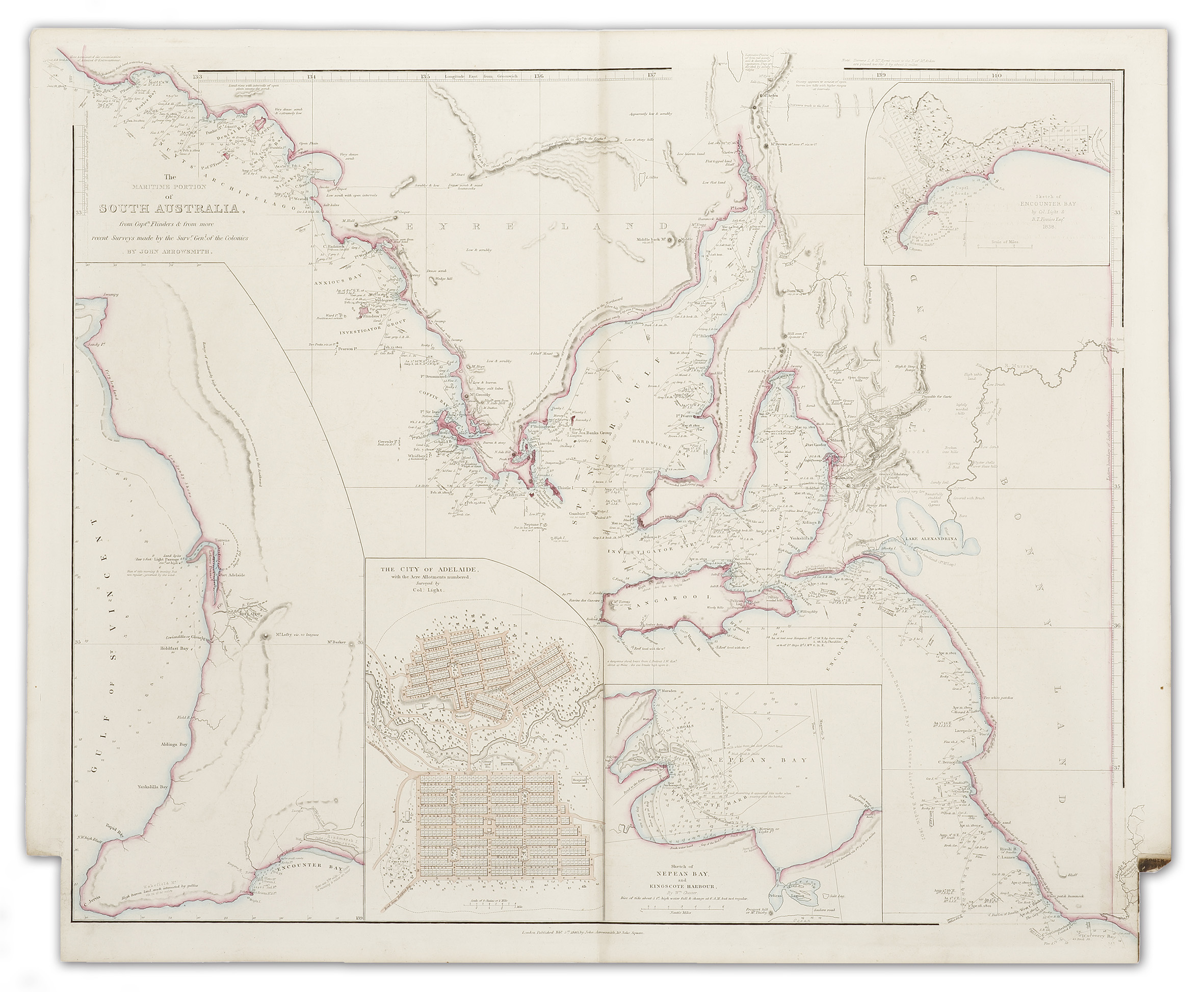
First state of the completely revised issue of this important colonial map of South Australia. This 1840/1 state of the map has been completely revised from the previous issues, with a change of title which is now located at the … Read Full Description

$A 1,950

In stock

S/N: TLAT-AM-SAMP400205–345918
(M13)
Free Shipping
Map of the Counties of Darling, Inglis, Vernon, Ma… New South Wales

Within Australia

All orders ship freewithin Australia

Map of the Counties of Darling, Inglis, Vernon, Ma… New South Wales

Rest of the World

Orders over A$300
ship free worldwide

See Shipping page for Terms & Conditions

Details

Full Title:

The Maritime Portion of South Australia from Surve…

Date:

C1840

Condition:

Small repaired tear at top, otherwise in good condition with centre fold as issued.

Technique:

Copper engraving with original hand colouring

Image Size: 

645mm 
x 530mm

Paper Size: 

670mm 
x 550mm
AUTHENTICITY
The Maritime Portion of South Australia from Surveys of Captn. Flinders & of Col. Light, Survr. Gen. of the Colonies. - Antique Map from 1840

Genuine antique
dated:

1840

Description:

First state of the completely revised issue of this important colonial map of South Australia.

This 1840/1 state of the map has been completely revised from the previous issues, with a change of title which is now located at the top left of the map.

Much new information appears;

Eyre Peninsula is shown as EYRE LAND with Eyre’s track (unnamed) from the peninsula going westward along the coast towards Streaky Bay and on to Pt. Bell (32°S /133°’05’E) then north via the Gawler Range to Mt. Arden.
North of Spencer Gulf the Flinders Range and the tip of L. Torrens appear. New topographic features to the north-east of Yorke Peninsula include Crystal Brook, Rocky R., R. Broughton and Reedy Cr. East of these streams are parallel north/south trending ranges.

There is much development north and east of Adelaide with many unnamed streams and ranges. This area has been named STURT LAND.
East of the Murray River the entire area reaching to the south coast is named BONNY LAND.INSETS:

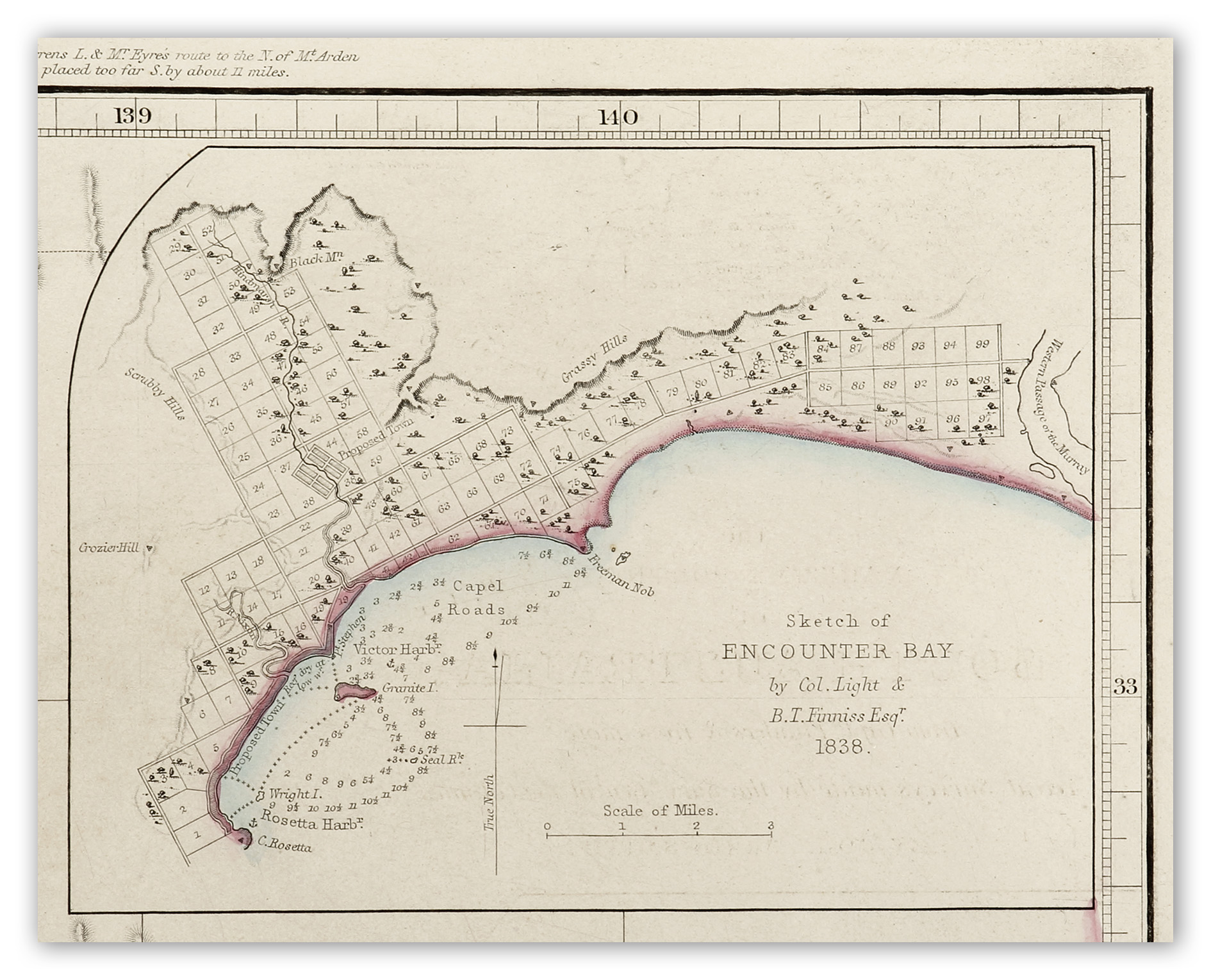
Top right: Sketch of Encounter Bay by Colonel Light and B. T. Finniss Esqr. 1838.

Lower right: Sketch of Nepean Bay and Kingscote Harbour.

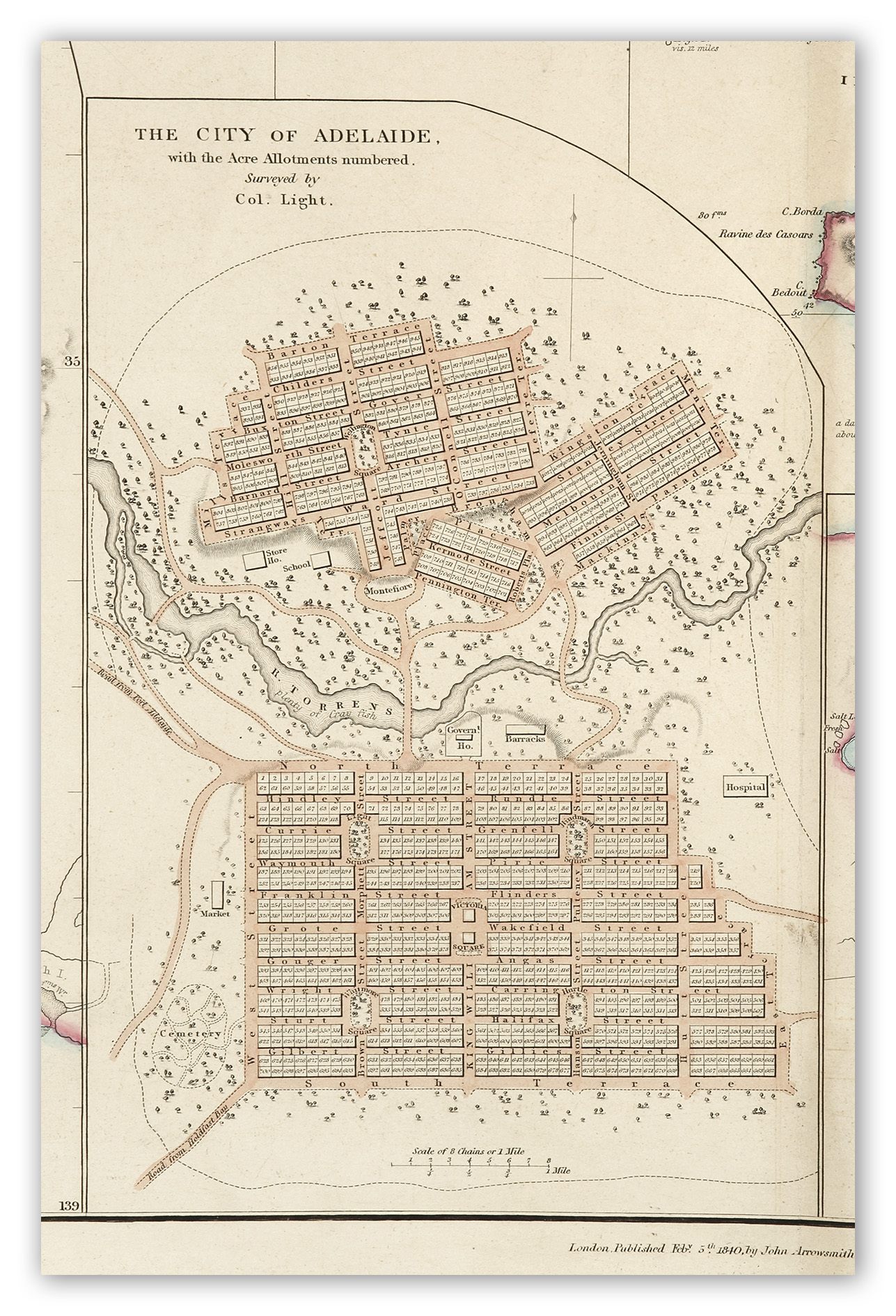
Centre bottom: The city of Adelaide with the acre allotments numbered and surveyed by Col. Light.

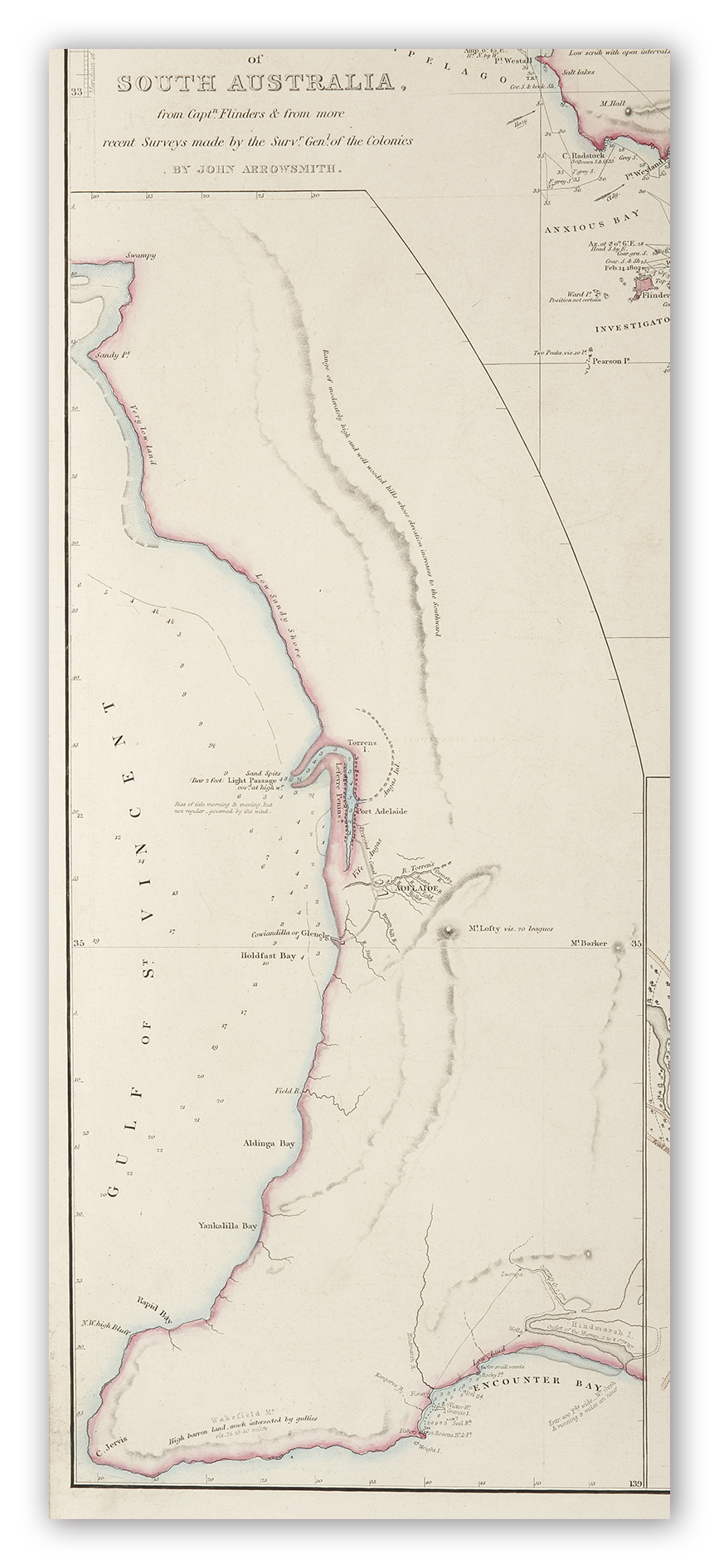
At left: [Gulf of St. Vincent].

Reference

Prescott, Arrowsmith’s Australian Maps.

http://www.asmp.esrc.unimelb.edu.au/biogs/E000055b.htm

References:
Prescott, D. Arrowsmith's Australian Maps. From the London Atlas of Universal Geography by John Arrowsmith and later Edward Stanford :: Martime Portions 1840/1.
Tooley, R.V. The Mapping of Australia. London 1979 :: 109, P.17.


Collections:
British Library London: Maps 43.f.23.
State Library New South Wales: b2020849*
Library of Congress Washington D.C.: G1019 .A8 1842c fol. Copy 1
National Library Australia: Bib ID 937446
State Library South Australia: C 934 OUTSIZE 6
State Library Victoria: MAPS 830.65 A 1840 ARROWSMITH

John Arrowsmith (1790 - 1873)

English mapmaker, the last of a family of map makers that produced maps during the period 1790 to 1870. His uncle Aaron (1750 - 1823) left the north of England and went to work in London as a land surveyor where he surveyed the Great Post Roads between London and Falmouth which was engraved and published by John Cary an engraver in 1782 (Verner, 1971, p.1). In the 1790s he decided to establish his own map making business. He published about 200 maps and achieved great eminence being appointed Hydrographer to the King in 1820. John Arrowsmith, Aaron's nephew, who was born in Winston, county Durham, England (1790 - 1873) came to work for him in 1810. During the next thirteen years he learned from his uncle the art of map making, including engraving and printing. His two cousins, Aaron junior (1802-54) and Samuel (1805-39) (Verner, 1971, p.2) both worked in the business and inherited jointly the house, business, copper plates, presses etc. as stated in their father's will. By the time of his uncle's death John had established his own business which operated out of 33 East Street, Red Lion Square, although he still worked with his two cousins Aaron and Samuel. All three produced individual works, although Samuel was in charge of the business at 10 Soho Square. Aaron the younger, lost interest in map making and ceased producing maps in 1832 (Verner, 1971, p.2). In 1839 Samuel died and John bought the business including plates, MSS and copyrights at auction of December 1839 (Herbert, 1983) and continued operating from 10 Soho Square. In 1834 he produced his magnum opusThe London Atlas of Universal Geography, which he continued to revise and reissue until the last 1858 edition. However his atlas contains maps of later dates into the 60s (Herbert, 1989). He became a founding member of the Royal Geographical Society in London (1830) and a member of its council. He remained an active member for over forty years during which time he met many explorers and persons of influence who were instrumental in supplying him with information for his maps. In 1831 the society's Journal was established and Arrowsmith began producing maps for it from 1832 until 1870. He received the Gold medal of the Society in 1863 (Tooley, 1999). After his death his plates were bought by Edward Stanford of London who continued to issue the atlas with the name of Stanford's London Atlas of Universal Geography. This atlas continued into the 1920s. (Dorothy Prescott, 2010-2015)

View other items by John Arrowsmith
Related Products

Choose currency

Exchange rates are only indicative. All orders will be processed in Australian dollars. The actual amount charged may vary depending on the exchange rate and conversion fees applied by your credit card issuer.

Account Login

The List

Join our exclusive mailing list for first access to new acquisitions and special offers.