C1830

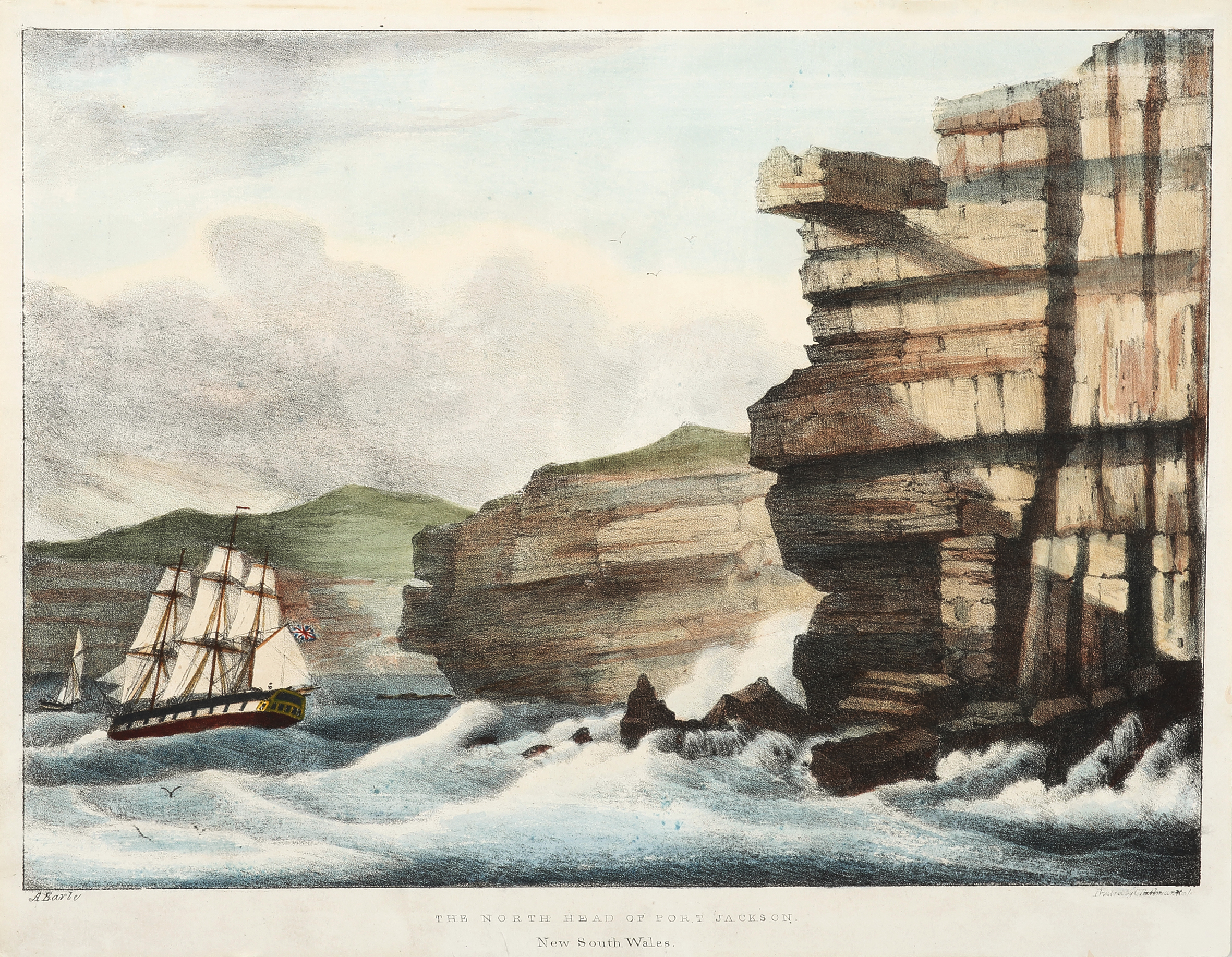
The North Head of Port Jackson. New South Wales.

Very rare, early 19th-century hand-coloured lithograph, plate no. 1 from part 1 of Augustus Earle’s Views in New South Wales and Van Diemen’s Land: Australian Scrap Book, published in London, 1830. Earle arrived in Hobart in 1825 on the Admiral … Read Full Description

$A 13,500

In stock

Free Shipping
The Peacock Australian

Within Australia

All orders ship free
within Australia
The Peacock Australian

Rest of the World

Orders over A$300
ship free worldwide

See Shipping page for Terms & Conditions

Details

Full Title:

The North Head of Port Jackson. New South Wales.

Date:

C1830

Condition:

Small repaired tear at lower sheet edge, otherwise in good condition.

Technique:

Hand coloured lithograph.

Image Size: 

288mm 
x 208mm

Frame Size: 

570mm 
x 510mm

Paper Size: 

301mm 
x 237mm
AUTHENTICITY
The North Head of Port Jackson. New South Wales. - Antique View from 1830

Genuine antique
dated:

1830

Description:

Very rare, early 19th-century hand-coloured lithograph, plate no. 1 from part 1 of Augustus Earle’s Views in New South Wales and Van Diemen’s Land: Australian Scrap Book, published in London, 1830.

Earle arrived in Hobart in 1825 on the Admiral Cockburn after being rescued from the remote island of Tristan da Cunha, and spent three years in Australia painting portraits, landscapes, and depictions of the Aborigines. He spent four months in Van Diemen’s Land before leaving in May 1825 for Sydney. There, he quickly established himself as the colony’s leading artist and, on 8 July 1826, advertised the opening of his art gallery at 10 George Street, Sydney, where he offered painting lessons and “a large assortment of every description of articles used in Drawing, Painting &c.” as well as his own pictures.

In August 1826, Earle was given a lithographic press by the astronomer James Dunlop, which had been brought out by Governor Brisbane and was probably the first lithographic press in the colony. Earle’s first lithographic attempt was a portrait of the Sydney Aborigine Bungaree. By November, he had published the first part of his lithographed views of Sydney, Views in Australia, and the second part was issued the following month. However, Earle’s views were evidently not a commercial success, as no further parts were issued, despite his original intention. Only three known sets of the Sydney printing of these lithographs survive, all in institutional collections.

On 20 October 1827, he sailed for New Zealand on board the Governor Macquarie, intending to record its landscape and inhabitants. Thought to be the first professional European artist to take up residence in the country, he remained for six months before returning to Sydney on the same vessel on 5 May 1828. On 12 October that year, he left New South Wales permanently, embarking on The Rainbow, bound for the Caroline Islands. Back in London in 1829, Earle published his set of lithographic Views in New South Wales and Van Diemen’s Land (1830).

Although more successful than his colonial attempt, all of Earle’s lithographs remain extremely rare. (Wantrup)

References:
Wantrup, J. Australian Rare Books. Sydney, 2nd ed. 2023:: Vol. I, pp. 383-386, Vol. II, item 220.
Ferguson, J. A. Bibliography of Australia Volumes 1-8, Canberra 1976 :: 1342.
Kerr, J. The Dictionary of Australian Artists Painters, Sketchers, Photographers and Engravers to 1870 Melbourne 1992 :: pp. 234-237.
Hackforth-Jones, J. Augustus Earle Travel Artist. 1980 Canberra:: pp. 23-26.


Collections:
National Library Australia: Bib ID: 172466
State Library New South Wales: IE Number IE8802334
State Library New South Wales: Legacy id 4039
National Gallery Victoria: Accession Number 2016.402
National Maritime Museum Greenwich: ID: PAD2124

Augustus Earle (1793 - 1838)

Painter and lithographer, born in London on 1 June 1793, son of an American Tory portrait painter who fled to England in 1778. His uncle, Ralph Earl, was an eminent American portrait painter, his older sister, Phoebe, became flower painter to Queen Victoria, while her husband, Denis Dighton, was a printer who later lithographed some of Earle’s watercolours. Earle reached Hobart in 1825 on the Admiral Cockburn after being rescued from the remote island of Tristan da Cunha, and spent three years in Australia painting portraits of ‘exclusives’, landscapes and the Aborigines. He spent four months in Van Diemen’s Land and then left in May 1825 for Sydney. There he quickly established himself as the colony’s leading artist and on the 8 July 1826, Earle advertised the opening of his art gallery at 10 George Street, Sydney, where he offered painting lessons and ‘a large assortment of every description of articles used in Drawing, Painting &c.’ as well as his own pictures. In August 1826 Earle was given a lithographic press by the astronomer James Dunlop that had been brought out by Governor Brisbane, which was probably the first lithographic press in the colony. Earle’s first lithographic attempt was a portrait of the Sydney Aborigine Bungaree. By November he had published the first part of his lithographed views of Sydney, Views in Australia and the second part was issued the following month. Earle’s views were not a success as no further parts were issued as had been his original intention. There are three known sets of the Sydney printing of these lithographs, all are in institutional collections. On 20 October 1827 he sailed for New Zealand on board the Governor Macquarie, with a view to record its landscape and inhabitants. Earle wanted to know more about the Maori, some of whom he had met in Sydney. He spent eight months in Hokianga and the Bay of Islands. No native race he had studied on his travels could compare with the New Zealanders, that ‘splendid race of men’ with ‘a natural elegance and ease of manner’. Earle painted dozens of accurate representations of Maori customs, occasions and domestic scenes. He left Northland in May 1828 to continue his travels. He was the first European artist to establish himself for a time in New Zealand and make a prolonged study of a part of the country and a number of its people. Back in London in the 1830s, he exhibited and published his views of New Zealand, New South Wales, and Van Diemen’s Land.

View other items by Augustus Earle

Choose currency

Exchange rates are only indicative. All orders will be processed in Australian dollars. The actual amount charged may vary depending on the exchange rate and conversion fees applied by your credit card issuer.

Account Login

The List

Join our exclusive mailing list for first access to new acquisitions and special offers.