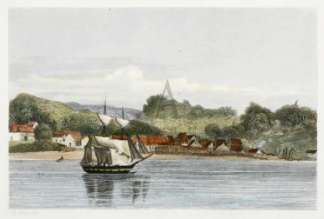
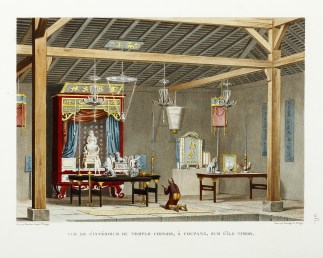
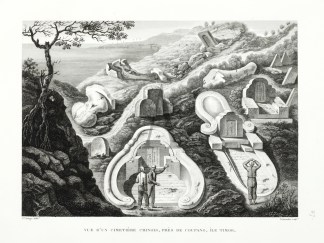
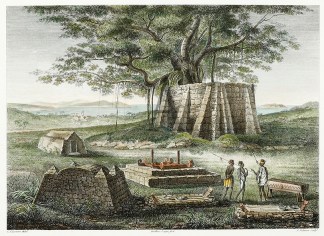
Rare c.19th engraving of a young Timorese girl carrying water.
In October 1800, Nicolas Baudin commanded an expedition to the south seas to complete the French survey of the Australian coastline, and make scientific observations. The two ships, Le Geographe and Le Naturaliste, arrived near Cape Leeuwin in May 1801. Following instructions issued in France, both ships sailed north along the western coast of the continent. After staying at Timor, the French then sailed south to survey Van Diemen’s Land [Tasmania]. In following this itinerary, they missed the opportunity to be the first Europeans to survey the unknown southern coast. By early April 1802 Baudin in Le Geographe was in South Australian waters. He sailed westwards along the southern coastline, meeting Flinders at Encounter Bay, and continuing to Golfe de la Mauvaise [Gulf St Vincent] and Golfe de la Melomanie [Spencer Gulf], giving French names to many locations already named by Flinders. At Cape Adieu the survey was abandoned and Baudin sailed for Port Jackson where Le Naturaliste had already arrived. After wintering at Port Jackson, Baudin returned to the southern coast for a more detailed survey, and in January 1803 circumnavigated Ile Borda [Kangaroo Island]. While Baudin anchored at Nepean Bay, Freycinet and the geographer Boullanger explored the two gulfs in Casuarina – Le Naturaliste had been sent back to France with its scientific collections. By the end of February Le Geographe and Casuarina rendezvoused at King George Sound, and then explored the west and northwest coasts of ‘New Holland’, before heading home via Timor.
Baudin died in 1803 on the homeward voyage, so publication of the account and charts of his voyage was undertaken by Francois Peron, the expedition’s naturalist. The first volume of Voyage de decouvertes aux Terres Australes and Volume I of Atlas, which included plates, was released in 1807. French place names were recorded for ‘Terre Napoleon’ west of Wilson’s Promontory. As Peron died in 1810, cartographer Louis de Freycinet continued to edit the voyage’s account, and in 1811 he published the second part of Atlas, which featured the charts of the expedition, again recording French place names on ‘Terre Napoleon.’
From Peron, Voyage de decouvertes aux terres australes, execute sur les corvettes le Geographe, le Naturaliste et la goelette le Casuarina, pendant les annees 1800, 1801, 1802, 1803 et 1804 … Paris.
References:
Ferguson, J. A. Bibliography of Australia Volumes 1-8, Canberra 1976 : F 307.
Wantrup, J. Australian Rare Books. Sydney, 1987 : 78a, 79a, 80a, 81..
Hill, J. The Hill Collection of Pacific Voyages. San Diego 1974 : 1329.
Collections:
National Library Australia: Bib ID 273719
State Library New South Wales: Z/M1 811.17/1802/4
National Gallery Victoria: Accession Number2010.96.18
Bibliotheque Nationale de France: Identifier : ark:/12148/btv1b2300134q