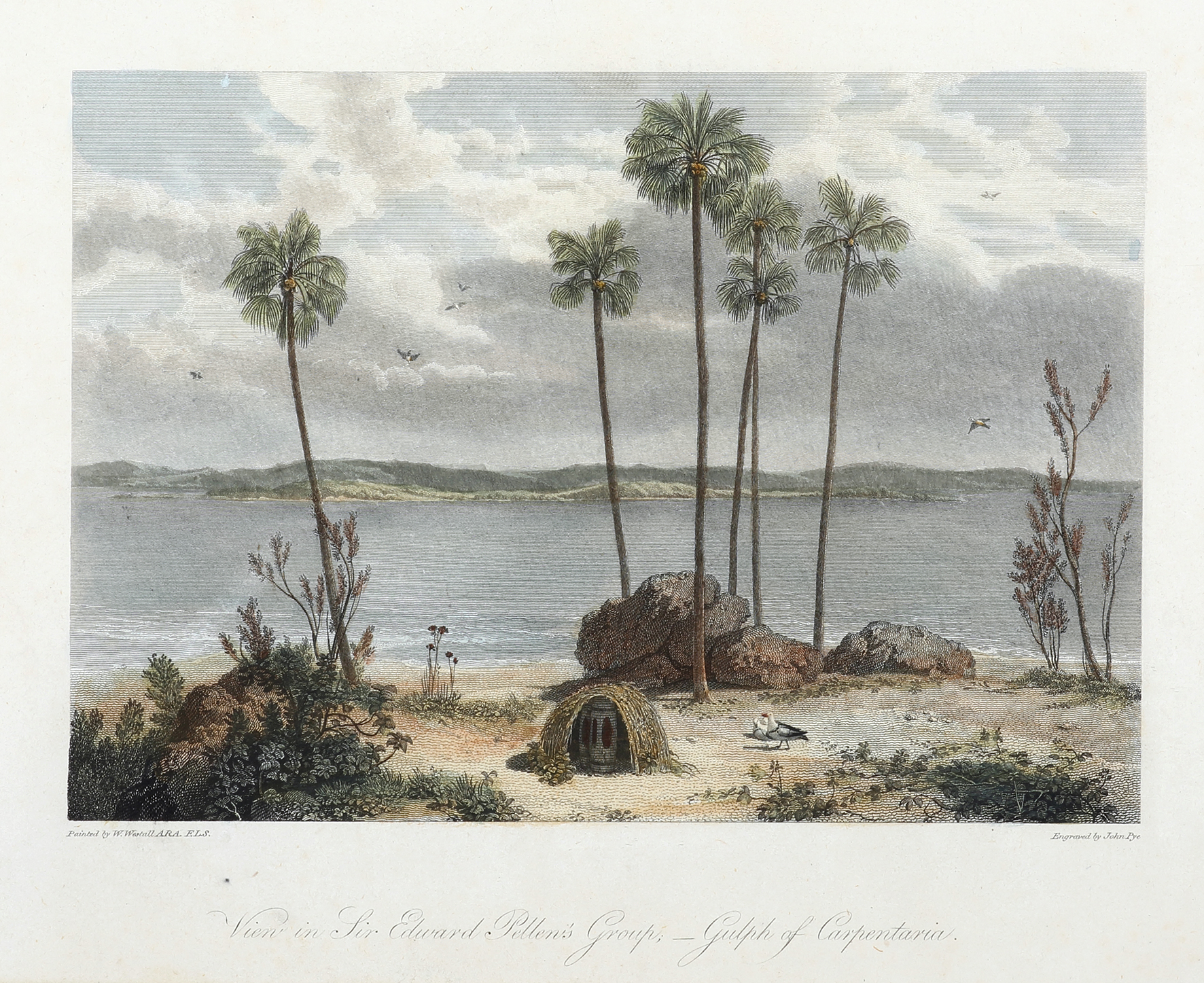
Rare engraved view of Sir Edward Pellew Group of Islands, situated in the south-west corner of the Gulf of Carpentaria, by William Westall (1781-1850), the artist on board Matthew Flinders important voyage of exploration on H.M.S. Investigator.
The islands lie very close to the coast in the south-west of the Gulf of Carpentaria, northern Australia.
They were previously sighted from seaward in 1644 by Tasman, who mistook them for part of a headland that he (and Flinders) called Cape Vanderlin. Westall’s view may be from Observation Island, where Flinders landed, towards the mainland. He noted on 16 December 1802: ‘The botanical gentlemen [Brown, the naturalist and the artist Ferdinand Bauer] landed abreast of the ship, and lieutenant Flinders [Matthew’s brother, Samuel] went to commence a series of observations for the rates of the time keepers on the small isle, thence called Observation Island. My attention was attracted by a cove in the western shore, upon the borders of which, more abundantly than elsewhere, grew a small kind of cabbage palm, from whence it was called Cabbage-tree Cove.’ Westall’s view is also from the west side but apparently not from within this long and shallow cove. Flinders later named the island group after Pellew (subsequently Viscount Exmouth), a celebrated fighting officer and seaman of the French-war period from 1793, but mainly for Pellew’s attempts – while Commander-in-Chief in the East Indies from 1805 – to get him released from French detention on Mauritius.
From, Flinders, M., A Voyage to Terra Australis; Undertaken for the Purpose of Completing the Discovery of That Vast Country, and Prosecuted in the Years 1801, 1802, and 1803, in His Majesty’s Ship the Investigator”.
References:
Ferguson, J. A. Bibliography of Australia Volumes 1-8, Canberra 1976 : 576.
Wantrup, J. Australian Rare Books. Sydney, 1987 : 67a.
Hill, J. The Hill Collection of Pacific Voyages. San Diego 1974 : 614.
Howgego, J. Encyclopedia of Exploration 1800-1850. Sydney 2004 : II, F11.
Sabin, J. A Dictionary of Books Relating to America, from its Discovery to the Present Time. New York. (1936) 1967 : 24758.
Ingleton, G. Charting a Continent. Sydney 1944 : 6487.
Collections:
National Library Australia: Bib ID: 750902
State Library South Australia: 919.4042 F622 d+++
State Library Victoria: RARELTEF 919.4 W 521
![[AUSTRALIA-SA] Gulf of St.Vincent Backst… South Australia](https://antiqueprintmaproom.com/wp-content/uploads/2020/03/icon-aust-gold.svg "[AUSTRALIA-SA] Gulf of St.Vincent Backst… South Australia")
![[AUSTRALIA-SA] Gulf of St.Vincent Backst… South Australia](https://antiqueprintmaproom.com/wp-content/uploads/2020/03/icon-world-gg-2.svg "[AUSTRALIA-SA] Gulf of St.Vincent Backst… South Australia")