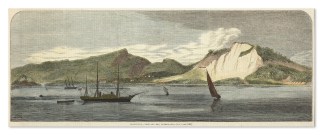
Rare engraved view of Murray Island, Queensland made by William Westall (1781-1850), the artist on board Matthew Flinders important voyage of exploration on H.M.S. Investigator.
Murray Island (Mer) at distant centre and presumably its two small satellites, Dauar and Waier, to the left. The view is therefore probably north or north-west. Five sea-going canoes are seen in the middle ground on a calm sea, four under sail. The closest has its twin masts down and stowed, and holds 15 men, six with the canoe’s long paddles in the water and three waving items of potential barter in their raised hands identifiable as unhusked coconuts, probably a quiver or bamboo water container, and a bow: one also holds a large hand of plantain or bananas. This vessel is also clearly an outrigger, as probably are the others. Murray (Mer) is the most easterly of the inhabited islands of the Torres Strait, well north and east of Cape York, the northern point of Queensland, and north of the Great Barrier Reef. The men shown are presumably the Melanesian Meriam people who populated the Torres islands now part of Australia rather than mainland Aboriginals, as their apparent size also seems to suggest.
Flinders account of the meeting on 29 October 1802 makes clear that it occurred on the north-west side of the island, where the ship anchored (which Westall seems to have altered for a better and more distant topographical view).
‘We had scarcely anchored when between forty and fifty Indians came off, in three canoes. They would not come along-side of the ship, but lay off at a little distance, holding up cocoa nuts, joints of bamboo filled with water, plantains, bows and arrows, and vociferating tooree! tooree! and mammoosee! A barter soon commenced, and was carried on in this manner: a hatchet, or other piece of iron (tooree) being held up, they offered a bunch of green plantains, a bow and quiver of arrows, or what they judged would be received in exchange; signs of acceptance being made, the Indian leaped overboard with his barter, and handed it to a man who went down the side to him; and receiving his hatchet, swam back to the canoe…[Saturday 30 October]…. The colour of these Indians is a dark chocolate; they are active, muscular men, about the middle size, and their countenances expressive of a quick apprehension. Their features and hair appeared to be similar to those of the natives of New South Wales, and they also go quite naked; but some of them had ornaments of shell work, and of plaited hair or fibres of bark, about their waists, necks, and ancles. Our friend Bongaree [Flinders’ Aboriginal translator] could not understand any thing of their language, nor did they pay much attention to him; he seemed, indeed, to feel his own inferiority, and made but a poor figure amongst them.’
From, Flinders, M., A Voyage to Terra Australis; Undertaken for the Purpose of Completing the Discovery of That Vast Country, and Prosecuted in the Years 1801, 1802, and 1803, in His Majesty’s Ship the Investigator”.
References:
Ferguson, J. A. Bibliography of Australia Volumes 1-8, Canberra 1976 : 576.
Wantrup, J. Australian Rare Books. Sydney, 1987 : 67a.
Hill, J. The Hill Collection of Pacific Voyages. San Diego 1974 : 614.
Howgego, J. Encyclopedia of Exploration 1800-1850. Sydney 2004 : II, F11.
Sabin, J. A Dictionary of Books Relating to America, from its Discovery to the Present Time. New York. (1936) 1967 : 24758.
Ingleton, G. Charting a Continent. Sydney 1944 : 6487.
Collections:
National Library Australia: Bib ID: 750902
State Library South Australia: 919.4042 F622 d+++
State Library Victoria: RARELTEF 919.4 W 521