John Webber (1752 - 1793)
Born in London in 1752, the son of a Swiss sculptor. He received his early artistic training in London before continuing his studies in Paris under Jean-Georges Wille, where he developed the precise draughtsmanship that later distinguished his work. By the early 1770s he had returned to Britain and established himself as a promising young artist.
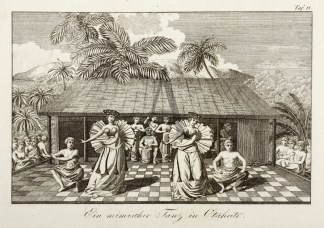
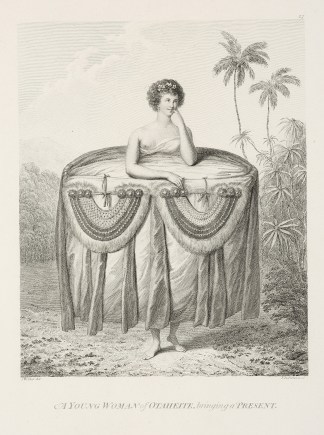
In 1776 Webber was appointed official artist to James Cook's 3rd and final voyage of exploration. The expedition, undertaken in HMS Resolution and HMS Discovery, sought a northern passage between the Pacific and Atlantic Oceans. During the voyage, which lasted until 1780, Webber produced an extensive visual record of the regions visited, including the Pacific Islands, the northwest coast of North America, and parts of eastern Asia. His drawings documented landscapes, settlements, flora, fauna, and the inhabitants encountered by the expedition, particularly in places such as Tahiti, Hawai‘i, and Nootka Sound. Webber was present during the final stages of the voyage, including the events surrounding Cook’s death at Kealakekua Bay in 1779. His work from this period includes some of the earliest European visual representations of Hawaiian society. Throughout the expedition he worked under demanding conditions, often producing rapid sketches in the field which were later refined into finished compositions.
Following his return to Britain, Webber prepared many of his drawings for engraving for the official account of the voyage, A Voyage to the Pacific Ocean, published in 1784. These images played a central role in shaping European understanding of the Pacific and its peoples. His work combined empirical observation with the compositional conventions of late eighteenth-century European art, and it contributed to the visual culture of exploration. Webber exhibited at the Royal Academy in London and continued to produce paintings and drawings based on his travels, as well as other subjects. He was elected an Associate of the Royal Academy in 1785, reflecting his professional standing. His later work included both exhibition pieces and commissioned works, though he remained best known for his Pacific imagery.
John Webber died in London in 1793 at the age of forty-one. His surviving drawings and paintings are held in major collections, including the British Museum and other institutions, and they remain an important visual record of Cook’s Third Voyage.
View other items by John Webber
![[Fly flaps South Sea Isles] Captain Cook](https://antiqueprintmaproom.com/wp-content/uploads/2020/06/MG_0712web-324x395.jpg "[Fly flaps South Sea Isles] Captain Cook")
![[AUSTRALIA-SA] Gulf of St.Vincent Backst… South Australia](https://antiqueprintmaproom.com/wp-content/uploads/2020/03/icon-aust-gold.svg "[AUSTRALIA-SA] Gulf of St.Vincent Backst… South Australia")
![[AUSTRALIA-SA] Gulf of St.Vincent Backst… South Australia](https://antiqueprintmaproom.com/wp-content/uploads/2020/03/icon-world-gg-2.svg "[AUSTRALIA-SA] Gulf of St.Vincent Backst… South Australia")


![[Tools etc from the South Sea Isles] Captain Cook](https://antiqueprintmaproom.com/wp-content/uploads/2020/06/099_web_a-324x412.jpg "[Tools etc from the South Sea Isles] Captain Cook")